
How to Buy China High-Speed Train Tickets (2026)
How foreigners book Chinese high-speed rail tickets — via Trip.com or 12306 with a passport, and how to board without a paper ticket.
China’s high-speed network is the best way to see the country — and yes, foreigners can book it online with a passport.
The old image of queueing at a station ticket window is gone. You can book from home, pay with a foreign card, and board by scanning your passport. Here’s how.

China’s high-speed network is the fastest way to see the country — most intercity legs under four hours are better done by rail than by plane.
Your options, ranked
1. Trip.com (easiest for most travelers)
- English interface built for foreign travelers.
- Accepts foreign Visa/Mastercard at payment.
- Books real Chinese rail tickets (G/D high-speed and regular trains) at the same prices.
- You get an e-ticket / booking reference by email.
- Small service fee applies, but it’s worth it for convenience.
2. The official 12306 site (cheapest)
- 12306.cn — the national rail booking system, which has an English version.
- Register an account with your passport number.
- Search, book, and pay — though foreign-card payment can occasionally be finicky.
- Same tickets, no service fee, but the interface and payment are less forgiving.
3. Station ticket windows (last resort)
- Works, and staff are used to foreigners, but queues and language barriers make it the least pleasant option.
- Bring your passport and ideally a printed booking reference.
Step-by-step (Trip.com path)
- Create an account on the Trip.com site or app.
- Search your route — e.g., Beijing South → Shanghai Hongqiao.
- Choose a train and seat class (Second class is great value; Business/First for comfort).
- Enter passenger details — passport number must match exactly.
- Pay with a foreign card.
- Keep the e-ticket/booking reference on your phone.
At the station

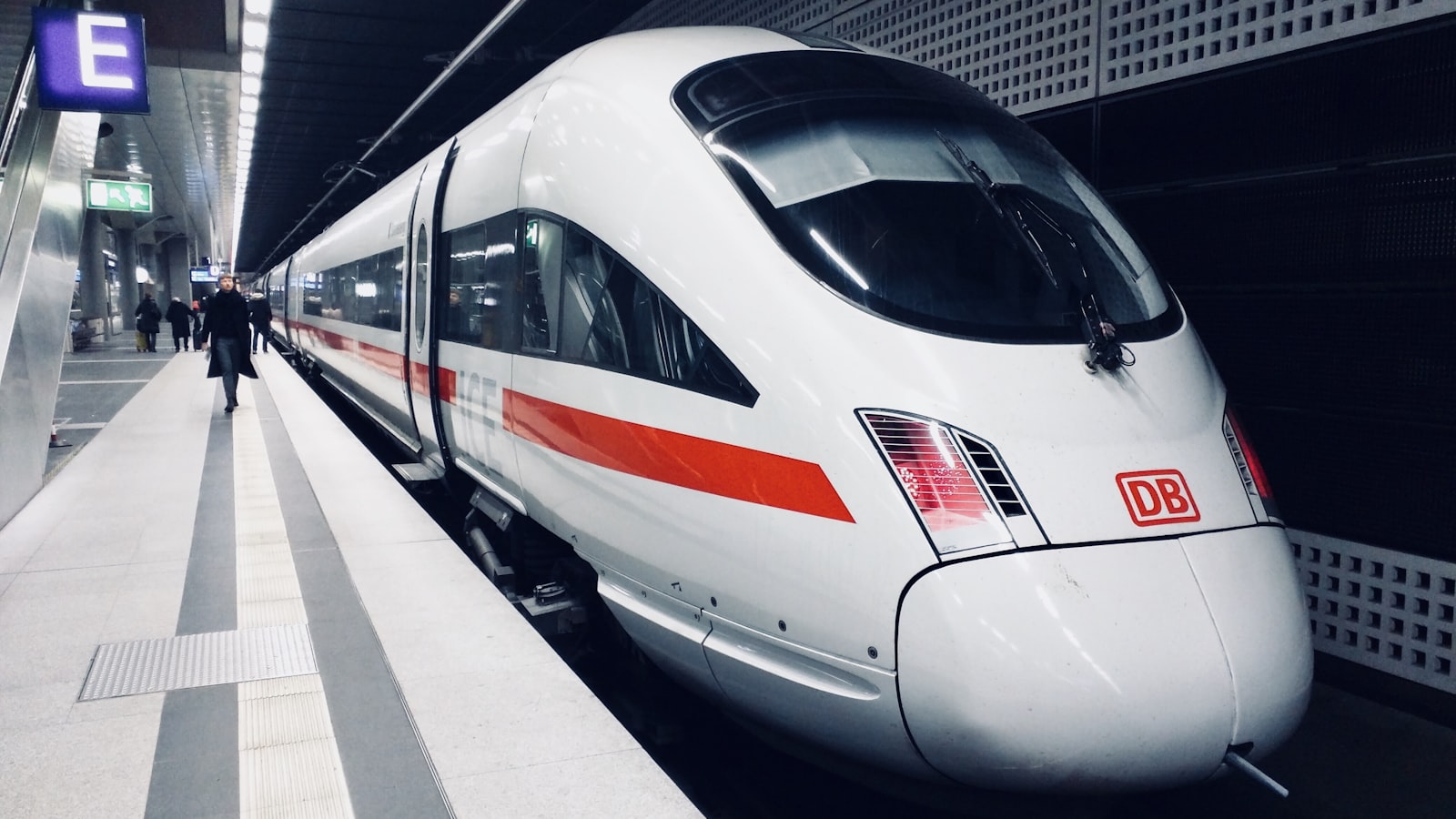
Big stations like Beijing South and Shanghai Hongqiao combine rail, metro and often an airport — arrive 30–45 minutes early for security and gate checks.
- Boarding: scan your passport at the automatic gates (foreign passports work at most big stations).
- Trouble scanning? Head to the manual gate or service window — staff can check you in with your booking reference.
- Arrive 30–45 minutes early at big stations; security and gate checks take time.
- Seat classes: Second class (2+3 seating), First class (2+2), Business class (recliners). Second class is comfortable for most journeys.
Practical tips
- Book early — especially around Chinese New Year, National Day and summer, when popular routes sell out.
- Passport consistency — the number on your ticket must match your passport at the gate.
- Luggage: big bags go on the overhead racks; there are no baggage checks, but keep your bag with you.
- Trains vs flights: for trips under ~4 hours, the high-speed rail to city-center stations usually beats flying.
- G vs D trains: G trains are the fastest; D trains are slightly slower but still quick.
FAQ highlights
- Can I change or refund? Yes, with fees; rules vary by train and time before departure — do it through the same channel you booked.
- Do kids need tickets? Children pay reduced fares and need real-name booking too.
- Is the network connected to the airport? Many airports have direct rail links (e.g., Shanghai Hongqiao combines airport + rail + metro).
What a journey actually costs
Fares on the high-speed network are set by the rail operator and don’t surge like flights. As rough 2026 guidance (per person, second class, one way — and prices change):
- Beijing–Shanghai (about 4.5h): roughly ¥550–660 second class.
- Shanghai–Hangzhou (about 1h): roughly ¥70–90.
- Xi’an–Chengdu (about 3–4h): roughly ¥260–300.
- Guangzhou–Shenzhen (about 30 min): roughly ¥80–100.
First class runs about 1.5–1.7× second class; business class is significantly more. Booking via Trip.com adds a small service fee on top of these rail fares; 12306 charges none. For multi-city trips, trains often beat the combined cost of flights plus airport transfers.
Booking windows and holiday strategy
Chinese rail tickets open for sale 15 days ahead on 12306 (some international channels differ). Around the three big travel peaks — Chinese New Year, National Day (Oct 1), and summer — popular routes can sell out within minutes of release. Strategy: book the moment your travel date is firm; if a direct train is gone, check a transfer (e.g., Beijing–Shanghai via Nanjing) or a later departure; and set a reminder for when sales open rather than hoping for last-minute seats. Outside holidays, booking a few days ahead is usually plenty.
Seat classes, decoded
Chinese high-speed trains have three classes, and the differences matter on long journeys.
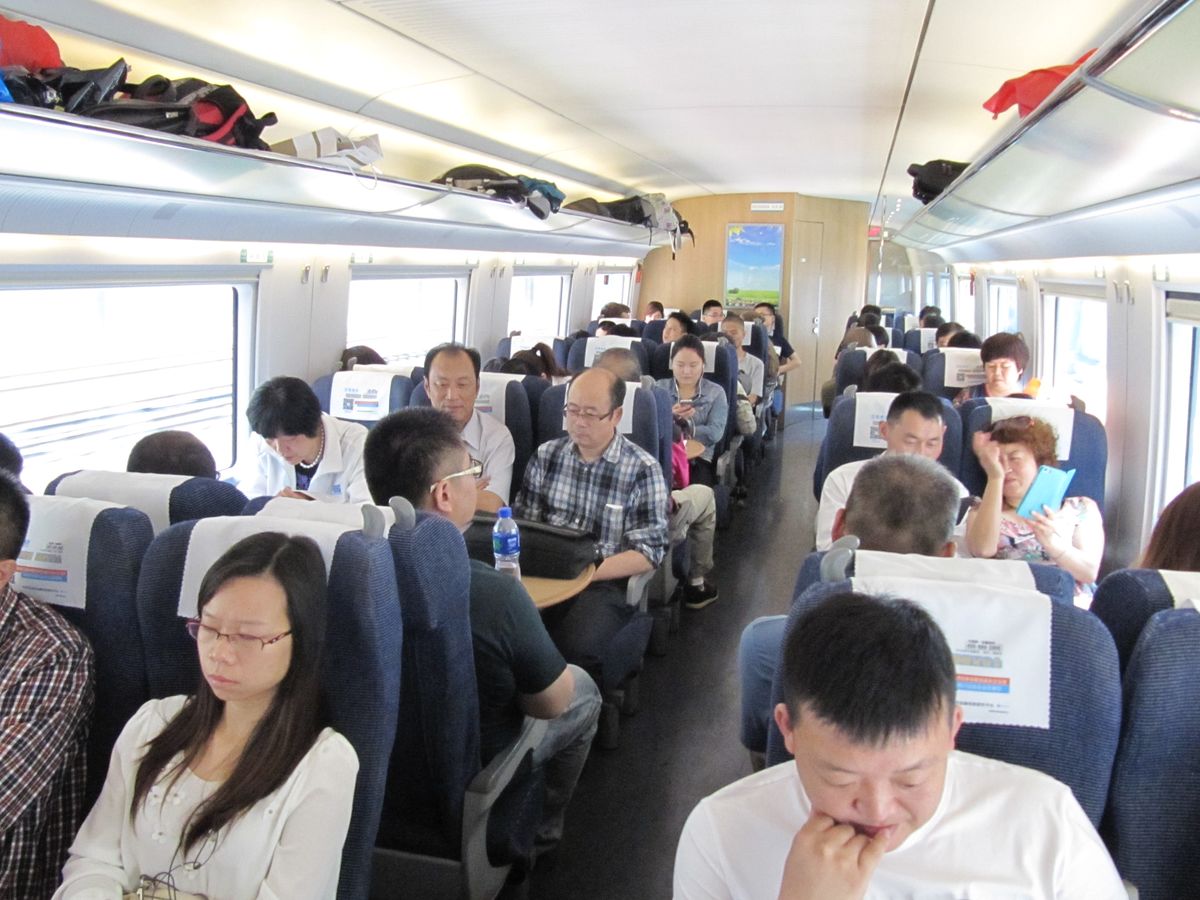
Second-class seating is 3+2 and perfectly comfortable for most journeys — first class adds width and legroom for the long 4+ hour legs. Second class (二等座): 3+2 seating, comfortable and great value — most travelers’ default. First class (一等座): 2+2, wider seats, more legroom, quieter — worth it on 4+ hour rides. Business class (商务座): reclining seats, at premium prices — the treat option for a long stretch like Beijing–Shanghai. On night trains (overnight sleepers on some routes) you can book a soft sleeper (软卧) cabin berth. When booking, pick your class per leg — short hops are fine in second class.
On the train, and practical do’s
- Find your carriage and seat: numbers are on the platform and above the seats; luggage racks are above and at the end of carriages.
- Food: hot meals and snacks are sold by trolley; you can also order from the train’s QR menu in many services. Bring your own is fine too.
- Power: most high-speed trains have USB sockets at seats — charge while you ride.
- Toilets: at carriage ends; standard.
- Stopping quickly: trains are punctual — be at the door a few minutes before your stop, as doors close promptly.
- Arrive early: security at big stations is a real queue; 30–45 minutes ahead is the safe rule.
Connecting to the network
China’s high-speed network is vast, and a little planning turns it into a multi-city tour. Key legs and rough times (2026): Beijing–Shanghai about 4.5h, Shanghai–Hangzhou about 1h, Xi’an–Chengdu about 3–4h, Guangzhou–Shenzhen about 30 min. Stations are often jointly located with metros and airports (Shanghai Hongqiao, Beijing South, Chengdu East), so arrivals flow straight into the city. For first-timers, the classic Beijing–Xi’an–Shanghai loop is an easy, well-served route to start with.
Kids, seniors and groups
Rail fares are age-aware. Children pay reduced fares and still need real-name booking under their own (or a parent’s) passport. Seniors aren’t discounted on high-speed trains in the same way as some buses, but many stations offer assistance and priority boarding help at big hubs. For groups, booking together on one Trip.com or 12306 account keeps everyone on the same train and adjacent seats — book in one transaction rather than separately. If you need wheelchair or boarding assistance, most major stations offer it; ask at the service window with your booking reference.
If you are new to the system, the Trip.com path is the friendliest way to make your first booking — the small service fee is usually worth it for the English interface and foreign-card payment. Once your first booking is done, repeat trips take only minutes — the account remembers your passport details for every ticket after that. For the classic first-timer route, see our Beijing–Xi’an–Shanghai guide for how the legs fit together. With the network so fast and cheap, most first-time visitors find trains quickly replace flying for inter-city legs.
The real-name system, explained
Every Chinese rail ticket is tied to a person, and that’s why your passport matters. The real-name system was rolled out across China’s rail network in the early 2010s to curb ticket scalping, and it means each ticket is issued to a specific identity and checked at the gate. For you, the practical consequences: the name and passport number on the booking must match your passport exactly; you board by scanning that passport at the gate (no paper ticket is needed, though carrying the booking reference on your phone helps if a machine struggles with your passport); and you can’t simply pass a ticket to someone else — transfers aren’t possible. If you’re booking for others, add their passport details as separate passengers in the same transaction. It’s a small amount of care that prevents most problems at the station.
Changes, refunds and missed trains
Plans change, and the system handles it — with fees. Refunds and changes are allowed up to departure, with fees that rise as the train time approaches; acting more than 15 days out is usually free or near-free, while same-day changes cost more. Make changes through the same channel you booked (Trip.com or 12306). If you miss your train: you can often rebook a later train the same day for a fee, or get a partial refund, but it depends on the specific train and how quickly you act — head to the ticket office or contact your booking platform promptly. No-shows generally forfeit the fare. One rule worth remembering: always leave buffer time, because Chinese trains close their doors promptly and departures are punctual.
Luggage, bikes and oversized items
Luggage on Chinese high-speed trains is straightforward but has a few specifics. Overhead racks above the seats and luggage areas at the end of each carriage handle standard suitcases; there are no checked-baggage counters for high-speed trains, so you carry what you bring, and reasonable luggage carries no extra charge. Oversized items — large boxes, sporting equipment — may not fit the racks and can be refused if they block aisles. Bicycles generally need to be folded and bagged; full-size bikes are not allowed. Sharp or hazardous items follow standard airline-style restrictions. If you’re traveling with a big suitcase and a tight connection, book a seat in a carriage near the luggage racks and arrive early enough to find space above your seat.
Last updated: August 2026. Booking rules and fees change — confirm on the platform you use before your trip.
Frequently Asked Questions
Can foreigners buy China high-speed rail tickets online?
Yes. The official 12306.cn site has an English version, and third-party platforms like Trip.com make it even easier — they accept foreign cards and email you a booking confirmation. In both cases, boarding is done with your passport, not a paper ticket.
Do I need to pick up a paper ticket at the station?
No. With a real-name booking under your passport, you can scan your passport at the station gates and board directly. Keep the booking confirmation on your phone in case a machine struggles with your passport.
Which is better, 12306 or Trip.com?
Trip.com is friendlier for most foreigners: English interface, foreign-card payment, immediate e-ticket. The official 12306 is cheaper (no booking fee) but the registration and payment steps can be fiddly with a foreign card. For first-timers, Trip.com is the smoother route.
What if my trip includes the Chinese New Year or National Day?
Book as early as possible — tickets for these windows sell out fast, sometimes within minutes of release. Set a reminder and book the moment sales open (usually 15 days ahead).
Does my passport number have to match my booking exactly?
Yes — exactly. Your passport number and name must match what you entered at booking, because the ticket is tied to your identity for real-name checks at the gate.