
Airport to City in China: Taxi & Transport Guide (2026)
How to get from Chinese airports into the city — official taxis, Didi ride-hailing, airport express trains, and metro lines, with fares and scams to avoid.
Landing at a Chinese airport and wondering how to get into town? The good news: every major city now has fast, cheap rail links, and the taxis are official, metered and safe — as long as you know the right rank.
Getting from the airport to your hotel is the first test of any China trip, and it’s easier than most travelers expect. Chinese airports are modern, well-signed, and connected to the center by metro, express trains, official taxis and ride-hailing. The pitfalls are few, and they’re mostly about knowing which door to walk out of and which car to get into. This guide covers every option, what it costs, and how to avoid the handful of common mistakes.
First: check if your airport has a rail link
The single most useful fact to know before you fly is whether your arrival airport has a train or metro connection to the center. Most of China’s busiest airports now do, and it’s almost always the fastest, cheapest option:
- Beijing Capital (PEK): Airport Express line to the city, about 25–35 minutes.
- Beijing Daxing (PKX): Daxing Airport Express, about 20–30 minutes into the city.
- Shanghai Pudong (PVG): Metro Line 2 and the Maglev (top speed 300 km/h) into town.
- Shanghai Hongqiao (SHA): Metro and high-speed rail hub — literally connected to the station.
- Guangzhou (CAN), Shenzhen (SZX), Chengdu (TFU), Xi’an (XIY), Hangzhou (HGH), Kunming (KMG): all have metro or airport express links.
Fares on airport rail links are typically ¥5–50 depending on the city and distance, and the ride takes 30–60 minutes. It’s by far the cheapest way in, and it avoids traffic entirely. Our airport arrival guide has the per-airport breakdown for the biggest hubs, and China’s airport metro and HSR links covers the rail options across the country.
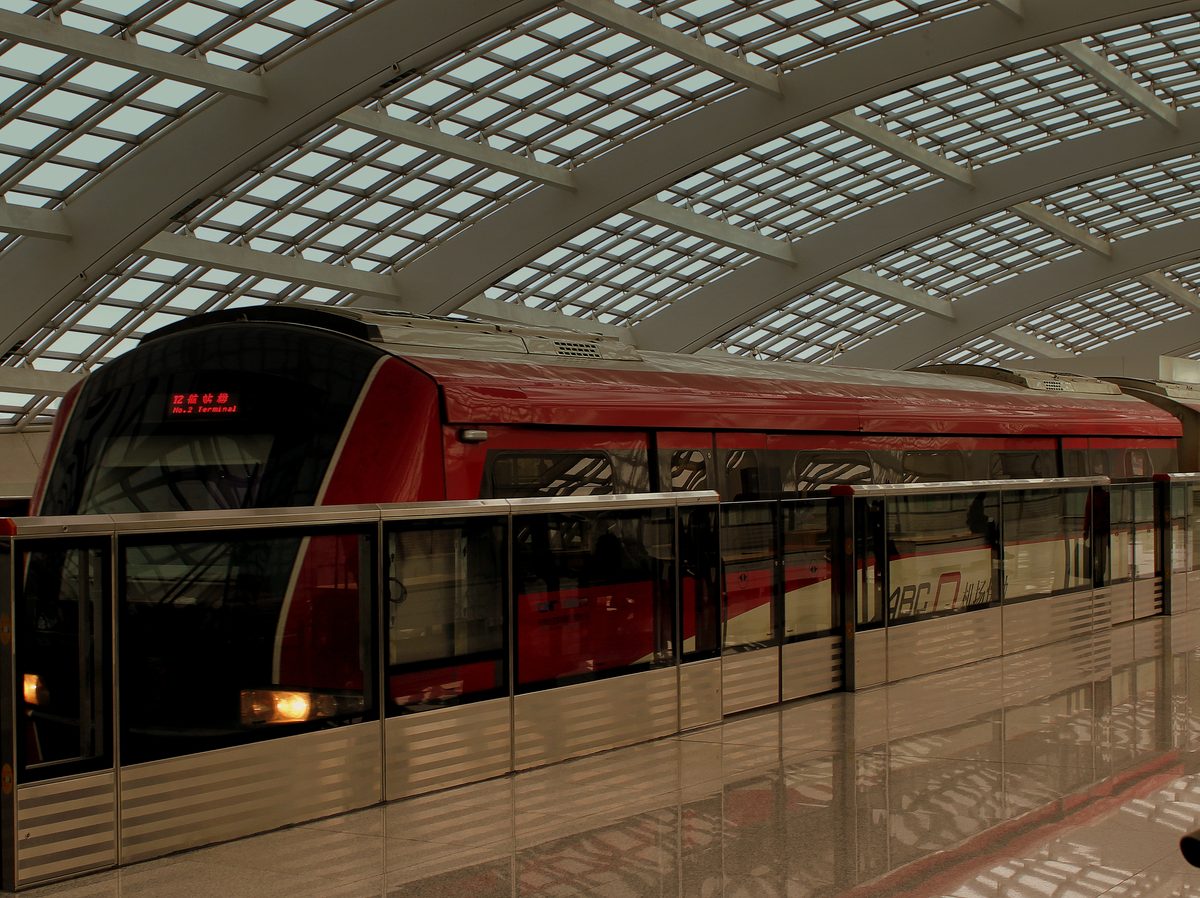
Most big Chinese airports are connected to the center by metro or an airport express train — the fastest, cheapest way into town, typically ¥5–50 and 30–60 minutes.
The official taxi rank: how it works
For door-to-door convenience, take the official taxi rank. It works almost identically at every Chinese airport:
- Follow the taxi (出租车) signs from the arrivals hall to the rank outside.
- Join the queue — it moves fast, and airport marshals direct you to the next car.
- Confirm your destination with the driver (have the hotel name and address in Chinese on your phone).
- Make sure the meter is running (打表, dǎ biǎo) or that an official fixed airport fare applies.
- Pay the meter at the end. Rounding up is optional; tipping isn’t expected.
The queues are organized, the drivers are licensed, and the meters are generally trustworthy at official ranks. The problems start only when you skip the rank.
Didi and ride-hailing at the airport
If you’ve already set up Didi (it’s the easiest way for foreigners to arrange a car), airports are one of the best places to use it:
- Open the app and it will show you the airport’s designated ride-hailing pickup zone — follow the signs to it rather than the taxi rank.
- Set your pickup to the zone, confirm the fare estimate, and watch the app as the driver approaches.
- The fare is fixed in the app before you ride, so no haggling and no meter surprises.
At some airports the ride-hailing zone is a specific parking area a short walk or escalator ride from arrivals — follow the “网约车” (ride-hailing) signs. For late-night arrivals when the metro has stopped, Didi is often the fastest way to a hotel bed, though wait times can stretch to 10–20 minutes.
Taxi fares: realistic estimates
Taxi fares from Chinese airports depend heavily on the city, the airport’s distance from town, and traffic. As a rough guide, with the caveat that prices change:
- Beijing Capital (PEK) → center: ¥80–150.
- Beijing Daxing (PKX) → center: ¥150–250 (it’s far south of the city).
- Shanghai Pudong (PVG) → downtown: ¥150–250.
- Shanghai Hongqiao (SHA) → downtown: ¥60–120.
- Guangzhou (CAN) → center: ¥80–150.
- Chengdu (TFU) → center: ¥60–120.
Airport surcharges, night-time fees (typically a 20–30% markup between 11 pm and 5 am), and tolls may be added to the meter. All of this is legitimate; the meter handles it automatically. Compare these against the metro (¥5–50) and the decision gets easy: rail in the day, taxi or Didi when it’s late, raining, or you have heavy bags.
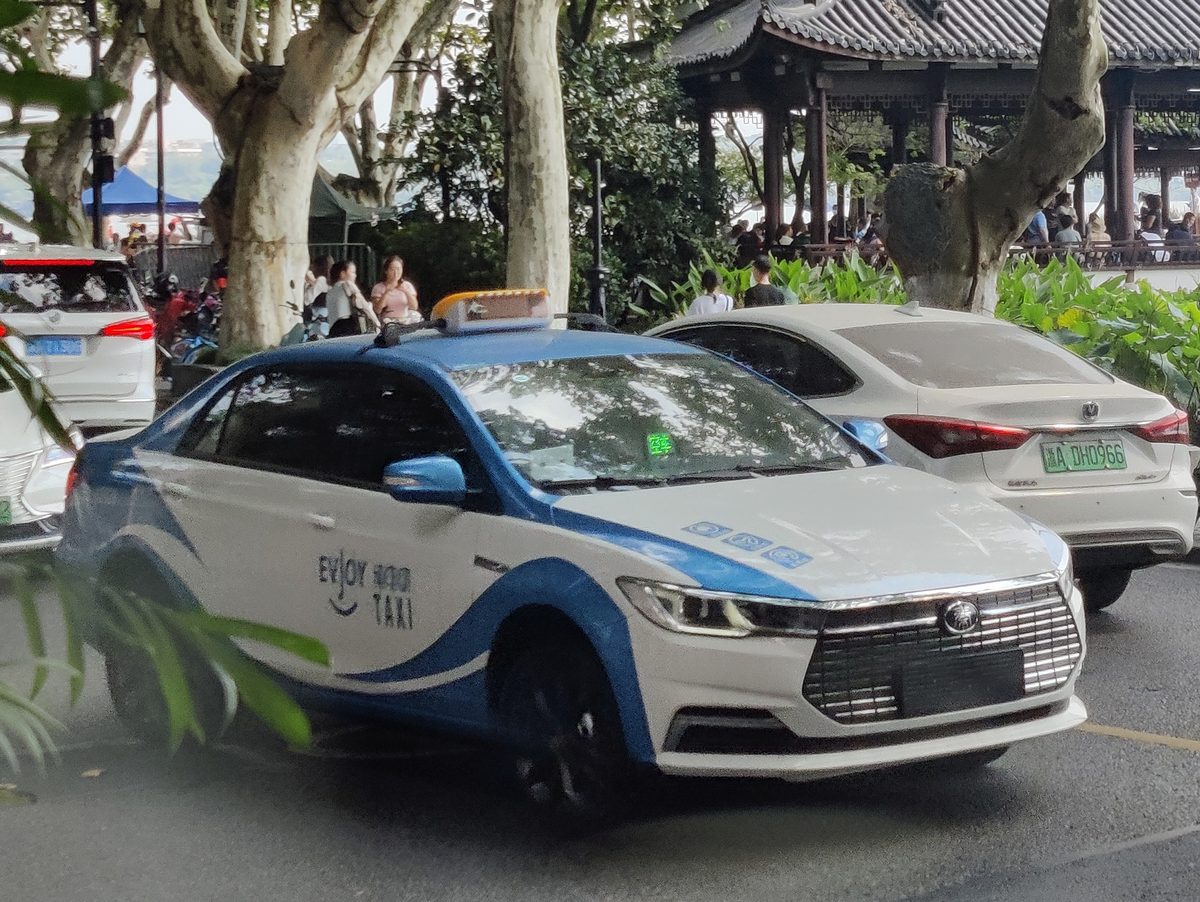
At the official rank, taxis are licensed, metered and safe — follow the signs outside arrivals and make sure the meter is running before you set off.
Airport buses: the middle option
Most cities also run airport shuttle buses (机场大巴) to major hotels and central districts. They’re cheaper than a taxi (usually ¥20–40) but slower and harder to navigate because the signs and announcements are mostly in Chinese. They’re a fine budget option if you’re staying near a main route — check the route map at the airport desk — but for most first-time visitors the metro or a taxi is simpler.
The mistakes travelers actually make
Most airport-transfer problems come down to a handful of avoidable errors:
- Accepting a ride inside the terminal. Drivers who approach you before the official rank are almost always unofficial, unlicensed, or overpriced. Walk past them to the taxi queue.
- Agreeing to a fixed price without checking. At some airports (notably Beijing Capital) there are official fixed fares posted for certain zones — fine. But a driver who names a random price instead of using the meter is overcharging. Ask for the meter.
- No Chinese address. The driver needs your destination in Chinese characters. Have the hotel name and address on your phone, or a screenshot from the hotel booking confirmation.
- Assuming the metro runs all night. It doesn’t — most lines stop around 10:30–11:30 pm. If you land late, plan for a taxi, Didi, or a pre-booked car.
- Skipping the meter check. A driver who says the meter is “broken” wants to negotiate. Decline and take the next car in the queue.
- Getting the wrong airport. Beijing, Shanghai, Guangzhou, Shenzhen and Chengdu all have two airports. Confirm which one you’re landing at before you book any transfer — it’s a very expensive mistake to make.
Hotels, private transfers and first-class comfort
If you want the simplest possible arrival, arrange a pickup through your hotel. Most mid-range and upscale hotels offer airport transfers at a fixed price, and it’s worth it for late arrivals, large groups, or first trips. A driver meets you at arrivals with a name board, takes your bags, and handles everything — no meter, no queue, no Chinese required. Prices are typically ¥150–400 depending on the city and car class. Many travelers use a hotel car for arrival and the metro or Didi for the rest of the trip.
A quick decision guide
- Daytime, light bags, want cheap and fast: metro or airport express.
- Daytime, want door-to-door convenience: official taxi rank (meter on).
- Have the Didi app set up: ride-hailing zone at the airport.
- Late night, metro closed, or heavy luggage: taxi, Didi, or a pre-booked hotel car.
- Any time you want zero stress: pre-booked hotel pickup.
Beyond the airport: getting around the city
Once you’re in town, the same principles apply. The metro is cheap and English-signed in big cities, taxis are metered and safe, and Didi is the most reliable way to book a car with an English interface. For getting between cities, high-speed rail beats flying for most journeys under 1,500 km, and the trains arrive in city centers — no second airport transfer needed.
Last updated: August 2026. Airport rail links, fares and metro operating hours change — confirm current details for your specific airport before you go.
Frequently Asked Questions
What's the cheapest way from a Chinese airport into the city?
The metro or airport express train, almost always. Most major airports — Beijing Capital and Daxing, Shanghai Pudong and Hongqiao, Guangzhou, Shenzhen, Chengdu, Xi'an and many more — now have a rail link into the city that costs roughly ¥5–50 and takes 30–60 minutes. Taxis and Didi are faster door-to-door but cost 5–20 times more.
How much does a taxi from a Chinese airport cost?
It varies a lot by city and distance. Rough estimates: Beijing Capital (PEK) into the city center around ¥80–150, Beijing Daxing (PKX) more like ¥150–250, Shanghai Pudong (PVG) into downtown ¥150–250, and a shorter hop like Hangzhou or Chengdu airport into the center ¥60–120. Prices change and meters vary, so these are ballpark figures, not quotes. Always use the official taxi rank and the meter.
How do I get a taxi at a Chinese airport?
Follow the official taxi signs from arrivals to the designated taxi rank outside — the queue is usually organized and well-signed, and airport staff or marshals direct you to the next car. Use the meter (打表, dǎ biǎo) or a set official airport fare where posted. Never accept a driver who approaches you inside the terminal with a fixed price; those offers are almost always overpriced.
Can I use Didi from the airport?
Yes, and it's the smoothest option for many travelers. Open the Didi app, set your pickup to the airport's designated ride-hailing zone (the app tells you exactly where), and wait there — drivers can't usually stop at the arrivals curb. The fare is fixed in the app before you ride, so there's no haggling. For foreign users it works best when you've [set up Didi with a card or Alipay](https://chinotrips.com/how-to/ride-hailing-didi/) in advance.
What happens if I arrive late at night and the metro is closed?
Most Chinese metros stop running around 10:30–11:30 pm. After that, your options are a taxi (the rank outside arrivals is usually still operating), Didi (wait times can be longer at night), or a pre-booked hotel car. If you're arriving very late, arranging a pickup in advance — through your hotel or a private transfer — removes all the uncertainty.
What airport taxi scams should I watch for?
The main ones are drivers who quote a fixed price instead of using the meter, offer to take a 'scenic route', or claim the meter is broken. Others include unofficial drivers meeting you inside the terminal, and people offering to 'help' with your luggage then demanding payment. The fixes are simple: use only the official taxi rank, insist on the meter, agree on a price only where airport officials have posted fixed fares, and confirm the destination in writing.