
Metro to Airport: China's Airports & Train Stations (2026)
Metro to airport patterns across China — dedicated airport express lines, high-speed rail stations on the subway, and airport bus backups.
The single most useful transport fact about China is that almost every big city puts its airport and its high-speed rail station on the metro — so the whole country is reachable without a taxi.
This guide explains the general pattern, the city-by-city variations, and what to do when the metro doesn’t reach your airport.
The pattern: metro to the airport
Chinese city planning has made airport access remarkably consistent. Nearly every first- and second-tier city has built either:
- a dedicated airport express line (Beijing’s Capital and Daxing lines, Shanghai’s Maglev, Chengdu’s Line 18), or
- a regular metro line that happens to reach the airport (Shanghai Line 2 to Pudong, Guangzhou Line 3 to Baiyun).
Both are fast, air-conditioned and cheap by international standards. The dedicated lines cost more than an ordinary metro fare but are still far less than a taxi. The regular-line option is slower but very inexpensive.
A few landmarks to anchor you:
- Beijing — Capital Airport Express and Daxing Airport Express, both from the city core. See our Beijing metro guide.
- Shanghai — the Maglev from Longyang Road to Pudong (about 8 minutes) plus Line 2; Hongqiao combines airport and trains in one hub. See our Shanghai metro guide.
- Guangzhou — Line 3 runs out to Baiyun Airport; it’s a normal metro line, so the fare stays low. See our Guangzhou guide.
- A practical detail: airport express trains usually stop at each terminal, so note which terminal your airline uses before you board — the difference can be a long walk or a free shuttle once you’re airside.
- Shenzhen, Chengdu, Xi’an, Hangzhou, Nanjing and others all have airport metro or rail connections as of 2026.
High-speed rail stations sit on the metro
The same pattern applies to the railway network. Every major high-speed rail station is designed to connect with the local metro, usually in the same complex:
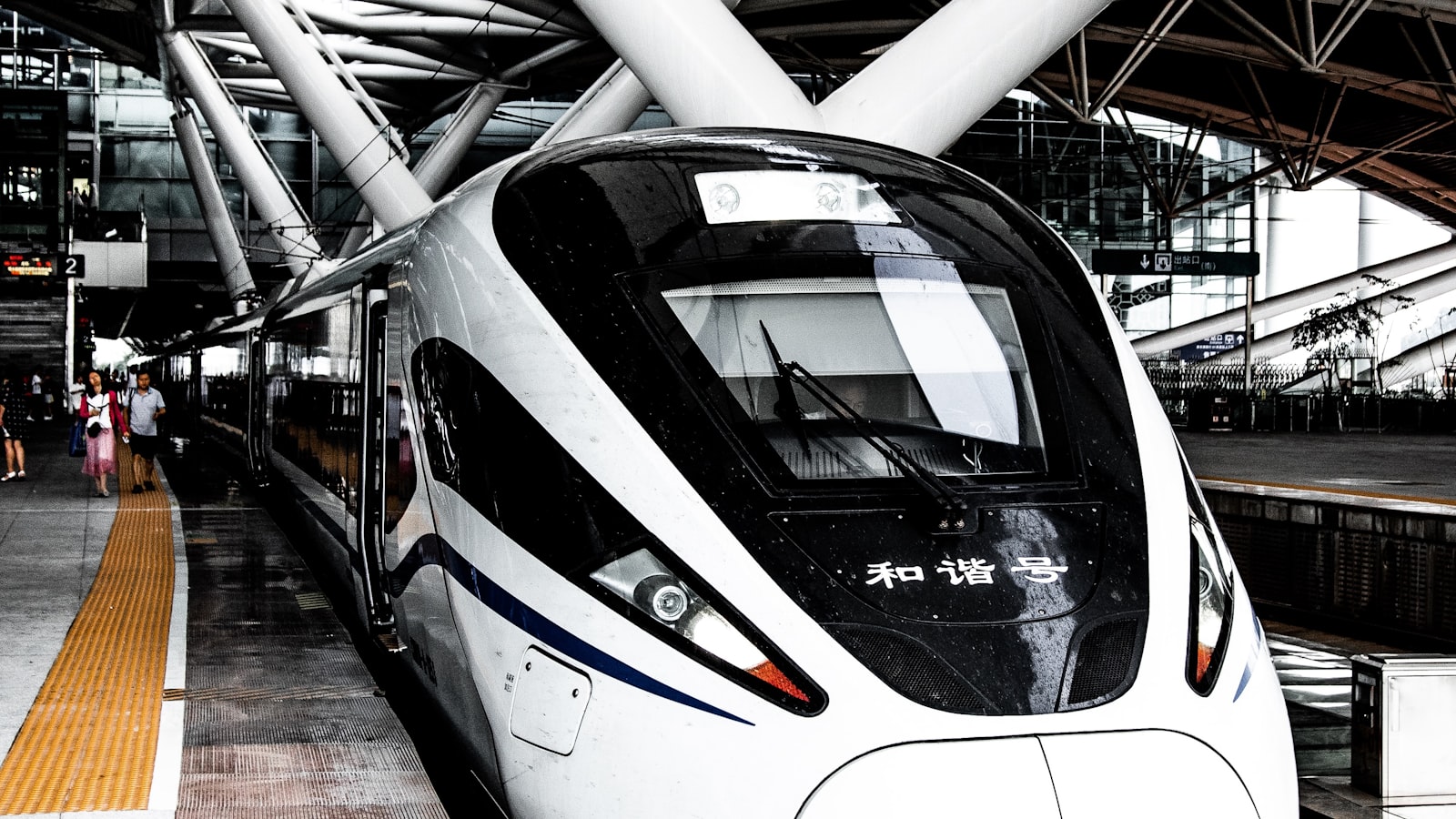
- Beijing South (Line 4 and Line 14) for trains to Shanghai; Beijing West (Line 7 and Line 9) for Xi’an.
- Shanghai Hongqiao — airport terminal, rail station and two metro lines in one building.
- Guangzhou South — the huge rail hub on the city’s metro network.
- Xi’an North — the arrival point for the Terracotta Army city, on the metro.
- Chengdu East — likewise on the metro, as is the city’s airport line.
What this means in practice: you can step off a train from Beijing in Xi’an, follow the signs down to the metro, and reach your hotel without ever taking a taxi. Staying near a metro stop is the single best location decision you can make in any Chinese city.
When the metro doesn’t reach: airport buses
Some airports are still only served by coaches. The standard backup is the airport bus (机场大巴):
- Routes run from the airport to central transport hubs and major hotels.
- They’re comfortable, cheap, and run from early morning to late night, though frequency drops at night.
- Buy a ticket at the airport arrivals hall counter or from the driver; cash and QR payment are both usually accepted.
- Airport buses are also the fallback for late-night flights when the metro has stopped.
For cities where the metro doesn’t reach the airport, a taxi or Didi is the reliable (if pricier) alternative — see our ride-hailing guide and the taxi guide for how to use them cleanly.
Luggage, security and timing
Metro-to-airport travel in China has a few universal realities:
- Every station entrance has a security check — bags go through an X-ray machine, and liquids are sometimes inspected. Add 5–10 minutes for this with luggage.
- Airport express lines are luggage-friendly (dedicated trains, space for bags), but a normal metro line at peak hours is not — avoid 7:30–9:30 am and 5:30–7:30 pm with a suitcase.
- Allow 10–15 minutes over the pure ride time for walking from the platform to the check-in hall — airports in China are big.
- Last trains vary, but most metros stop around 10:30–11:30 pm; if your flight departs early or arrives late, check the schedule and keep an airport bus or taxi as backup.
- Pay with the same Alipay QR across every city — set it up, along with a payment method, before you leave home.
Putting it together
A typical day of long-distance travel in China looks like this: metro to the high-speed rail station, train between cities, metro from the arrival station to your hotel. On the way home, metro or airport express to the airport. The whole chain costs a fraction of what the equivalent journey costs by taxi, and it’s almost always faster than sitting in traffic.
For the general rules of riding Chinese metros — tickets, QR entry, English signage, etiquette — start with our China metro guide, then read the city-specific guides for Beijing, Shanghai and Xi’an before you go.
Last updated: August 2026. Metro lines and fares change — confirm before you go.
Frequently Asked Questions
Do all Chinese airports have metro connections?
Most big-city airports do — Beijing, Shanghai, Guangzhou, Shenzhen, Chengdu, Xi'an and others have dedicated airport metro or rail lines. Smaller regional airports may not, in which case an airport bus or taxi is the backup. Check before you fly.
Are Chinese high-speed rail stations connected to the metro?
Almost always, yes. Major stations like Beijing South, Beijing West, Shanghai Hongqiao, Guangzhou South, Xi'an North and Chengdu East sit directly on a metro line, so you can reach any hotel in the city without a taxi. It's one of the best reasons to stay near a metro stop.
What if my hotel isn't near a metro station?
Take the metro to the closest station and finish with a short taxi or Didi ride. China's ride-hailing is cheap and easy once Alipay is set up. Alternatively, an airport bus often stops near major hotels and transport hubs.
Are airport metro lines more expensive than normal metro fares?
Yes. Dedicated airport express services — like Beijing's Capital and Daxing lines or Shanghai's Maglev — are priced well above ordinary metro fares. If you're on a budget, a normal metro line that reaches the airport (like Shanghai Line 2 or Guangzhou Line 3) is much cheaper, just slower.
How much time should I allow for airport rail travel?
Add 10–15 minutes over the pure ride time for station security screening, luggage handling and walking to the terminal. For international flights, aim to arrive at the airport at least 3 hours early, so work backwards from there using the schedule.
Can I use one payment method across all these cities?
Yes — an Alipay transit QR works on metro systems across most major Chinese cities. Open the transport section and select the city you're in, then scan in and out. See our Alipay guide to set this up before you leave home.