
China Smoking Rules: Where You Can and Can't Smoke
China's smoking rules for visitors — indoor smoking bans, where smoking is allowed, high-speed train and airport rules, e-cigarettes, and etiquette.
China is one of the world’s biggest smoking markets, but the rules for visitors are simple: indoors is no-smoking, trains and planes are strictly no-smoking, and the designated outdoor spot is your friend. Here’s the practical guide.
For travelers, China’s smoking rules can feel contradictory. The country has the world’s largest smoking population and some public spaces still smell of smoke, yet its cities have some of the strictest indoor bans in Asia — with real fines. The key is to understand the split: the law is clear and enforced at transport hubs and in big cities, while enforcement frays in small-town bars. If you smoke, this guide keeps you legal, comfortable and courteous. If you don’t, it tells you where you’re most likely to encounter smoke and what to do.
The legal picture: indoor is banned
China ratified the WHO Framework Convention on Tobacco Control in 2005, and national rules ban smoking in all indoor public places and workplaces. Cities have gone further — Beijing’s 2015 smoking-control regulation is the strictest, banning smoking in all indoor public places, public transport and workplaces, with fines for individuals (around ¥200) and heavier fines for venues that permit it. Shanghai, Xi’an, Shenzhen and many others have similar bans.
What this means in practice:
- Restaurants, malls, stations, airports, hospitals, schools, offices — all smoke-free by law.
- Outdoors — generally allowed, but keep away from entrances, queues, crowds and children.
- Enforcement — strict and effective at stations, airports and in big-city restaurants; much looser in small-town bars and some karaoke and club venues, where you may still encounter smoke.
- The direction of travel — everywhere is getting stricter, not looser.
The golden rule for visitors
When in doubt, step outside. The sidewalk in front of any venue is the universal, legal smoking area in China. If you’re at a restaurant, a bar, a mall or a sight, and you want a cigarette, the answer is always the same: go outside, away from the entrance. This one habit keeps you on the right side of every city’s rules and most locals’ expectations.
Trains, planes and airports: strictly no-smoking
Transport is where the rules bite hardest.
- High-speed trains — completely no-smoking. Trains have sensitive smoke detectors in the carriages and toilets; lighting up triggers an alarm, brings staff, and can cause a fine and a temporary ban from the rail system — a real risk for a traveler with booked onward tickets. There is no smoking car on Chinese high-speed trains. Our train guide explains the booking and boarding process.
- Regular trains — also no-smoking, though enforcement on some older long-distance services is looser. Don’t test it.
- Aircraft — smoking has been banned on Chinese flights for decades. Non-negotiable.
- Airports — the only legal place to smoke in a terminal is the designated smoking room, usually found near departure lounges and in some check-in areas. Look for the signs; there’s often a small glass room with ashtrays and an extractor fan. Outside the terminal, use the designated outdoor areas if provided.
- Taxis — drivers almost universally enforce no-smoking; many have signs. Lighting up in a taxi is a quick way to end the ride. See our taxi guide for more on taking cabs.

Stations and high-speed trains are strictly no-smoking zones — use the designated smoking rooms, not the platforms.

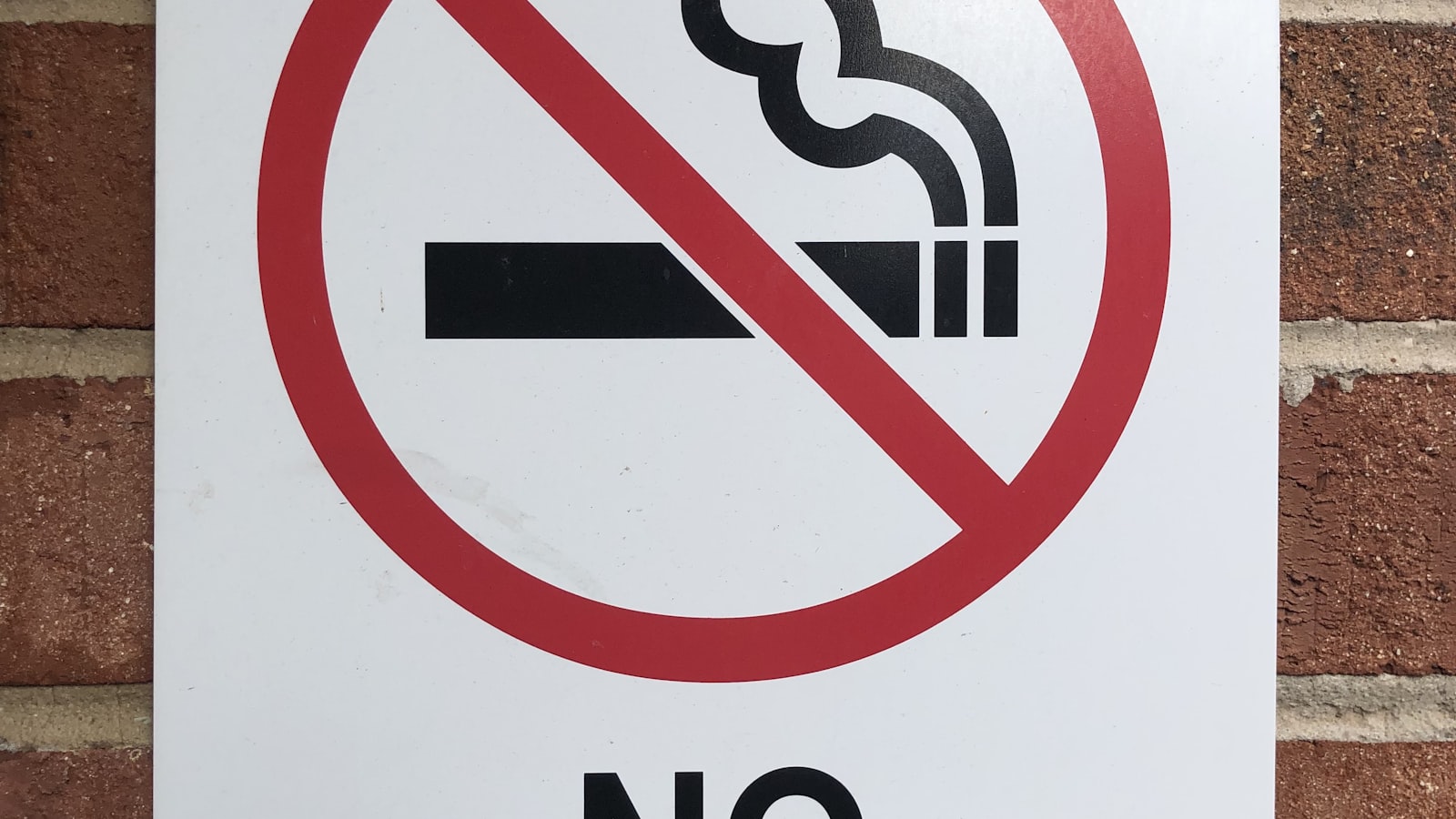
“No smoking” signs are standard across Chinese public spaces, stations and malls — the law bans indoor smoking and the signs mean it.
Hotels and restaurants
- Hotels — most international and many domestic hotels are non-smoking throughout, with a fine for smoking in the room (the smell is hard to remove). When booking, request a non-smoking room, or check whether the hotel has smoking floors or rooms if you need one. Hotel lobbies and restaurants are no-smoking; go outside.
- Restaurants — legally smoke-free indoors. In big cities this is enforced and restaurants are genuinely smoke-free. In smaller cities and older restaurants, you may still see a smoking table or two; rather than argue, simply choose a table away from smokers or ask the staff to move you. Your own smoking belongs outside.
- Bars and clubs — the loosest enforcement; some venues still allow smoking, and you may find yourself in a smoky karaoke booth or club. If it bothers you, choose modern, international-style venues or step out. Our restaurant etiquette guide has more on dining-room behaviour.
E-cigarettes and vaping
Vaping is treated as smoking under China’s smoking-control rules. That means no vaping indoors, on trains, on planes, in stations, or in any indoor public place. Enforcement of the vaping ban is patchier than for cigarettes, but the fines and the rules are the same, and many cities explicitly cover e-cigarettes.
A few practical notes: buying vape products requires ID and is restricted — minors cannot purchase them, and some flavours and devices are regulated. Carrying your own device for personal use is generally fine, but use it where you would smoke. And in restaurants, vaping at the table is as rude as smoking there — step outside.
The social and etiquette side
Smoking is a social act in China, and offers of cigarettes are common among men in business and casual settings. A few etiquette points:
- Offering a cigarette is a gesture of friendship; declining politely — “wo bu xihuan” (I don’t like it) or “wo bu chou” (I don’t smoke) — is perfectly acceptable and never causes offence.
- Don’t light up at the table while others are eating; if you need a cigarette mid-meal, excuse yourself and go outside.
- Be considerate around non-smokers — ask before smoking near others, and keep well away from children, elders and queues.
- Dispose of butts properly — dropping butts in scenic areas can draw a fine from park wardens, and it’s simply discourteous.
- Don’t smoke while walking through crowds — a lit cigarette waved around in a packed market is how clothes get burned.
For the broader manners around people and shared spaces, our Chinese etiquette guide covers the do’s and don’ts beyond smoking.
If you don’t smoke: how to cope
Non-smokers will occasionally encounter smoke — a bar in a small city, a crowded outdoor area, or someone smoking near a doorway. The practical responses:
- Choose your venues — modern malls, international hotel bars and big-city restaurants are reliably smoke-free.
- Ask to move — in restaurants, a polite request to change tables is usually accommodated.
- Outdoor dining — in night markets and street-food areas, you’re outside, so smoke drifts rather than concentrates. The night market guide has more on the street-food scene.
- The metro and trains are your refuge — China’s public transport is strictly smoke-free, which for a non-smoker is a genuine relief.
What you can bring through customs
If you smoke, note the duty-free allowance: adult travelers can generally bring about 400 cigarettes (two cartons), or the equivalent in cigars or loose tobacco, into China duty-free for personal use. The exact figures are set by customs rules and change, and anything over the limit must be declared and may attract duty. Always check the current customs guidance before flying — our customs and duty-free guide has the detail.
The bottom line
China’s smoking rules are easy to summarise: indoors is no-smoking, transport is no-smoking, and outside away from people is fine. Big cities and stations enforce strictly; small-town bars are looser. If you smoke, step outside, use the designated rooms at airports, and never light up on a train or in a taxi. If you don’t, you’ll find modern China’s indoor spaces are increasingly smoke-free, and the outdoor smoke you do meet is easily walked around. A little awareness keeps everyone comfortable — and keeps you out of a fine.
Last updated: August 2026. Smoking bans, e-cigarette rules and customs allowances change — confirm current details before you go.
Frequently Asked Questions
Is smoking banned in China?
Indoor smoking is banned by law in all public indoor places, workplaces and public transport, and in Beijing and several other cities the ban is strictly enforced with fines for both smokers and the venues that allow it. Outdoor smoking is generally allowed but you should keep away from crowds, entrances and children. The reality: enforcement is rigorous in big cities and at stations and airports, but looser in small-town restaurants and bars, where smoking in some venues still happens. The law is clear — follow it, and watch for 'no smoking' signs.
Can I smoke on trains or in airports in China?
No. Smoking is completely banned on all Chinese trains — including high-speed trains — and on aircraft. Trains have smoke detectors in the carriages and toilets; lighting a cigarette triggers an alarm, stops the train, and results in a fine and a temporary ban from the rail system. Airports allow smoking only in designated smoking rooms, usually near the gate lounges and in terminals; anywhere else in the terminal is off-limits. Treat the train and plane as strictly no-smoking, and use the designated rooms at the airport.
Where can I actually smoke in China?
Your legal options are: outdoors, away from entrances, crowds and children; in designated smoking areas; and in the smoking rooms some airports, malls and hotels provide. Many hotels have non-smoking floors and some have smoking floors or rooms — request the type you need when booking. Some restaurants and bars, especially in smaller cities, still have smoking sections, but the direction of travel is toward smoke-free everywhere. When in doubt, step outside. The sidewalk in front of a venue is the universal fallback.
Is vaping (e-cigarettes) allowed indoors?
No — e-cigarettes and vaping are treated like smoking under China's smoking-control rules. Indoor public places, workplaces, trains, aircraft and stations are all no-vape zones, and several cities have explicitly extended their bans to e-cigarettes. Enforcement of the vaping ban is patchier than for cigarettes, but you risk the same fines if challenged. Vape where you would smoke: outside, away from people. Note that buying vape products requires ID and they are not sold to minors; some flavours and devices have been restricted.
Can I bring cigarettes into China?
Adult travelers can bring a limited amount of tobacco duty-free — commonly cited as about 400 cigarettes (two cartons), or the equivalent in cigars, for personal use, though the exact allowance is set by customs rules and changes. Anything beyond the allowance is subject to duty and declaration. If you're a non-smoker, it's simply not worth carrying. For up-to-date allowances and the departure tax-refund rules, see our [customs and duty-free guide](https://chinotrips.com/how-to/customs-duty-free/).
What is the etiquette around smoking in China?
Smoking is common in China, and while the law is moving against indoor smoking, social etiquette still matters. Ask before smoking around others, especially near non-smokers, children, women in conservative settings, and elders. Don't light up at the table while others are eating; excuse yourself and step outside. Never smoke in queues, on trains, or in taxis — drivers enforce this. Dispose of butts in bins, not the street or scenic areas (some parks fine for littering butts). A simple 'wo bu xihuan' (I don't like it) politely declines offers of cigarettes, which are often offered socially.