

Datong Travel Guide (2026): Yungang Caves & Hanging Temple
Datong, the 'Black Myth' capital of ancient China — the Yungang Grottoes, the Hanging Temple, Yingxian Wooden Pagoda and Liao-dynasty temples, easy from Beijing.
OpenStreetMap Google Maps (opens externally)
Datong is the China you’ve seen in movies and games — cliff temples, thousand-year-old wooden pagodas and grottoes full of Buddhas, and one of the few cities where ancient architecture feels alive. If you played Black Myth: Wukong, you’ve seen Datong’s buildings; here’s how to visit them for real.
The essentials
- Days needed: 2–3 days.
- Getting there: high-speed rail from Beijing to Datong South in about 1h40 — the easiest add-on to a Beijing itinerary.
- Best season: May–June and September–October; summer is dry and warm, winter quiet with snow on the ancient roofs.
Day 1 — Yungang Grottoes
A morning at the Yungang Grottoes, a UNESCO site of 53 major caves and 50,000+ statues carved from the 5th century. The highlights are Caves 5 and 6 and the five Tanyao Caves (16–20). Go early, rent the audio guide, and save the late-afternoon light for photos. Admission about ¥120 in peak season.
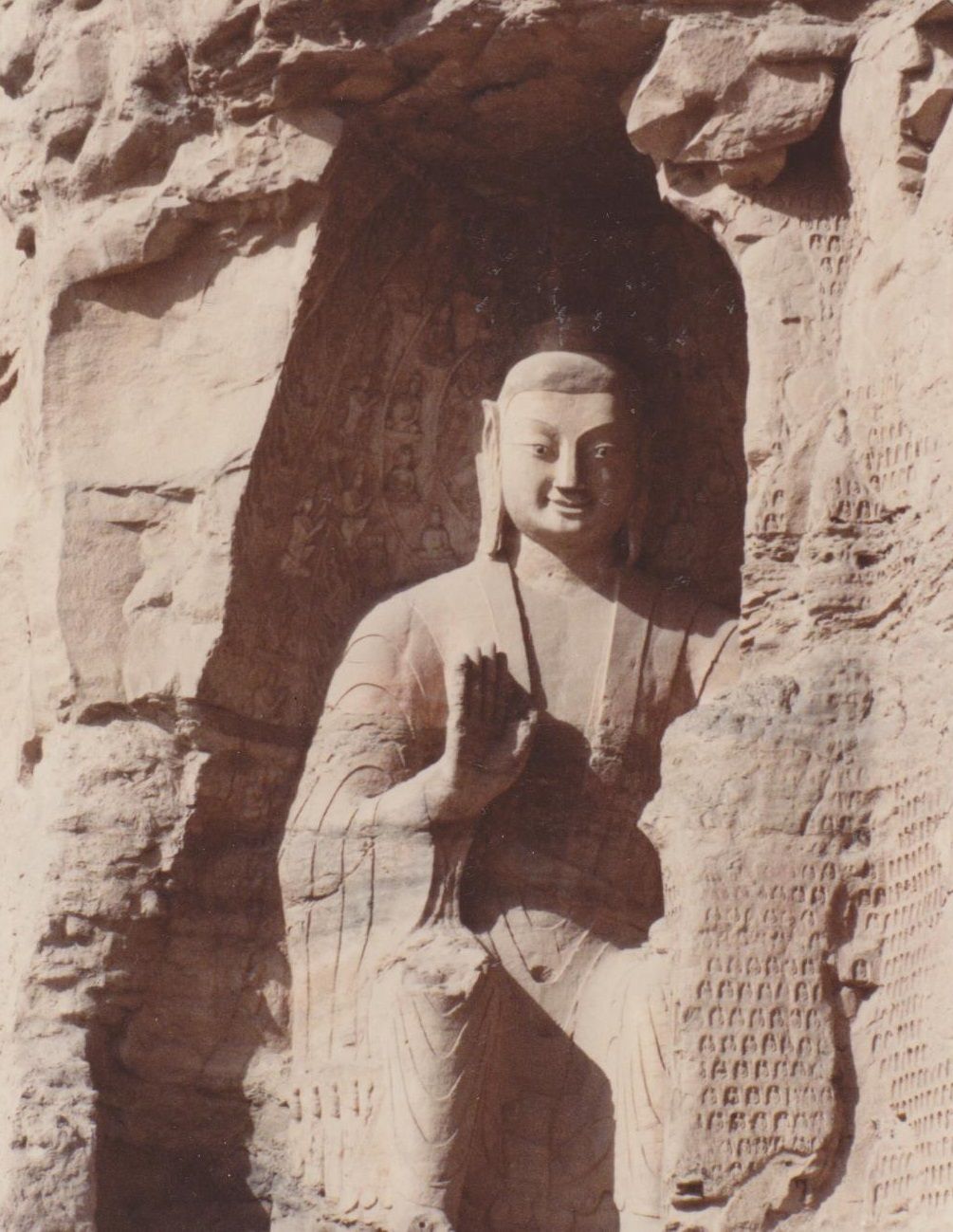
The Yungang Grottoes hold more than 50,000 Buddhist statues carved into the sandstone cliff between 460 and 525.
Day 2 — The Hanging Temple & the Wooden Pagoda
Both are on the route out of Datong:
- The Hanging Temple (Xuankong Si): a three-religion temple bolted to a cliff, more than 1,500 years old. Entry ¥15 plus a ¥100 ascent fee; climbing is limited, so arrive early and book ahead on holidays.
- The Yingxian Wooden Pagoda: the world’s oldest and tallest wooden pagoda (67m), the “museum of Chinese bracket architecture.” Best photo spot is the second-floor platform of the pagoda museum across the road. Admission ¥50.
Day 3 — The old city’s temples
- Huayan Temple (¥50): a Liao/Jin-dynasty complex with the famous smiling Bodhisattva and a 4.5m glazed chiwen ornament.
- Shanshan Temple (free): another Black Myth location, with superb Jin-dynasty buildings.
- Nine Dragon Wall and the city wall: a free walk around the old city, best at dusk when the wall lights up.
The Yungang Grottoes in depth
The Yungang Grottoes are one of the four great cave complexes of China, alongside Longmen near Luoyang, the Mogao Caves at Dunhuang and the Maijishan grottoes in Gansu. The site was carved between roughly 460 and 525, at the high point of the Northern Wei dynasty, when Datong — then called Pingcheng — was the dynasty’s capital. That makes Yungang the earliest of the major Chinese cave complexes, and stylistically the most “Central Asian” of them: the broad-shouldered, round-faced Buddhas echo the sculpture of Gandhara and Mathura, filtered through the steppe cultures the Northern Wei — themselves of Xianbei origin — ruled and traded with.
Because the cliff is sandstone, softer than the limestone at Longmen, the carvings have weathered and been repaired repeatedly — which is why several caves are fronted by protective wooden gallery structures. The icon of the site is the seated Buddha in Cave 20, part of the Tanyao Five (caves 16–20) carved under the monk Tanyao. The cave’s front wall collapsed long ago, leaving the great figure fully exposed — the image you have seen in a thousand photographs and, if you have played Black Myth: Wukong, in the game.
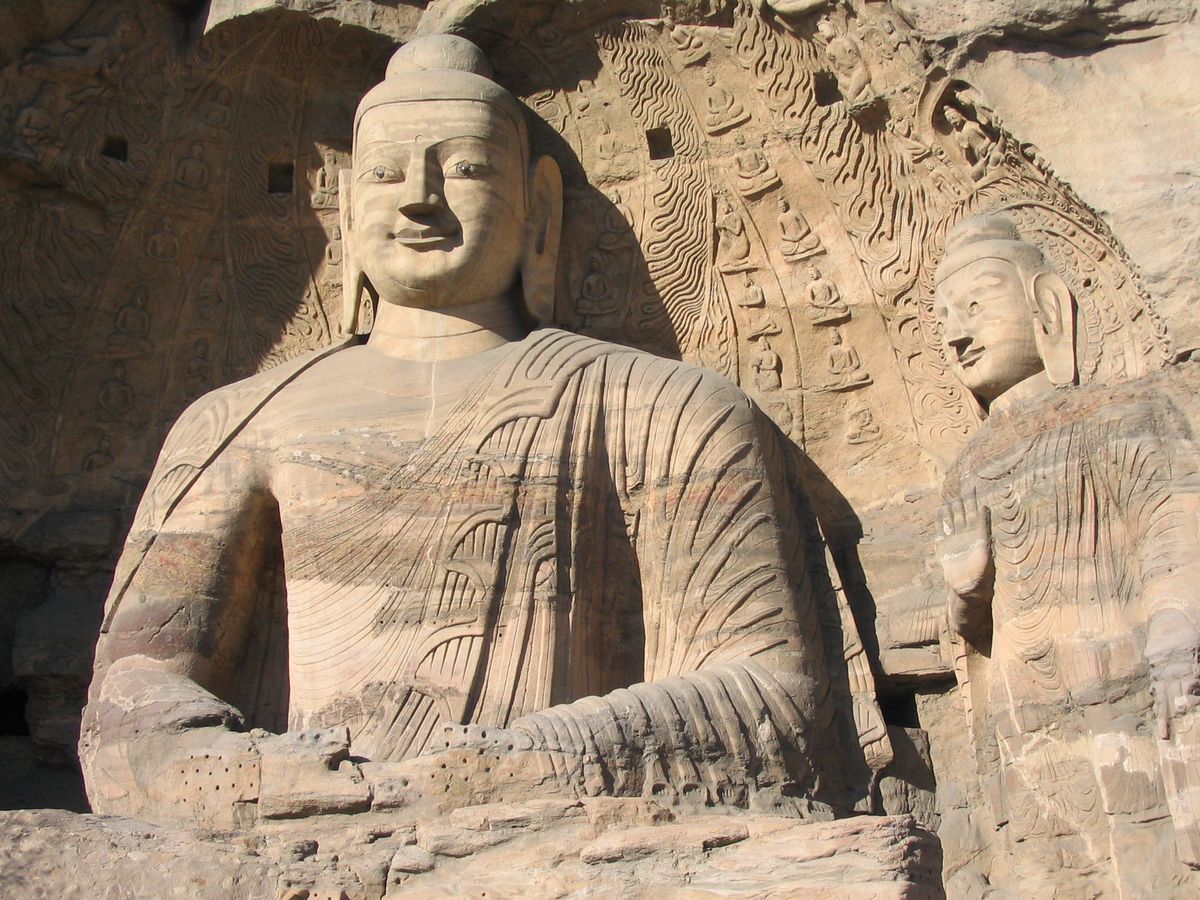
Cave 20’s great seated Buddha, its front wall collapsed, is the most photographed image at Yungang.
For the richest interiors, head to Cave 5, dominated by a 17-meter seated Buddha, and Cave 6, whose walls are densely carved with narrative scenes from the life of the Buddha. The earlier caves (1–13, mostly fifth century) preserve the blocky, powerful style; the later caves (from about 494 onward) show a more sinuous, Chinese idiom as the dynasty shifted tastes and, eventually, its capital south to Luoyang. Rent the audio guide — it explains the iconography far better than a silent walk — and allow about three hours. Go for the opening slot, when the light rakes across the cliff face and the tour groups have not yet arrived.
The Hanging Temple & the Wooden Pagoda in depth
The two headline sites outside town reward a little context. The Hanging Temple (Xuankong Si) was first built in 491, during the Northern Wei, on a sheer face of Cuiping Peak at the foot of the sacred mountain Hengshan. The buildings hang on a combination of wooden crossbeams wedged into sockets drilled into the rock and a careful stack of columns and brackets — the engineering has held for 1,500 years, but the site is capacity-limited for a reason, and the climb is steep and narrow in places. Unusually for a Chinese temple, it honors three religions at once: Buddhist statues in the middle halls, Taoist and Confucian images on either side. The ¥100 ascent fee plus ¥15 entry looks steep on paper; most visitors find the extraordinary structure worth it.
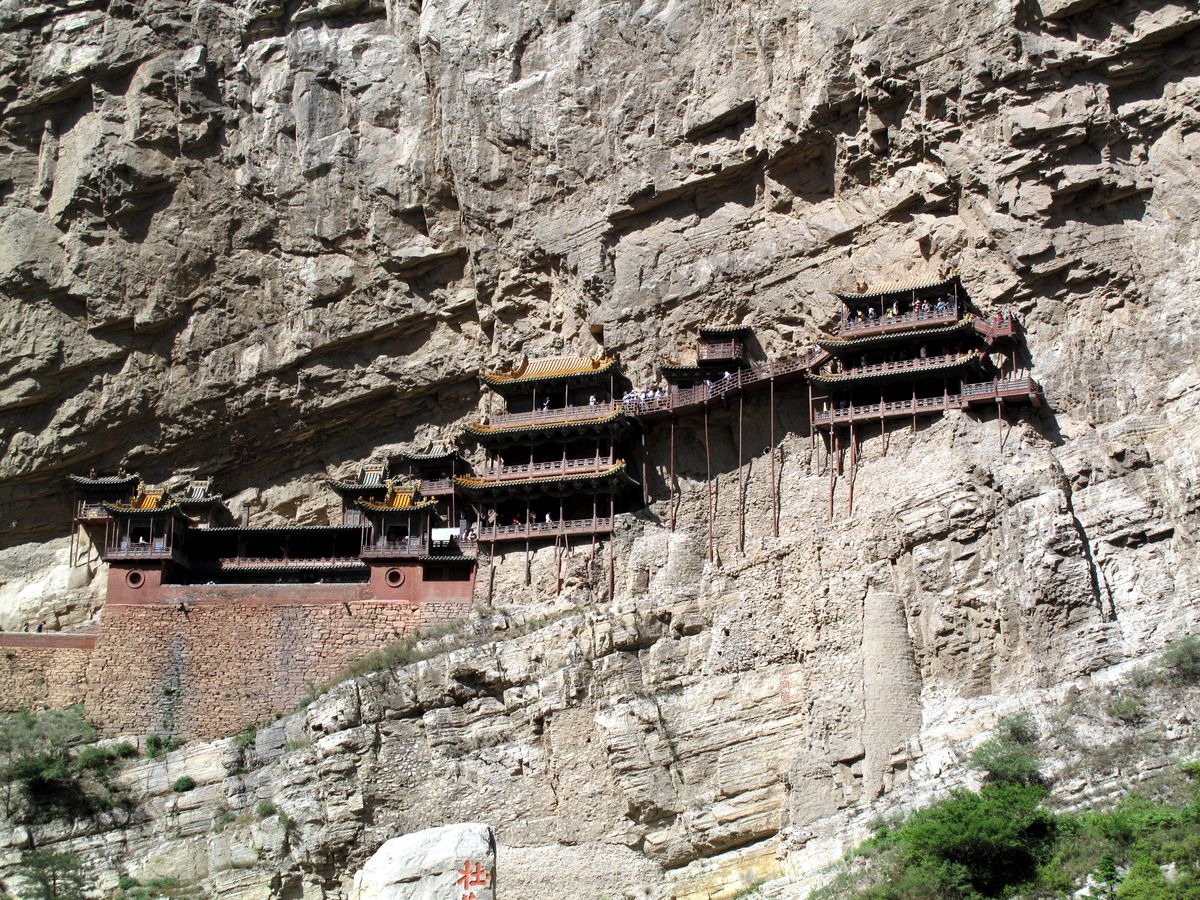
The Hanging Temple has clung to the cliff face of Cuiping Peak since 491.
Forty minutes or so further on the same road is the Yingxian Wooden Pagoda, properly the Sakyamuni Pagoda of the Fogong Temple, built in 1056 during the Liao dynasty. At about 67 meters it is the oldest and tallest wooden pagoda in the world, raised entirely from interlocking timber — no nails — with a complex system of bracket sets (dougong) that has absorbed the region’s earthquakes for nearly a millennium. You can no longer climb it, but the best photograph is taken from the museum platform across the road, which frames the whole tower against the sky. Its survival is remarkable given Datong’s earthquake history and the fact that the wood is original Liao-era timber.
When to go, season by season
Datong has a dry, continental climate — cold winters, warm summers and little rain year-round.
- May–June and September–October: the sweet spots — mild days, clear air and comfortable walking. This is the recommended window.
- July–August: warm days (25–30°C) and cool nights; the practical summer season, though it coincides with school holidays and domestic tour groups.
- November–March: genuinely cold, often below freezing, with the Hanging Temple’s walkways potentially icy. The upside: snow on the ancient roofs, thin crowds and the cheapest hotels. Check that all sites are open before a winter trip.
- Around Chinese New Year: a short-lived domestic surge — book ahead if your trip lands then.
A realistic budget
Datong is one of China’s cheaper destinations, with the main cost being the spread-out sights.
- Hotels: ¥250–450 per night for a comfortable mid-range hotel; budget options from about ¥150.
- Sights: Yungang Grottoes about ¥120 in peak season; Hanging Temple ¥15 plus ¥100 ascent fee; Yingxian Wooden Pagoda about ¥50; Huayan Temple about ¥50; Shanshan Temple and the Nine Dragon Wall free or near-free. Allow ¥350–450 total across two days.
- Transport: the sites are scattered, and the practical choice is a private driver or van at about ¥600 for a day (haggling standard). Taxis between town and Yungang run roughly ¥60–80 each way.
- Food: knife-cut noodles ¥15–30 a bowl; shaomai and lamb dishes ¥40–80 per person; local hotpot ¥60–120.
All figures are planning estimates — confirm current prices, which shift between peak and off-peak.
Common mistakes to avoid
- Skipping the audio guide at Yungang. The iconography is rich and the site is otherwise easy to walk through with no idea what you are seeing.
- Arriving at the Hanging Temple late in the day. Climbing is capacity-limited; latecomers can wait hours or be turned away on busy days.
- Booking nothing ahead on holidays or weekends. The Yungang Grottoes and the Hanging Temple both fill; book online in advance.
- Missing the wooden pagoda’s photo platform. The classic shot is from the museum across the road, not from the pagoda entrance.
- Treating Datong as a one-cave town. The old city’s Huayan and Shanshan temples, the Nine Dragon Wall and the city wall are genuine highlights, not fillers.
- Underestimating the distances. Yungang, the Hanging Temple and the pagoda are in different directions from the center; trying to do them all by taxi without a plan eats the day.
Getting around
Datong’s sights are unusually spread out, so transport is the one thing to plan. The Yungang Grottoes are about 16 km west of the center — reachable by taxi, or by a tourist bus from the rail station area. The Hanging Temple and the Yingxian Wooden Pagoda sit to the south, roughly 65–80 km out, which is why a private driver or van (about ¥600/day) is the standard recommendation — it lets you do both plus stop at the Hengshan pass. The old city temples are walkable, with the Huayan Temple, Shanshan Temple and Nine Dragon Wall within a short loop and the city wall encircling it all.
If you are coming from Beijing, the high-speed train to Datong South (about 1h40) drops you on the east side of the city — a short taxi from the old town. On return, leave buffer time for the station, which sits outside the walls. Confirm current bus and fare details on a map app, as services change.
Practical tips
- Book the top sights online ahead — the Yungang Grottoes and the Hanging Temple fill up on weekends and holidays.
- Getting around: the sites are spread out; a private driver or taxi is the practical way (about ¥600 a day for a van), or use the tourist bus from the rail station to Yungang.
- What to eat: knife-cut noodles, shaomai, lamb offal soup and Hunyuan bean jelly in the old city near the Drum Tower.
- Payment and data: set up Alipay and an eSIM before you arrive.
Where this fits
Datong is the northern anchor of the Shanxi ancient-architecture trail — combine it with Taiyuan, Pingyao and the Black Myth sites further south on our Wukong Shanxi route. It also works as a 2-day side trip from Beijing.
Prices and times as of August 2026 — confirm current tickets and schedules before you go.
Frequently Asked Questions
Why is Datong famous now?
Datong is a treasure house of ancient Chinese Buddhist art, and it was heavily featured in the 2024 video game Black Myth: Wukong — the Yungang Grottoes, the Hanging Temple, the Yingxian Wooden Pagoda, the Huayan Temple and the Shanshan Temple all appear in the game, drawing a wave of players on a 'pilgrimage' to the real sites.
How many days do I need in Datong?
Two to three days: one full day for the Yungang Grottoes, one for the Hanging Temple and the Yingxian Wooden Pagoda (they're on the same route out of town), and a third for the old city's temples. Datong is an easy add-on to a Beijing trip via the 1h40 high-speed rail.
What are the Yungang Grottoes?
A UNESCO World Heritage Site and one of China's four great grotto complexes — 53 major caves carved from the 5th century, with more than 50,000 Buddha statues. Caves 5 and 6 and the famous Tanyao Five are the highlights. Admission is about ¥120 in peak season.
Is the Hanging Temple worth the climb fee?
The Xuankong (Hanging) Temple clings to a cliff face and is one of the most extraordinary buildings in China. Entry is about ¥15 plus a ¥100 ascent fee, and climbing is capacity-limited — go early and book ahead on holidays. On the same day you can see the Yingxian Wooden Pagoda, the world's tallest wooden tower.
What should I eat in Datong?
Datong knife-cut noodles (daoxiaomian), lamb offal soup, shaomai dumplings, Hunyuan bean jelly, and the local hotpot. The old city's restaurant lanes near the Drum Tower are the place to eat.