
Shanghai, Suzhou & Hangzhou: A 5-Day Water Town Route
The classic east-China line — Shanghai's skyline, Suzhou's classical gardens and Hangzhou's West Lake, all connected by fast trains. A day-by-day 5-day plan.
OpenStreetMap Google Maps (opens externally)
Shanghai, Suzhou and Hangzhou form China’s easiest and most relaxed multi-city trip — three world-class sights connected by trains that run every few minutes. This five-day plan strings them together without a single rushed day.
The route at a glance
| Day | City | Focus |
|---|---|---|
| 1 | Shanghai | The Bund, old town |
| 2 | Shanghai | French Concession, Pudong |
| 3 | Suzhou | Classical gardens, canals |
| 4 | Hangzhou | West Lake |
| 5 | Hangzhou | Lingyin Temple, tea village |
Day 1 — Arrive in Shanghai
Touch down and settle in — keep today light. If you arrive early, walk the Bund at sunset and see the Pudong skyline light up across the river. Dinner: xiaolongbao (soup dumplings) near the old town.
- Getting from the airport: the metro is cheap and easy; the Maglev from Pudong is the fast option. See our Shanghai guide for the details.
Day 2 — Old & new Shanghai
- Morning: Yu Garden and the old town bazaar.
- Afternoon: the French Concession (Wukang Road, Anfu Road) for cafés and architecture.
- Evening: the Pudong skyline from the Huangpu River cruise, or from the top of Shanghai Tower if you booked ahead.
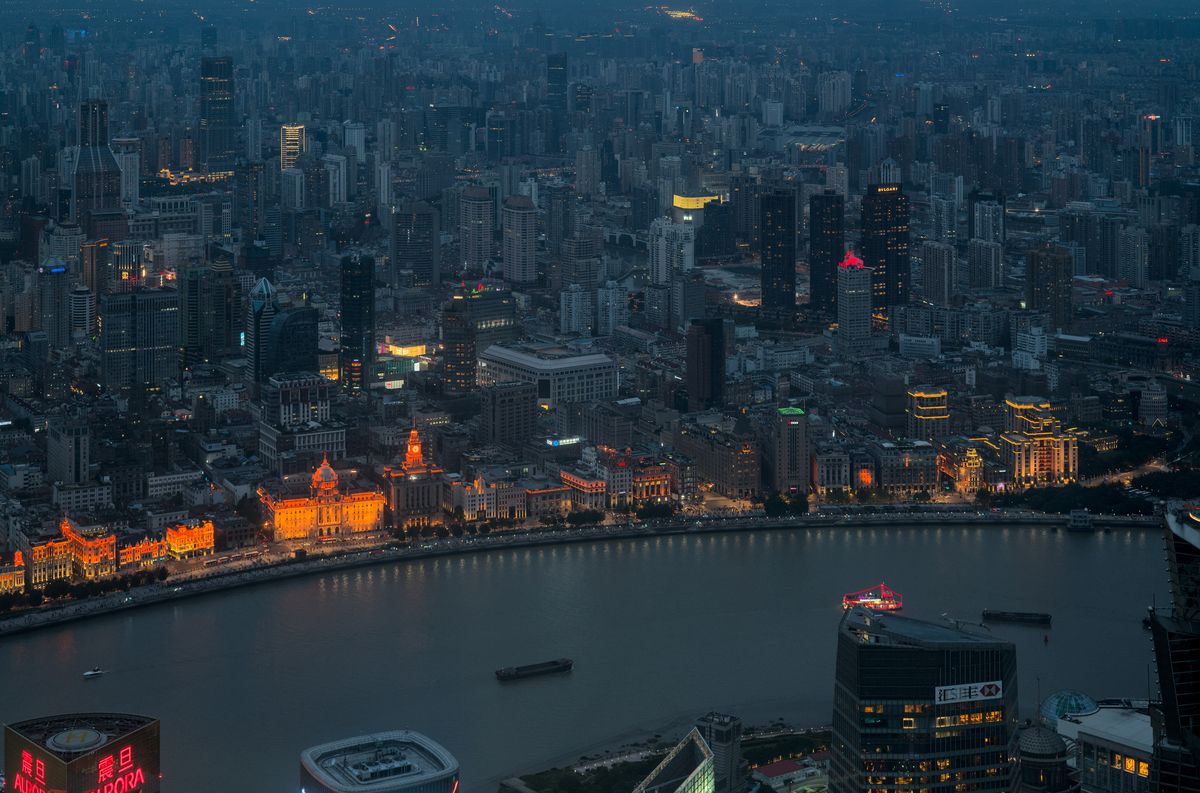
Shanghai’s Bund and Pudong skyline frame the Huangpu River — the evening cruise and the tower-top view are the route’s two best vantage points.
Day 3 — Suzhou: the garden city
Take the morning train (about 30 minutes) to Suzhou.
- Morning: the Humble Administrator’s Garden at opening — the most famous classical garden, and worth it before the crowds.
- Afternoon: Pingjiang Road for a canalside stroll and lunch, then one more garden — the Lingering Garden is quieter and more refined.
- Evening: back on the train to Hangzhou (about 1.5 hours) and sleep there. Full guide: Suzhou.
Day 4 — West Lake
- Morning: walk or cycle the Su Causeway — Broken Bridge, Leifeng Pagoda, and the lakeside at its calmest.
- Afternoon: Lingyin Temple and Feilai Peak, one of China’s great Buddhist complexes.
- Evening: a tea tasting in the Longjing tea village or dinner by the lake. Full guide: Hangzhou.
Day 5 — More of West Lake or a gentle exit
- Morning: the Guo’s Garden or a boat on the lake, then a late lunch.
- Afternoon: head to the train station — Hangzhou connects onward to Huangshan, Nanjing or back to Shanghai by fast rail.
Short on time? Drop a Shanghai day and do Suzhou as a day trip from Shanghai.
The classical gardens in depth
Suzhou’s classical gardens are a UNESCO World Heritage Site (listed in 1997), and they repay a little background before you walk in. The Humble Administrator’s Garden is the largest and most famous — begun in 1509 by a retired Ming-dynasty official — and it is the purest demonstration of the garden-makers’ art: water is the organizing element, with pavilions, bridges and rockeries arranged so that every window frames a different composition and every path reveals the garden in a new order. The name is a private joke — “the garden of one who administrates nothing” — which tells you how the gentry of Suzhou used these spaces as retreats from official life.
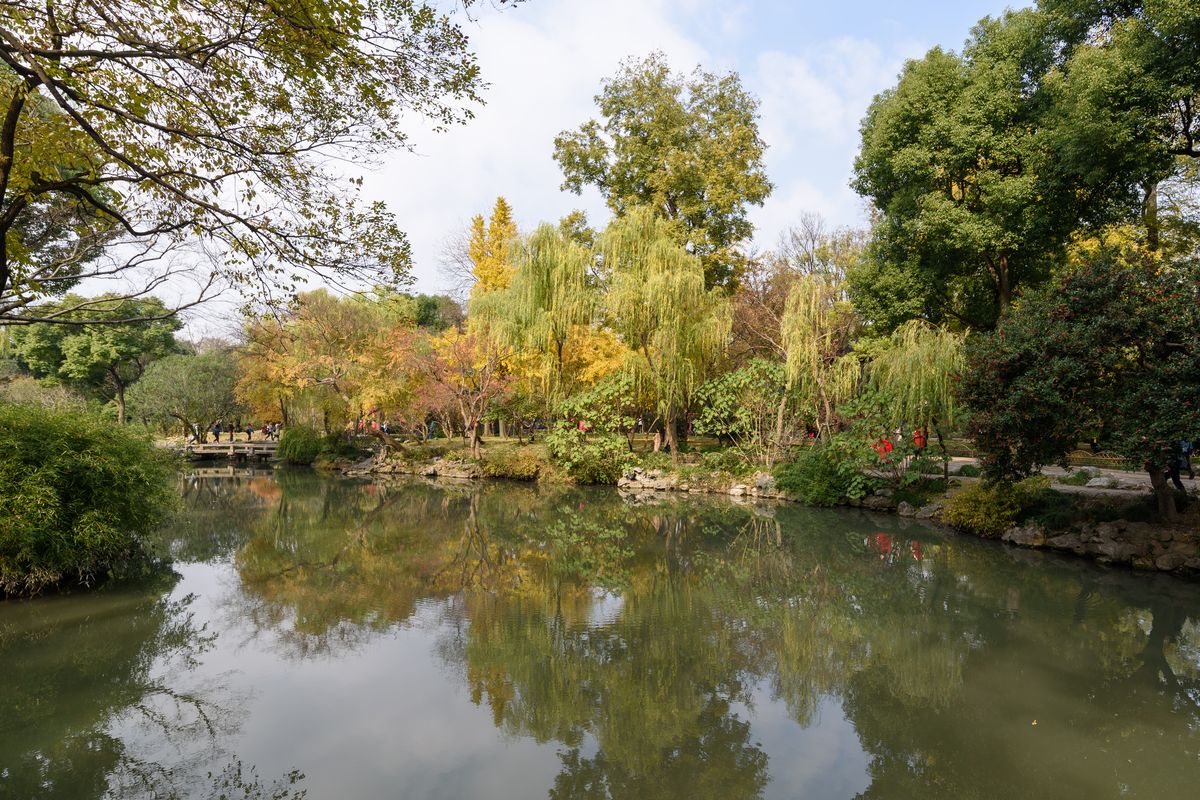
Suzhou’s Humble Administrator’s Garden is organized around water, with every window framing a different composition — go at opening, before the tour groups.
The Lingering Garden, the second stop on the one-day plan, was built later and is famous for its rockeries and its “borrowed views,” where the garden seems to extend beyond its walls. If you have appetite for a third, the tiny Master of Nets Garden is the connoisseur’s choice — the smallest of the famous gardens and the most perfectly proportioned, and the one with an evening opera program in summer.
All three work on the same principles: water, rock, architecture and planting arranged to suggest a landscape far larger than the actual plot. It helps to know that Suzhou’s gardens were designed to be looked at slowly, from specific viewpoints, in changing light — which is why going at opening, when the light is low and the crowds are thin, transforms the experience.
West Lake in depth
Hangzhou’s West Lake is a UNESCO World Heritage Site (2011) and possibly the most celebrated body of water in Chinese culture — the subject of centuries of poetry, painting and pilgrimage. The lake is ringed by two famous causeways: the Su Causeway, built by the Song-dynasty poet and official Su Dongpo in 1089, and the Bai Causeway, named after the Tang poet Bai Juyi, who was governor of Hangzhou. The classic “Ten Scenes of West Lake” — among them Autumn Moon on the Calm Lake and Broken Bridge with Snow — are a checklist that has shaped how visitors have seen the lake for 800 years.
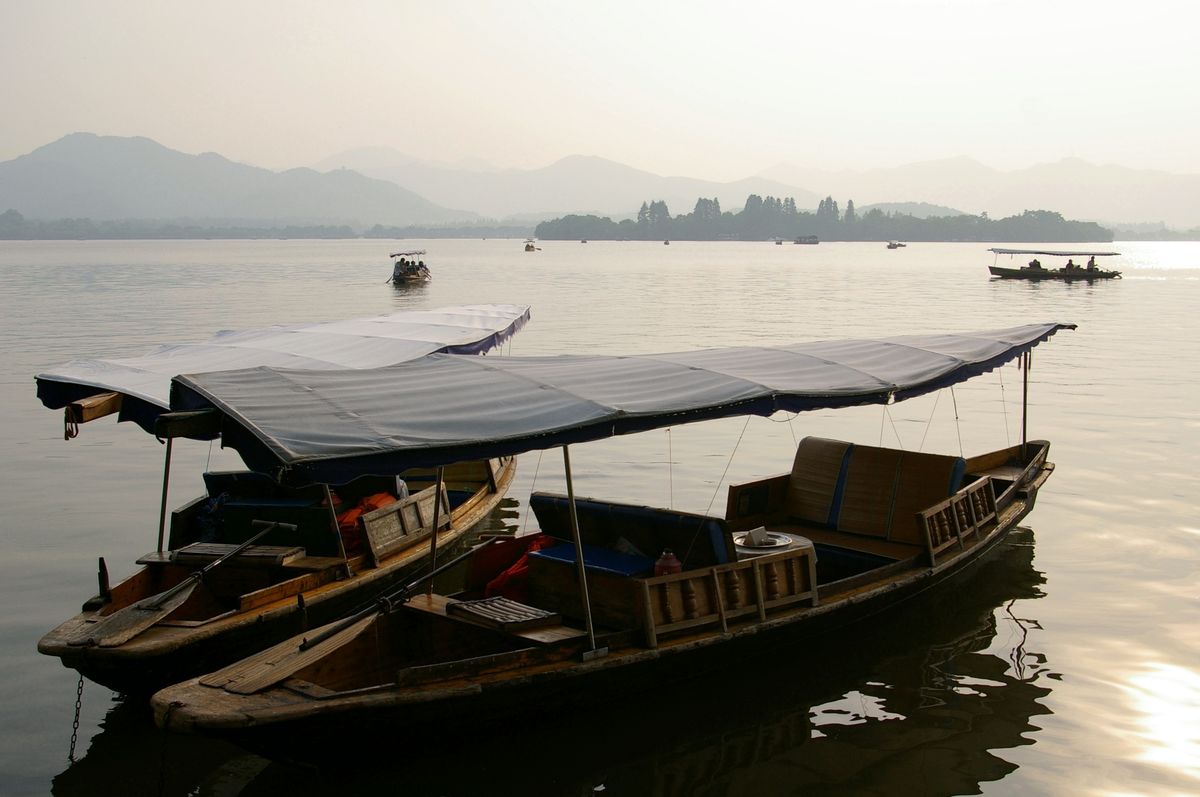
West Lake in Hangzhou rewards a slow day — walk or cycle a causeway at dawn, take a wooden boat across the water, then climb to a hillside teahouse.
The Broken Bridge at the northern end is actually a solid causeway whose name comes from a trick of perspective: from a distance it appears to break. The Leifeng Pagoda on the southern shore is a 2002 reconstruction of a Song-dynasty original, famous from the legend of the White Snake; the view from its base across the lake to the city is the standard postcard. Across the water, Lingyin Temple — founded in 326, one of China’s great Buddhist complexes — sits beneath the cliff of Feilai Peak, whose grottoes hold hundreds of carved Buddhist figures. In the hills above the lake, the Longjing tea villages grow the celebrated Dragon Well green tea, and the fields are at their most beautiful in spring.
A day at West Lake is best spent simply: walk or cycle a causeway at dawn, take a wooden boat across to the three-pool islet, then a late afternoon climb to a hillside teahouse. It is a place that rewards doing less.
When to go, season by season
- Spring (March–May): the classic window — willows green, plum and cherry blossom through March–April, and the tea fields busy with the spring harvest. The sweetest weather and the most visitors.
- Summer (June–August): hot and humid, with sudden downpours. The lake is at its most lush and the summer lotus blooms — but midday is punishing.
- Autumn (September–November): the other sweet spot — clear air, comfortable days, and in late September–October the osmanthus trees scent the whole city. Hangzhou in particular is arguably at its best now.
- Winter (December–February): cold and grey but quiet, with the cheapest hotels. The classic “Broken Bridge with Snow” scene is rare but magical when it happens. Avoid the Chinese New Year surge.
A realistic budget
This is China’s wealthiest corridor, but the trip is still moderate — the trains are cheap and the hotels are the main line.
- Hotels: ¥400–800 per night for a comfortable mid-range hotel in Shanghai; Suzhou and Hangzhou run slightly less. Budget hostels from about ¥150. Over five nights, roughly ¥2,000–4,000.
- Trains: Shanghai–Suzhou ¥30–40; Suzhou–Hangzhou ¥80–130 — second class. Intercity rail for the whole trip is under ¥300.
- Sights: Humble Administrator’s Garden about ¥70–80 (timed entry); Lingering Garden ¥55; West Lake free; Lingyin Temple about ¥75 including Feilai Peak; Yu Garden in Shanghai about ¥40. Total ¥300–400.
- Food: Shanghai’s xiaolongbao ¥10–20 per order; sit-down meals ¥80–150 per person; Hangzhou’s lake-view restaurants more. Budget ¥150–250 per day.
A realistic 5-day total, excluding international flights, is roughly ¥3,500–6,000 per person. All figures are estimates — prices shift with season and demand.
Common mistakes to avoid
- Going to the Humble Administrator’s Garden at midday on a weekend. Timed entry helps, but weekends still overflow; book the earliest slot.
- Trying to “do” West Lake by taxi. The lake is best at walking or cycling pace — a car gets you between the same three viewpoints and you miss the point.
- Skipping Suzhou’s evening option. One day in Suzhou works, but staying the night lets you see the gardens’ night program and the canals after dark, which day-trippers miss.
- Booking the wrong station. Suzhou has several stations and the gardens are near Suzhou Railway Station; Hangzhou East is the main hub. Confirm which one your ticket names.
- Eating only in Shanghai. Hangzhou’s lake-side restaurants and Suzhou’s canalside lanes are part of the experience; the food is a reason this route is classic.
- Underestimating the metro queues at Shanghai airports. Arriving and departing through Pudong or Hongqiao, the metro is cheap but slow with luggage; budget generous transfer time.
Practical tips
- Book trains as you go — tickets on this corridor are frequent and cheap; book the same morning or the night before. How to book.
- Payment: set up Alipay before you leave; it covers the metro, ferries and street food. Setup guide.
- eSIM: get one before you fly so maps and translation work everywhere. Best eSIMs.
- Hotels: base yourself near a metro line in each city; Shanghai People’s Square, Suzhou’s Pingjiang area and Hangzhou’s lakeside all work well.
Where this route fits
This is the perfect soft landing after the history of Beijing and Xi’an — see our 10-day golden triangle or the full first-timer plan. It also works as the east-China finale of a 14-day route.
FAQ highlights
- Is three cities in five days too much? No — the trains are short and frequent, and you sleep in a different city only twice.
- Can I use my passport on the metro? No, the metro uses Alipay’s transit code or a transport card — set up Alipay first.
- Do I need to book the gardens ahead? The Humble Administrator’s Garden takes timed entry and can sell out on weekends — book online in advance.
Last updated: August 2026. Train times and ticket rules change — confirm on the platform you use before you travel.
Frequently Asked Questions
How many days do I need for Shanghai, Suzhou and Hangzhou?
Five days is comfortable: two in Shanghai, one in Suzhou and two in Hangzhou. If you only have four, drop a Shanghai day and do Suzhou as a day trip. The three cities are close enough that the train transfers never cost you a full day.
Which order should I visit them in?
Shanghai → Suzhou → Hangzhou is the natural flow, but it works in either direction. Suzhou and Hangzhou are both easy day trips from Shanghai if you're short on time.
Is Suzhou worth it if I only have one day?
Yes — one day covers the Humble Administrator's Garden, Pingjiang Road and one more garden. It's the easiest and most rewarding day trip from Shanghai. See our [Suzhou guide](https://chinotrips.com/suzhou/).
How do I book the trains between these cities?
Book online with your passport via Trip.com or 12306, then board by scanning your passport — no paper ticket needed. Trains run every few minutes on the Shanghai–Suzhou–Hangzhou corridor. See our [train ticket guide](https://chinotrips.com/how-to/train-tickets/).
When should I visit the gardens and West Lake to avoid crowds?
Go at opening time — Suzhou's Humble Administrator's Garden and Hangzhou's West Lake are both magical before the tour groups arrive. West Lake is best in the late afternoon for the sunset light.