
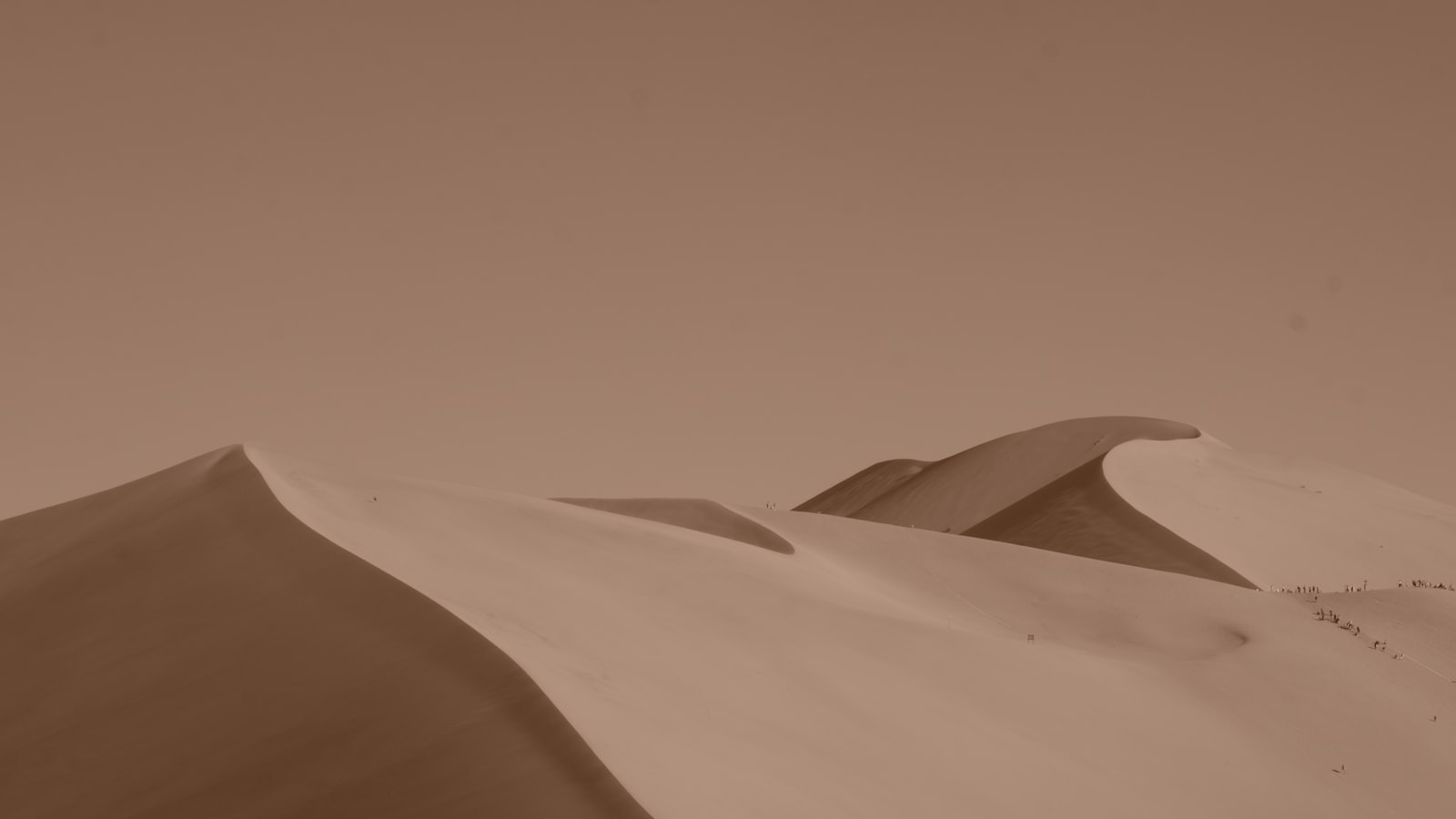
China's Silk Road: Xi'an to Dunhuang in 7 Days
Follow the old Silk Road through northwest China — Xi'an's Terracotta Army, the Great Wall's western end at Jiayuguan, and Dunhuang's Mogao Caves and desert dunes.
OpenStreetMap Google Maps (opens externally)
The Silk Road was China’s corridor to the world for two thousand years — and the stretch inside China is still one of the most romantic trips you can take. This seven-day route follows it from Xi’an through the Gobi edge to Dunhuang: Terracotta Army, the western end of the Great Wall, and caves full of thousand-year-old Buddhist art.
The route at a glance
| Day | Stop | Focus |
|---|---|---|
| 1 | Xi’an | Terracotta Army, city wall |
| 2 | Xi’an → Lanzhou → Jiayuguan | The train journey west |
| 3 | Jiayuguan | The Great Wall’s western fort |
| 4 | Jiayuguan → Dunhuang | Arrive, night market |
| 5 | Dunhuang | Mogao Caves |
| 6 | Dunhuang | Singing Sand Dunes, Crescent Lake |
| 7 | Dunhuang → back east | Yumen Pass & yardangs, or fly out |
Day 1 — Xi’an
Start in Xi’an, the eastern gateway of the Silk Road: the Terracotta Army in the morning, the City Wall by bike at sunset, and the Muslim Quarter for dinner. Full guide: Xi’an.
Day 2 — The train west
Take the morning high-speed train to Lanzhou (about 3 hours), then continue west toward Jiayuguan. The scenery flips from farmland to the edge of the Gobi — the point of the journey. Book your rail legs with your passport. How to book trains.
Day 3 — Jiayuguan: the end of the Great Wall
Jiayuguan Fort is where the Great Wall ends in the desert — the “First Pass Under Heaven.” A day here covers the fort, the overhanging Great Wall and the best-preserved section of the ancient Silk Road gates.
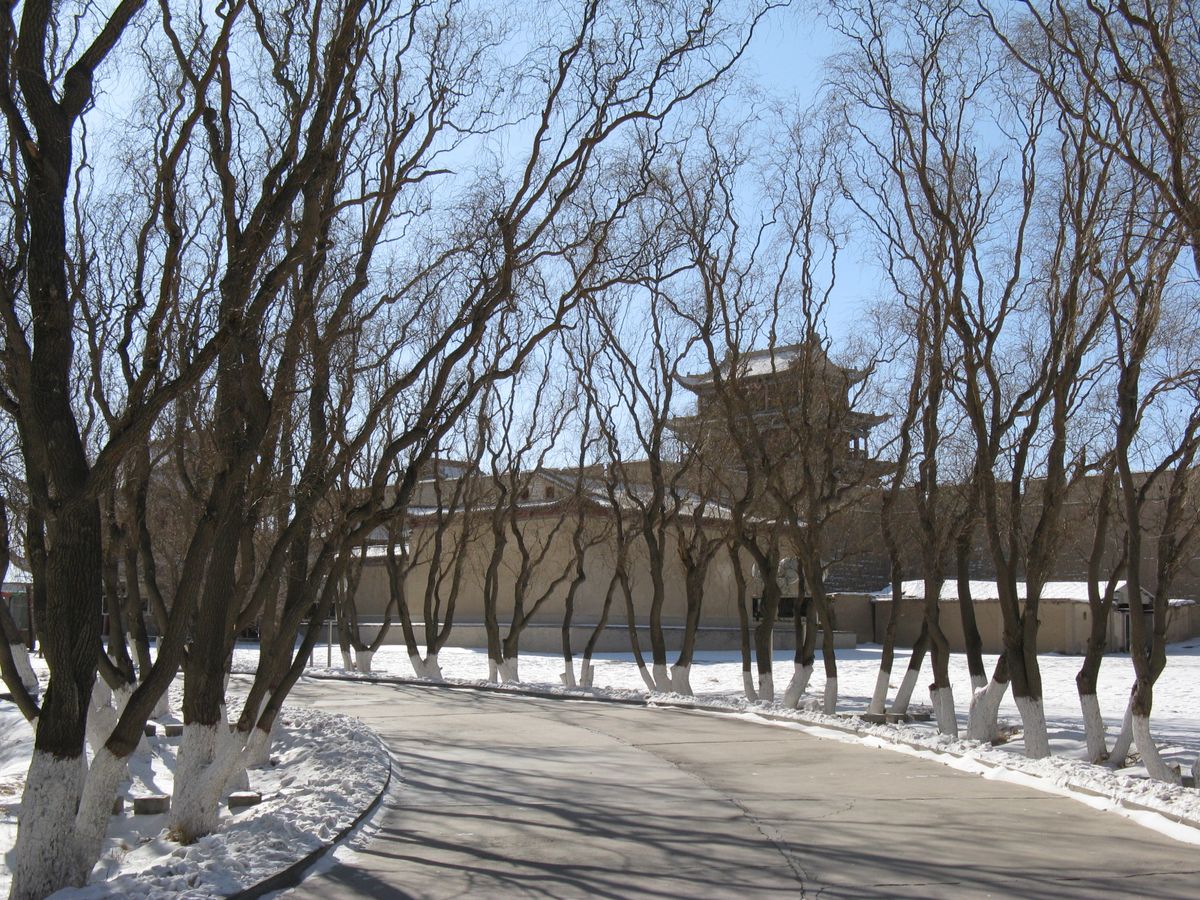
Jiayuguan Fort marks the Great Wall’s western end in the desert — the “First Pass Under Heaven” where Silk Road caravans left China proper.
Day 4 — On to Dunhuang
Continue the rail line to Dunhuang, the oasis city at the heart of the Silk Road. Settle in, then an evening at the Shazhou Night Market — camel meat skewers, apricots and the local-style grills.
Day 5 — The Mogao Caves
The Mogao Caves are the trip’s centerpiece: 700-plus Buddhist caves cut into a cliff, with murals and sculptures dating back to the fourth century. Book a timed slot, go early, and see a small selection of the best-preserved caves with a guide. Full guide: Dunhuang.
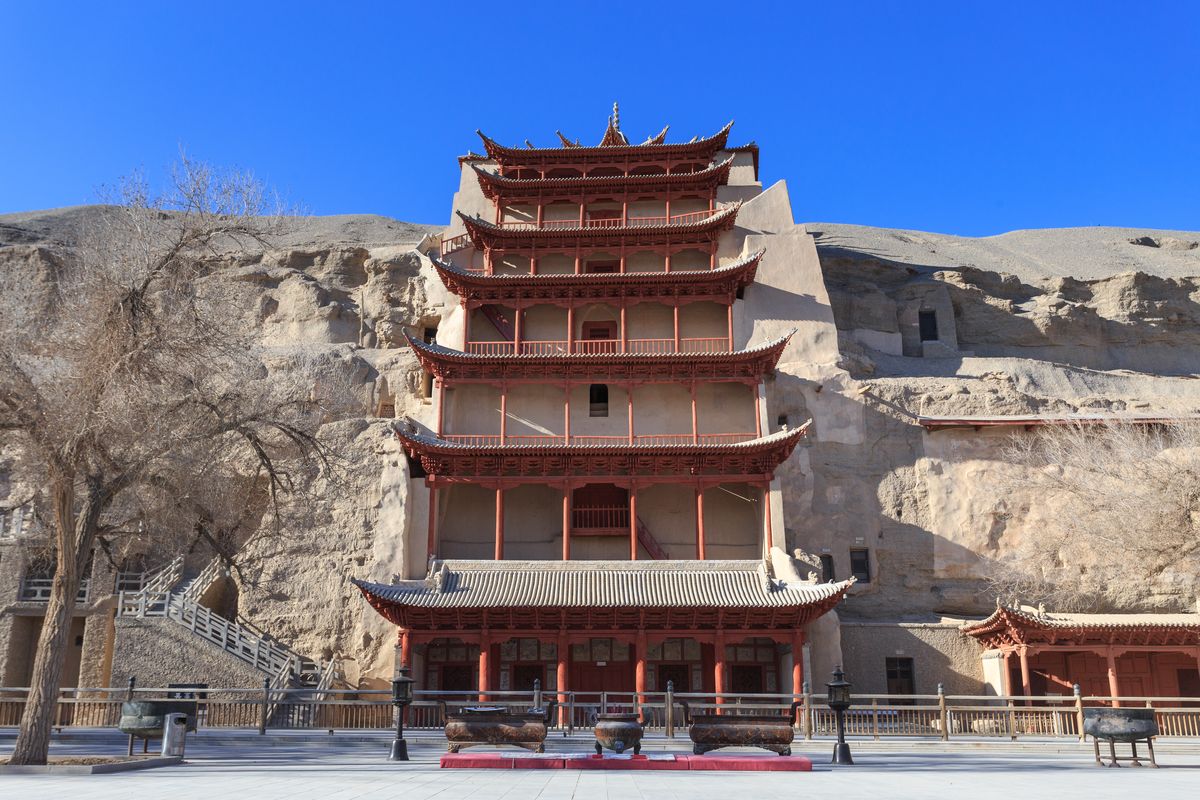
The Mogao Caves’ thousand-year-old murals and sculptures are Dunhuang’s intellectual centerpiece — entry is real-name and timed, so book ahead in season.
Day 6 — The desert
Singing Sand Mountain and Crescent Lake — ride the dunes (or a camel), watch the sun sink over the desert, and climb the crescent dunes for the classic photo. Go late afternoon to beat the heat and catch the sunset.
Day 7 — The far forts, or fly out
If you have the day, the full-day trip to Yumen Pass and Yangguan Pass and the strange yardang (“ghost city”) landforms is the proper Silk Road finish. Otherwise, fly out of Dunhuang or retrace the rail line back toward Xi’an.
More time? Extend the route a day or two with the Shuidonggou grottoes or push on to Turpan and Urumqi in Xinjiang for the far west. The Gansu guide has the wider picture.
The Mogao Caves in depth
The Mogao Caves — literally the “Caves of the Thousand Buddhas” — are the trip’s intellectual centerpiece and one of the great cultural sites on earth (UNESCO World Heritage since 1987). Carving began in 366, when a wandering monk named Le Zun is said to have seen a vision of a thousand Buddhas in the cliff above the river, and continued for a thousand years, through the Tang dynasty’s high point of Buddhist art and beyond into the Mongol era. The result is a cliff face of more than 700 caves packed with murals and painted clay sculptures that together form an unbroken visual record of how Buddhist art and the Silk Road’s cultures evolved across a millennium.
Dunhuang’s position made it a true crossroads — Chinese monks, Central Asian merchants, Tibetan and Uighur patrons all left their mark on the cave walls, and the murals show the Persian, Indian and Chinese styles mixing. The cave’s modern fame also comes from a scandal: in 1900 a sealed “Library Cave” was discovered holding more than 50,000 manuscripts, and in the following decades foreign explorers — among them Aurel Stein and Paul Pelliot — carried large portions of them away, which is why Dunhuang manuscripts now sit in London, Paris and elsewhere. What remains is still staggering.
Visiting in practice: entry is real-name and timed, with a daily visitor cap, and you see a rotating selection of roughly eight caves with a guide. Book online with your passport well ahead in season. Photography is not allowed inside — the flash and crowds damage the pigments — which is part of why the site remains in such extraordinary condition. Allow half a day, and go early.
The desert in depth
Dunhuang’s other great sight is the desert itself. Singing Sand Mountain (Mingsha Shan) rises beside the city, and at its foot lies Crescent Lake (Yueyaquan) — a spring-fed lake shaped like a crescent that has survived in the middle of the dunes for centuries, its water level maintained by an underground source that keeps the sand from swallowing it. The “singing” of the mountain comes from the sand grains vibrating when the wind moves them; on a breezy day you can hear the low hum. Climb the dunes for the classic view of the lake and the sunset, take a camel ride along the dune crest if the queue allows, and bring a scarf — the desert wind is persistent and fine sand gets everywhere.
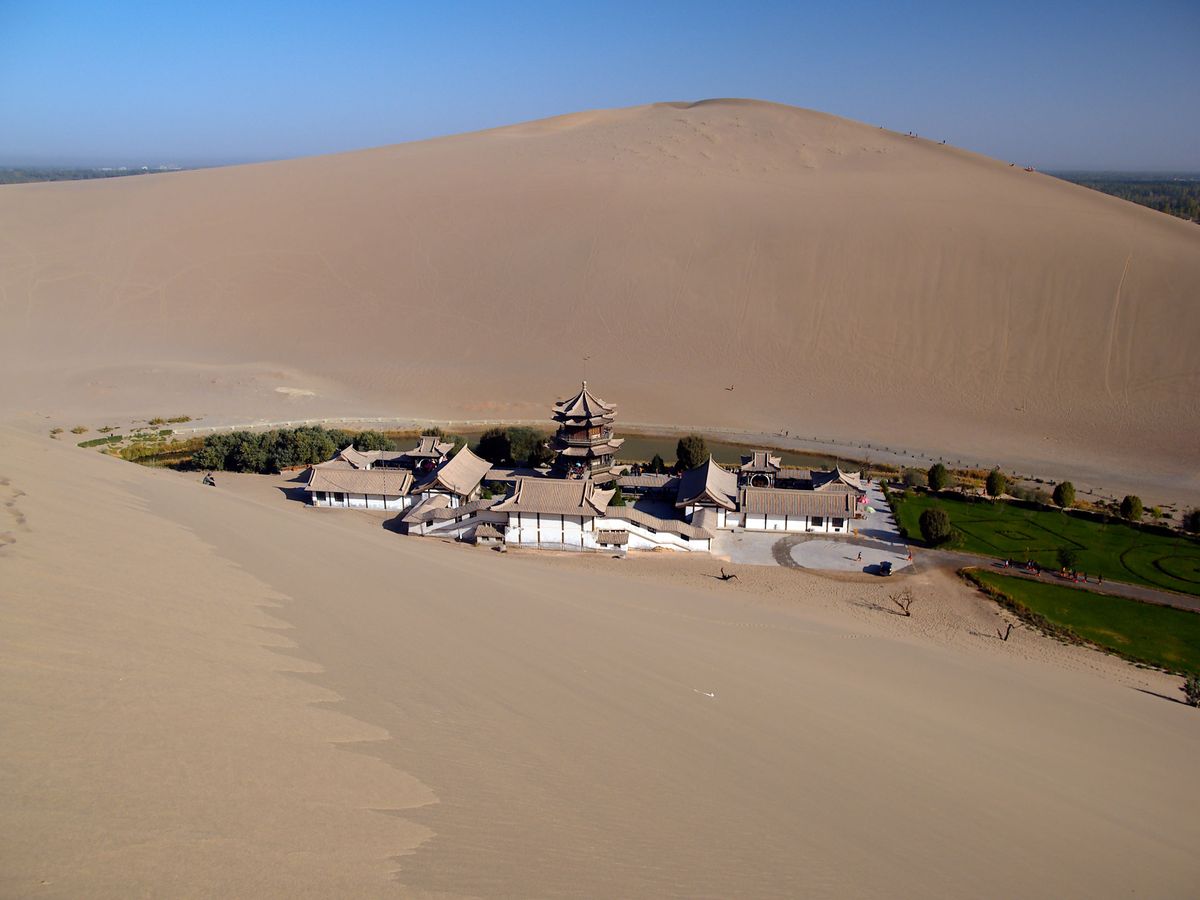
Crescent Lake has survived in the middle of the Singing Sand Dunes for centuries — climb the dunes late afternoon for the classic sunset view over the water.
The full-day excursion beyond town takes in the Yumen Pass and Yangguan, the two great gates of the western Great Wall. Yumen (“Jade Gate”) was the point where the Silk Road officially left China proper, and the nearby yardang landforms — wind-carved ridges of soft rock that locals call the “ghost city” — are the strangest landscape on the route. The passes themselves are mostly ruined walls and a museum, but standing where the caravans once waited to leave China is the emotional high point of the whole journey. The excursion is remote and best done with a driver or a small tour from Dunhuang.
When to go, season by season
- May–June: the sweet spot — mild days, clear light and the dunes at their most comfortable. Little rain, and the desert is not yet punishing.
- September–October: the other sweet spot — after the summer heat, with crisp air and good light for both the caves and the dunes.
- July–August: hot and dry, often above 35°C in the afternoon. The Mogao Caves provide shade, but the desert is best left to early morning and late evening. Also peak season for crowds and prices.
- November–April: cold, with sandstorms possible in spring; winter nights drop below freezing and some facilities close. Quiet and cheap, but check that the caves and desert sites are fully open, and be ready for real cold.
A realistic budget
The northwest is affordable, with the main costs being the caves, the desert excursion and the long train legs.
- Sights: Mogao Caves about ¥230–300 depending on season and ticket tier (confirm — it has several classes); Singing Sand Mountain and Crescent Lake about ¥110; a camel ride ¥100–150; the Yumen/yardang day trip with transport ¥300–500. Allow ¥800–1,200 total.
- Trains: Xi’an–Lanzhou–Jiayuguan–Dunhuang legs, if done by rail across the route, total roughly ¥600–1,000 in sleeper or second-class seats depending on class. Book ahead.
- Hotels: ¥250–500 per night in Dunhuang and Jiayuguan; budget options from about ¥150. Seven nights roughly ¥2,500–4,000.
- Food: noodles and lamb are the local staples and cheap — ¥15–30 for a bowl, ¥50–100 for a proper meal. The Shazhou Night Market is the splurge spot.
A realistic 7-day mid-range total, excluding flights into and out of the region, is roughly ¥4,500–7,500 per person. All figures are estimates — confirm current prices, especially for the Mogao Caves.
Common mistakes to avoid
- Booking the Mogao Caves too late. They are real-name, timed and capped; in season, tickets can sell out days ahead. Book the moment your dates are firm.
- Planning the desert for midday in summer. The dunes are brutal at 2pm in July; go late afternoon for the light and the sunset.
- Rushing Dunhuang to one day. The caves and the desert are each a full day; a third for the far forts makes the trip complete — two days leaves something important out.
- Skipping the audio guide or the cave tour’s value. The guided rotation is the only way into the caves; don’t treat it as a box to tick.
- Underestimating the northwest’s dryness. Sunscreen, lip balm, a scarf and more water than you think you need; the desert air dehydrates fast.
- Booking a tight onward connection. Dunhuang is remote and weather can delay flights and trains; give yourself a buffer at the end.
Practical tips
- Book the Mogao Caves and the trains ahead — both are real-name and sell out in season.
- Dust and sun: pack sunglasses, a scarf for the desert wind, and moisturizer — the northwest is dry.
- Water: always carry bottled water; the desert and rail stops are remote.
- Set up payment and data first: Alipay, eSIM, and a translation app.
Where this route fits
The Silk Road is a fantastic second trip to China, or the finale after the eastern classics. Start from the first-timer planner to plan the full journey.
FAQ highlights
- Is it safe and easy to travel solo here? Yes — the route is well-served by trains and tours, and Dunhuang is set up for visitors.
- Can I do it without a guide? Yes for Dunhuang; the Mogao Caves’ guided entry is included with the ticket.
- What about altitude? The northwest is high but not extreme — most travelers notice nothing beyond drier air.
Last updated: August 2026. Train and cave ticket rules change — confirm before you travel.
Frequently Asked Questions
How do I get to Dunhuang on the Silk Road route?
Most travelers fly into Xi'an, then take the high-speed or sleeper train line through Lanzhou and Jiayuguan to Dunhuang. There are also direct flights from Xi'an and Lanzhou to Dunhuang. Trains are the more atmospheric way — the line itself is part of the journey. See our [train guide](https://chinotrips.com/how-to/train-tickets/).
How many days should I spend in Dunhuang?
Two to three days: one for the Mogao Caves, one for the dunes at Singing Sand Mountain and Crescent Lake, and one for the day trip to the Yumen Pass and the yardang landforms. See our [Dunhuang guide](https://chinotrips.com/dunhuang/).
Is the Silk Road route worth it if I don't love history?
It's a different China from the east — desert, oasis towns and world-class archaeology. If you love the Great Wall, the Mogao Caves' Buddhist murals, or simply want to see the desert, it's one of China's most memorable trips. If you'd rather have beaches or big-city food, pick another route.
What's the best time of year?
May to June and September to October have the best weather — mild days, no summer heat and low sandstorms. July and August are hot; winter is cold and some desert sights are less pleasant. See our [weather guide](https://chinotrips.com/how-to/weather-packing-by-season/).
Do I need to book the Mogao Caves far in advance?
Yes — the Mogao Caves are real-name, timed-entry and cap daily visitors. In peak season tickets can sell out days ahead. Book online in advance with your passport; see our [Dunhuang guide](https://chinotrips.com/dunhuang/) for how.