
Gansu Travel Guide (2026)
The essential Gansu guide — Dunhuang's Mogao Caves, Zhangye's rainbow mountains, Jiayuguan's Great Wall fort and the Silk Road corridor.
OpenStreetMap Google Maps (opens externally)
Gansu is the corridor of the Silk Road — a long, narrow province of desert, oases and Buddhist cave art, capped by the greatest mural treasure in China at Dunhuang.
It’s a land of huge distances and dramatic extremes: the Yellow River cutting through Lanzhou, the rainbow-colored rock of Zhangye, the western end of the Great Wall at Jiayuguan, and the desert town of Dunhuang beyond. This guide covers the essentials.
Overview
Gansu stretches more than a thousand kilometers from east to west along the Hexi Corridor, the thin band of oases that carried Silk Road trade between central China and Central Asia. For centuries its towns were caravan stops, and that history survives in extraordinary form: the Mogao Caves at Dunhuang, hundreds of rock-cut Buddhist temples filled with murals spanning roughly 1,600 years.
The province is also home to Lanzhou, the capital, where the Yellow River runs through the city center, and a string of increasingly dramatic landscapes westward — the multicolored Danxia landforms near Zhangye, the Jiayuguan fort at the Great Wall’s western limit, and finally the dunes and desert of Dunhuang. It’s a route that rewards patience: the distances are real, but so are the rewards. The good news is that the corridor is easy to travel — high-speed rail and short internal flights link the main stops, and each town has a tourist-friendly base near the station.
Best time to visit
- May–June and September–October: the sweet spots — mild days, clear skies and the most comfortable travel conditions.
- July–August: hot, especially in the desert around Dunhuang; go early or late in the day for outdoor sites.
- Winter (November–March): cold, windy and quiet, with some sites scaling back services; the caves and museums remain the most weatherproof options.
Getting there & getting around
- By air: most travelers fly into Lanzhou Zhongchuan (LHW), the main gateway, or directly to Dunhuang (DNH) from Xi’an, Beijing or other hubs for the western end.
- By rail: high-speed trains run the corridor from Lanzhou through Zhangye and Jiayuguan, with overnight trains covering the longer leg toward Dunhuang. Book with your passport — see our train ticket guide.
- On the ground: taxis and ride-hailing cover each town; for outlying sites like the Yadan landforms or the Yumen and Yangguan passes, a shared or private day tour is the easiest arrangement.
Main destinations
- Dunhuang — the headline stop: the Mogao Caves (book ahead), the Singing Sand Dunes and Crescent Lake, and the ruined Silk Road passes beyond town. See our Dunhuang Travel Guide for the full plan.
- Zhangye — the Danxia landform (the “rainbow mountains”) plus a surprisingly atmospheric Great Buddha Temple; a half-day stop that most travelers slot between Lanzhou and Jiayuguan.
- Jiayuguan — the Ming-era fort at the western end of the Great Wall, with a museum and the overhanging section of wall nearby.
- Lanzhou — the capital on the Yellow River: a riverside walk, the famous beef noodle breakfast, and the Gansu Provincial Museum’s Silk Road collections.
- Xiahe — a Tibetan Buddhist town southeast of Lanzhou, home to the large Labrang Monastery; a good add-on for travelers heading toward the Sichuan highlands.
Suggested itinerary
A 7-day corridor route:
- Day 1: fly into Lanzhou; afternoon on the Yellow River waterfront and a beef noodle lunch.
- Day 2: the Gansu Provincial Museum in the morning, then the high-speed train west to Zhangye (about 3–4 hours).
- Day 3: a morning at the Zhangye Danxia landform, then onward by train to Jiayuguan.
- Day 4: the Jiayuguan fort and the overhanging Great Wall, then the overnight or evening train toward Dunhuang.
- Day 5: the Mogao Caves (your pre-booked timed slot) and the Shazhou night market.
- Day 6: the Singing Sand Dunes and Crescent Lake; add Yumen Pass if time allows.
- Day 7: fly out from Dunhuang, or take the long way back east by train.
With less time, fly straight to Dunhuang and treat it as a two-day standalone destination; with more, add Xiahe or the deeper desert sites.
Practical tips
- Book the Mogao Caves as soon as your dates are set — daily caps make availability the single biggest planning risk.
- Carry water and sun protection — the desert sun is fierce and shade is scarce.
- Dress for temperature swings — scorching days and cold desert nights, even in summer.
- The distances are real — don’t try to pack the whole corridor into a weekend; choose the eastern or western end for a short trip.
- Sort out mobile payment before you arrive; tickets, taxis and street food are cashless.
- What to eat: Lanzhou beef noodles, lamb skewers, hand-pulled noodles and the oasis-grown melons of the Dunhuang region.
Food & drink
Gansu’s signature dish is Lanzhou beef noodles — hand-pulled wheat noodles in a clear beef broth with chili oil, radish and cilantro, eaten at breakfast as often as lunch. The best bowls come from shops that make their own noodles on site; follow the morning queues. Elsewhere the cooking reflects the desert and the Silk Road: cumin-dusted lamb skewers grilled over charcoal, hand-torn noodles, mutton in flatbread (a legacy of the region’s Muslim Hui communities), and, around Dunhuang, the sweet oasis melons and dried apricots grown under the desert sun. Alcohol appears in the form of strong local baijiu; tea — sometimes salted butter tea in the Tibetan-influenced south — is the safer all-day drink.
A short history of the Silk Road
The Hexi Corridor was never just a road — it was a chain of oasis towns where caravans, monks, soldiers and merchants all passed, and where Buddhism entered China from the west. The Mogao Caves are its greatest record: nearly five hundred caves carved from a cliff near Dunhuang, their walls covered in murals and statuary that track the exchange of art, faith and goods across more than a thousand years. At Jiayuguan you see the corridor’s defensive logic — the fort guards a narrow pass between mountains and desert at what was, for the Ming dynasty, the western edge of the empire. Understanding even a little of this history turns a long rail journey into a narrative you can follow westward, town by town.
Extending the route
The main corridor fits in a week, but two add-ons are worth knowing about. South of Lanzhou, the town of Xiahe is home to Labrang Monastery, one of Tibetan Buddhism’s most important monasteries outside Tibet — a hillside maze of chapels, a three-kilometer prayer-wheel corridor and a genuinely different cultural register from the desert towns. Farther west beyond Dunhuang, the Yadan landforms and the ruined Yumen and Yangguan passes reward a full day’s excursion into the emptiness, though they require a tour and real time. If you’re continuing into Xinjiang, the same corridor logic extends naturally onward; if you’re turning south instead, the road toward the Sichuan highlands begins in the hills around Xiahe.
Allow an overnight in Xiahe rather than rushing it as a day trip; the altitude and the early-morning kora around the monastery are worth the time. In Dunhuang, the night market grills lamb and pours the local apricot drinks, and the oasis melons are sweet enough to plan a stop around. Whatever you add, keep a buffer day for weather and distance — the corridor punishes tight schedules. Sunsets over the Singing Sand Dunes are the classic end to a Dunhuang day, and they are worth timing your visit around.
Last updated: August 2026. Cave openings, ticket rules and rail timetables change — confirm before you go.
Frequently Asked Questions
How do I plan a Gansu Silk Road trip?
Most travelers fly into Lanzhou, the provincial capital on the Yellow River, and work west along the rail corridor: Zhangye for the rainbow mountains, Jiayuguan for the Great Wall fort, and Dunhuang for the Mogao Caves and dunes. Six to eight days covers the corridor at a relaxed pace, and the whole route runs on high-speed or night trains.
Do I need to book the Mogao Caves ahead?
Yes — strongly. Mogao has a timed-entry system and daily visitor limits, so tickets can sell out days ahead in high season. Book online with your passport details and arrive at your assigned time; walk-up tickets are rarely available during busy months.
Is the Zhangye rainbow mountain worth the detour?
For most people, yes. The Zhangye Danxia landform — bands of red, orange and green rock carved by wind and water — is one of China's most surreal landscapes, and the viewing walkways are easy. It's a half-day stop between Lanzhou and Jiayuguan, so it fits naturally into the corridor rather than requiring a detour.
How do I travel between the main stops?
High-speed rail links Lanzhou, Zhangye, Jiayuguan and points toward Dunhuang, with overnight trains covering the longer western leg. Book with your passport — see our train ticket guide. Dunhuang is the remote end, so budget a full day to reach it and a full day to leave.
When is the best time to visit Gansu?
May–June and September–October are the sweet spots — mild days, clear skies and comfortable travel. July–August is hot, especially in the desert around Dunhuang; winter is cold, windy and quiet, with some services scaled back. The Mogao Caves and indoor sites are visitable year-round, weather permitting.
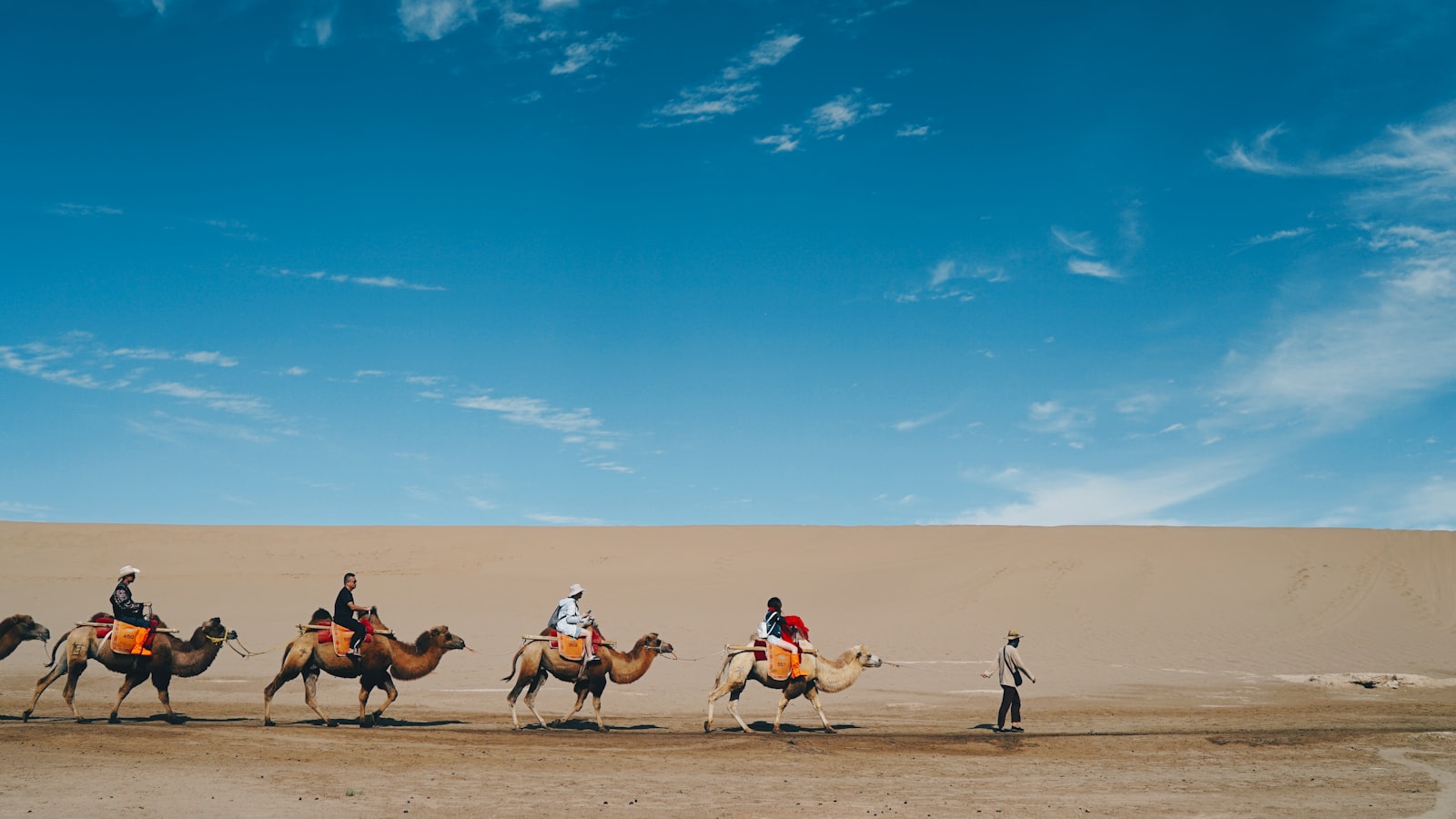
Is the camel ride at the Singing Sand Dunes worth it?
For most people, yes — riding a camel across the dunes to Crescent Lake is one of the most memorable experiences in western China. Book at the site, follow the guide's instructions, and go early morning or late afternoon to avoid the midday heat.