
Dunhuang & the Mogao Caves: The Deep Guide (2026)
The deep guide to Dunhuang and the Mogao Caves — the greatest treasure of the Silk Road, the cave murals and sculptures, the sand dunes, and how to plan the visit.
Mogao Caves, Dunhuang, Gansu, China
Open an external map for this location.
OpenStreetMap Google Maps (opens externally)
Dunhuang and the Mogao Caves are the greatest treasure of the Silk Road — 735 caves of Buddhist art carved over a millennium, and the sand dunes beyond. Here’s the deep guide to the oasis and its wonders.
At the western edge of China’s heartland, the oasis city of Dunhuang guarded the Silk Road for a thousand years — and left behind the greatest treasure of the great route: the Mogao Caves, 735 cave temples carved into the cliffs and filled with a thousand years of Buddhist murals and sculptures. Beyond the caves, the Singing Sand Dunes rise above the crescent lake. Together they make one of the most extraordinary visits in China — and one of the world’s great cultural treasures.
The Mogao Caves
- 735 caves — carved into the cliffs above Dunhuang over a millennium.
- The art — the Buddhist murals and sculptures, the richest repository in China.
- The UNESCO site — one of the great cultural treasures of the world.
- The guided visit — a selection of the caves, by timed-entry tour.
The Mogao Caves are the treasure of the Silk Road — the Buddhist art of a thousand years, preserved in the desert.
The visit, in practice
- Book ahead — the caves are capped by timed-entry tours and sell out.
- The visitor center — the film and the museum before the caves.
- The guided tour — into a selection of the painted chambers.
- No photos inside — the caves are protected; the guide explains the rest.
The visit is a guided journey into the treasure — book ahead and come with time.
The Singing Sand Dunes
- The vast dunes — the desert rising beside Dunhuang.
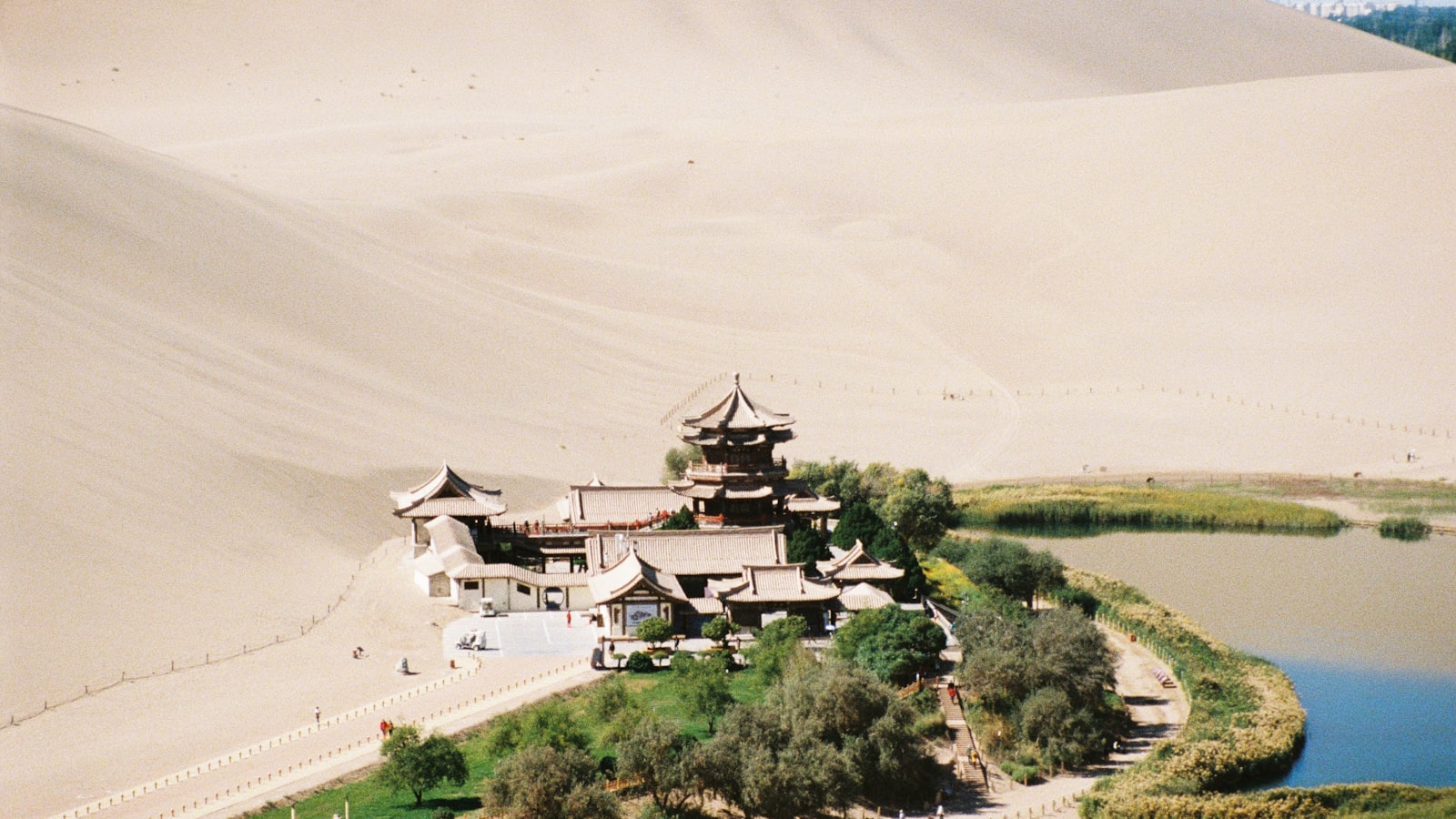
- Crescent Lake — the spring-fed pool in the curve of the dunes, the classic image.
- The desert experience — the climb, the view, the camel rides and the sand-boarding.
- Sunset — the light turning the dunes golden; the classic time.
The dunes are the desert counterpoint to the caves — the vast sand and the crescent lake.
A two-day plan
- Day 1 — the Mogao Caves: the tour, the visitor center and the treasure.
- Day 2 — the Singing Sand Dunes and the old town; sunset on the dunes.
- Day 3 (optional) — the longer desert trips: the Yadan landforms and the far Silk Road sites.
- The pace — the caves deserve the morning, the dunes the sunset.
Two days covers the great sights; a third opens the far desert.
The story of the caves
The Mogao Caves are not a single monument but a thousand-year archive of Buddhist art, and their story is inseparable from the Silk Road. From the fourth century, when a monk was said to have seen a vision of a thousand Buddhas on the cliff, generations of patrons — local rulers, traveling merchants, monks and pilgrims — commissioned cave after cave, filling them with murals and sculptures that trace the evolution of Buddhist art across the dynasties. The caves reached their golden age under the Tang, when Dunhuang stood at the crossroads of the great trading routes between China and the West.
The modern chapter is as dramatic as the ancient one. In 1900, a monk discovered a hidden library cave (Cave 17) packed with tens of thousands of manuscripts, paintings and textiles — the great “Library Cave” — sealed for centuries. In the decades that followed, foreign explorers carried much of the treasure to museums across the world, a dispersal that scholars still debate. The discovery made Dunhuang famous, and the caves today are among the most studied and best-protected sites on earth.
- A thousand years of art — the caves carved and painted from the fourth century through the Yuan.
- The crossroads — the oasis where the Silk Road routes met and the cultures mingled.
- The Library Cave — the hidden trove of manuscripts discovered in 1900.
- The dispersal — the treasure spread across the world’s museums, a story still told.
Inside the caves: what you’ll see
Each visit to the caves is a selection — the site opens a rotating choice of its 735 caves, and no single tour sees them all. The constants are the painted chambers: the ceilings dense with the flying apsaras (the celestial musicians and dancers of Buddhist art), the walls alive with scenes of the Buddha’s life and the bustling world of the Silk Road, and the great sculpted figures — Buddhas, bodhisattvas and guardian kings — that fill the cave interiors. The murals are not merely devotional; they are a visual record of the music, the fashion, the trade and the daily life of a vanished world.
- The apsaras — the flying celestials, the signature image of the caves.
- The murals — the painted record of a thousand years of Buddhist life and Silk Road commerce.
- The sculptures — the great figures filling the cave chambers.
- The selection — the rotating tour shows a choice of the 735 caves.
The conservation effort
The caves are as fragile as they are precious, and the protection is serious. Photography is forbidden inside because the flash and the moisture of the crowds damage the murals; the visitors enter in small groups, move through on the timed tours, and the total numbers are capped each day. The Dunhuang Academy runs the conservation — the world’s largest repository of research on a single cave site — and its digital project has created high-resolution archives of every painted cave, accessible remarkably online. Coming to the caves is coming to a working conservation site, and the respect for the art is part of the experience.
- No photos inside — the flash and the moisture threaten the fragile murals.
- The caps — the timed-entry tours limit the numbers and protect the site.
- The Dunhuang Academy — the world’s leading research center on the caves.
- Digital Dunhuang — the online archive of every painted cave, accessible anywhere.
The desert beyond the caves
Dunhuang’s other great sights lie in the desert. The Yadan landforms (“ghost town”) are the wind-sculpted rock formations of the Gobi, a strange and beautiful landscape a few hours out of town. The Jade Gate (Yumen Pass) marks the ancient western frontier, where the Silk Road left China proper, and the line of the Han Great Wall runs across the desert nearby — the old frontier of the empire. These are longer day trips, best done with a driver or a tour, and they give the visit its full Silk Road context.
- The Yadan landforms — the wind-carved “ghost town” of the Gobi.
- The Jade Gate — the ancient frontier post of the Silk Road.
- The Han Great Wall — the frontier line running through the desert.
- The day trips — best done with a driver or an organized tour.
Food and practicalities
Dunhuang’s food is the cooking of the Silk Road’s desert edge — noodles, lamb and the oasis fruits. The city’s streets are filled with the smell of Lanzhou beef noodles, hand-pulled to order; donkey meat huangmian (the yellow noodles served with the savory meat) is the local specialty; and the apricots and melons of the oasis are famous across China. The desert demands preparation — sun protection, water, and sensible shoes for the dunes — and the shoulder seasons of spring and autumn are the comfortable window for the whole visit.
- The noodles — Lanzhou beef noodles and the local donkey-meat huangmian.
- The oasis fruits — the apricots and the melons, the sweet taste of the desert edge.
- The desert gear — sun protection, water and sensible shoes for the dunes.
- The season — spring and autumn for the mild weather.
Practical notes
- Getting there — flights from Lanzhou and Xi’an, or the Silk Road route.
- Best season — spring and autumn; summer is extreme, winter quiet.
- Get connected — set up Alipay and an eSIM for tickets and transport.
- See our Dunhuang guide for the city details.
The bottom line
Dunhuang and the Mogao Caves are the greatest treasure of the Silk Road — a thousand years of Buddhist art in the desert caves, and the vast dunes beyond. Book the caves ahead, give them the day they deserve, and catch the sunset on the Singing Sand Dunes — and you’ll have seen one of the great cultural treasures of the world.
Last updated: August 2026. Cave access and conditions change — confirm current details before you go.
Frequently Asked Questions
What are the Mogao Caves?
The **Mogao Caves** are the greatest treasure of the Silk Road — 735 cave temples carved into the cliffs above Dunhuang, decorated over a thousand years with Buddhist murals and sculptures. They're the largest and richest repository of Buddhist art in China, a UNESCO World Heritage site, and one of the great cultural treasures of the world. For many travelers, they're the single most important sight of the Silk Road.
Is Dunhuang worth visiting?
Yes — Dunhuang is the oasis city that guarded the western Silk Road, and it holds two of the great sights of western China: the **Mogao Caves** (the Buddhist cave art, the treasure of the Silk Road) and the **Singing Sand Dunes** (the vast desert dunes with the crescent-shaped lake). It's remote and the trip is an effort, but the rewards are extraordinary. See our [Dunhuang guide](https://chinotrips.com/dunhuang/) and [Silk Road route](https://chinotrips.com/itineraries/silk-road-china-route/).
What will I see in the Mogao Caves?
The visit is **by guided tour**, in small groups, into a selection of the caves: the painted chambers with their murals of Buddhas, bodhisattvas and the scenes of the Silk Road world, and the sculpted figures that fill the caves. The art spans a thousand years, and the guide explains the history and the craft. The caves are protected (no photos inside), and the number open varies with the day and the conservation — each visit is a selection of the great treasure.
How do I visit the Mogao Caves?
**Book in advance** — the caves are capped by timed-entry tours, and they sell out, especially in season. The visit is by guided tour from the visitor center (which has a film and a museum), then into the caves. Bring your passport, tied to the ticket. It's about 30 minutes from Dunhuang. Booking ahead through the official channel is essential — see our [Dunhuang guide](https://chinotrips.com/dunhuang/) for the details.
What are the Singing Sand Dunes?
The **Singing Sand Dunes (Mingsha Shan)** are the vast desert dunes beside Dunhuang, with the **Crescent Lake** — the spring-fed pool held in the curve of the dunes — as the classic image. The dunes are the desert experience: the climb to the ridge, the view over the lake and the desert, and the sand-boarding and camel rides. Sunset is the classic time, when the light turns the dunes golden. It's the perfect counterpoint to the caves.
How much time do I need in Dunhuang?
**Two days** is the right amount: a day for the Mogao Caves (the tour and the visitor center), and a day for the dunes and the old town. A **third day** allows the longer trips into the desert — the Yadan landforms, the Jade Gate and the far Silk Road sites. It works as a 2–3 day stop on a [Silk Road route](https://chinotrips.com/itineraries/silk-road-china-route/), and the effort of getting there is repaid by the treasures.
When is the best time to visit Dunhuang?
**Spring (April–May) and autumn (September–October)** are the best — mild weather, clear skies and the desert at its most comfortable. **Summer** is extreme — the desert heat and the bright sun make the caves and the dunes demanding. **Winter** is cold but quiet, with the sites nearly empty. For the caves and the dunes, the shoulder seasons are the sweet spot.