

How to Bargain in China: Haggling Without the Awkwardness
How to bargain in China — where haggling is expected, opening offers, key Chinese phrases, walk-away tactics, and avoiding tourist overcharges.
Bargaining in China is an expected part of the market experience — a friendly, scripted dance that ends with a fair price and a smile on both sides. Here’s how to do it with confidence and without the awkwardness.
For many visitors, the first market encounter is confusing: you’re quoted a price that seems absurd, you pay it, and later learn you paid double what a local would. That’s not a scam — it’s simply a market where the opening number is a starting point. In China, haggling at markets isn’t rude; it’s the social ritual that makes the sale. The vendors expect it, enjoy it, and respect you more for doing it well. This guide teaches you where to bargain, how to do it, and how to keep it fun.
Where bargaining applies — and where it doesn’t
The first skill is knowing the field.
- Bargain: markets, street stalls, souvenir booths, and any vendor who quotes a price off the top of their head. The tourist-heavy markets — Beijing’s Panjiayuan, Xi’an’s Muslim Quarter, and most night markets — expect heavy negotiation.
- Don’t bargain: supermarkets, department stores, branded and chain shops, museums, restaurants, hotels, the metro, and metered taxis. All are fixed-price. Attempting to haggle at a chain store just confuses the cashier.
- Grey zone: unmetered street taxis in some cities, wholesale districts (electronics, jade, antiques), and large purchases where the shopkeeper is clearly willing to talk. Watch the locals — they are your best guide.
If there’s no price tag and the vendor is beckoning, the number they say is a negotiation opener.
The psychology of the market
Understand why the game works. Tourist-market vendors quote a high opening price because they expect you to negotiate — and because some visitors won’t. That’s not dishonesty; it’s a pricing system built around bargaining. The vendor’s goal is a sale at a reasonable margin; your goal is a fair price; the ritual in between is how the two meet.
Keep the tone light. Losing face matters in Chinese culture — a heated, aggressive haggle embarrasses everyone. A smiling, playful approach reads as respectful and usually lands a better price than a hard-line one. Think of it as improv comedy rather than a negotiation: you both know the script, and a good outcome leaves both sides feeling they won. Our etiquette guide has more on keeping things gracious.

Market vendors expect haggling — the quoted price is a starting point, and a friendly back-and-forth is part of the sale.
The walk-away technique
The single most effective move in Chinese bargaining is also the simplest: be willing to walk away.
- Ask the price — “Duoshao qian?”
- React mildly — “Tai gui le” (too expensive).
- Make a counter-offer at roughly half.
- When the vendor counters, either meet in the middle or thank them and start to leave.
- Walk away. This is the moment the vendor decides whether your price works. Many will call you back with a better number the instant you turn. If they don’t, you were too low — you can return and offer a little more.
The walk-away works because the vendor reads it as genuine disinterest, and because there are twenty identical stalls nearby. You have nothing to lose: the same item, or a near-identical one, is two metres away.
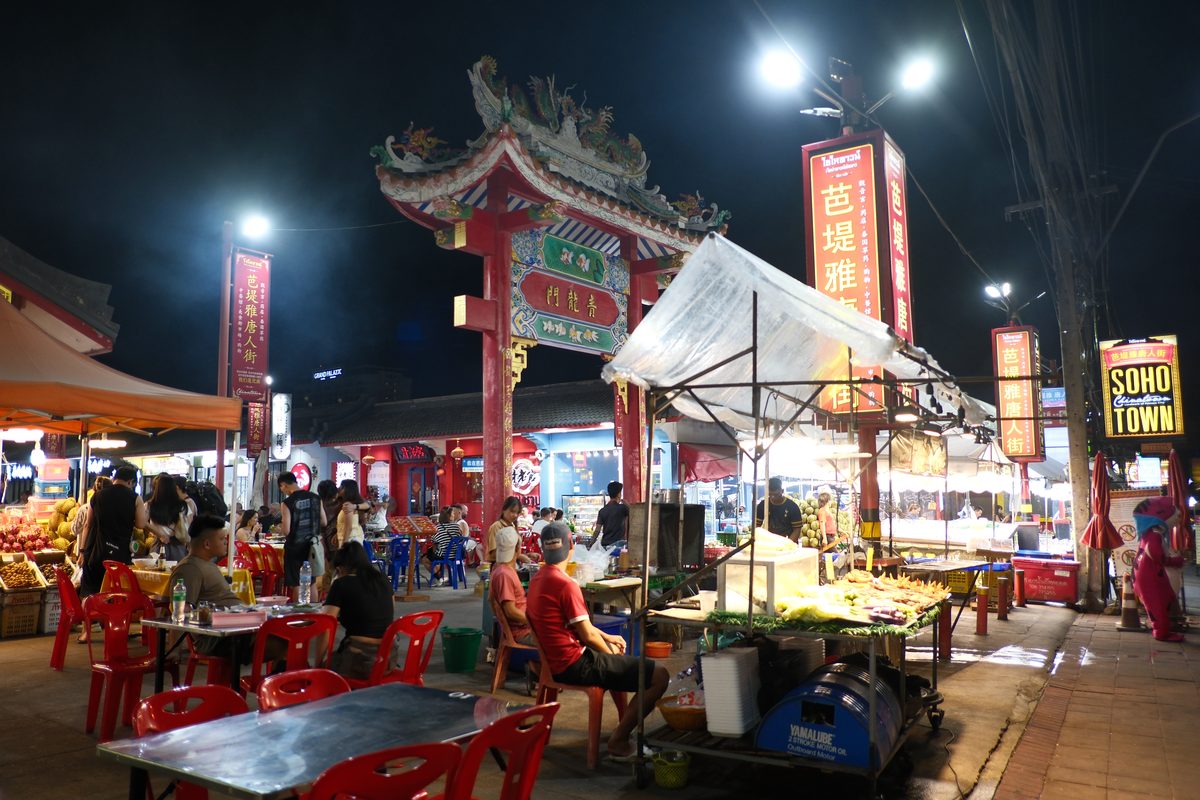
With so many stalls selling the same goods, the walk-away is safe — the identical item is usually two metres away.
The opening offer and settling
Open at 30–50% of the asking price — low enough to leave room, high enough to be taken seriously. A vendor quoting ¥100 for a scarf might accept ¥50–60; opening at ¥30 gives you space to climb.
- For small items, keep it quick and cheerful. Don’t grind over ¥5.
- For large purchases (jade, antiques, electronics), take your time, inspect the goods, and settle carefully — this is where the real negotiation happens. And for genuinely valuable items, the quality questions matter more than the haggle — see our jade guide and silk guide before you shop.
- Agree on the exact item — point at the specific piece, get the vendor to confirm, then pay. A classic trick is handing over a different (worse) item once the price is settled; prevent it by keeping the agreed piece in your hand.
- Check the goods before paying, and count your change or scan carefully.
Key Chinese phrases
You don’t need fluent Chinese — a few phrases plus a phone screen with numbers works everywhere.
- Duoshao qian? (多少钱) — How much?
- Tai gui le (太贵了) — Too expensive.
- Pian yi dian (便宜一点) — A bit cheaper.
- Zai shao yidian (再少一点) — A little less.
- Bu yao le (不要了) — I don’t want it (used as you walk away).
- Xie xie (谢谢) — Thank you, essential when you settle.
If tones are a struggle, type the number you want to pay into your phone’s calculator and show it. This is universal, unambiguous, and oddly charming.
Paying at markets
Once the price is agreed, payment is usually by phone. Most vendors display an Alipay or WeChat Pay QR code; you scan, enter the agreed amount, and confirm. A little cash is a good backup. Set up Alipay before you travel so you’re not fumbling in the moment. Paying by phone also gives you a record of the transaction, which helps if there’s a dispute later.
Bargaining at night markets and food stalls
Night markets are a special case. Food is fixed-price — you pay the posted rate for skewers, dumplings and drinks; nobody haggles over dinner. The exception is non-food goods at the same market: clothing, crafts, souvenirs and “fancy” items are open to negotiation. And note that the fresh-food morning markets are largely fixed-price too — the haggle lives in the tourist and souvenir economy. Our night market guide covers how to order and pay for food, and what to eat in China helps you spot the good stalls.
Avoiding the scams that hide behind bargaining
Bargaining is fair play; being sold a fake at a “great” price is not. The market stalls where haggling is most expected are also where the most convincing fakes live. Guard against:
- Fake silk and jade — test silk with the burn test and insist on jade certificates (see our silk and jade guides).
- “Antiques” and “handicrafts” that are machine-made and new.
- Branded goods (watches, bags, electronics) at a fraction of retail — almost certainly counterfeit. That’s a choice to make knowingly, and a customs risk on the way home.
- Scales and loose goods — count and weigh what you buy; some vendors are fast with a thumb on the scale.
- “Special price for you, my friend” approaches from touts — the special price is usually the opposite.
Common mistakes to avoid
Even seasoned travelers make a few classic errors in Chinese markets.
- Paying the first price. The biggest mistake — you pay the opening quote, the vendor thanks you warmly, and you’ve funded someone’s lunch. Always make an offer, even a token one.
- Arguing with anger. A raised voice or a frustrated face embarrasses both of you and rarely gets a discount. The moment it stops being fun, it stops working.
- Over-haggling small items. Grinding a ¥30 keychain down to ¥25 buys you nothing and irritates the vendor. Save the serious negotiation for real purchases.
- Losing sight of the item. A vendor hands you “the same thing” that is subtly worse. Keep the agreed piece in your hand until you’ve paid.
- Ignoring the quality question. The best negotiator in the world still buys a fake if they can’t tell the difference. Test silk, ask for jade certificates, and inspect goods before haggling the price.
- Haggling where it doesn’t apply. Bargaining at a supermarket checkout or a metered taxi makes you look uninformed, not savvy.
The bottom line
Bargaining in China is a friendly game that you win by staying relaxed: know where it applies, open around half, use the walk-away, and settle with a smile. On the way out, both sides should feel they got something — you a fair price, the vendor a sale and a pleasant exchange. With the phrases above and a calculator app on your phone, you’ll haggle like a seasoned traveler. When in doubt, remember the local proverb in practice: the stall next door has the same goods.
Last updated: August 2026. Market norms and prices change — confirm current details before you go.
Frequently Asked Questions
Is bargaining expected in China?
Yes, at certain places and no, at others. Haggling is the norm at markets, street stalls, souvenir booths and any place without fixed price tags — especially tourist markets. It is not expected at supermarkets, department stores, branded shops, restaurants, museums, hotels or taxis, which have fixed prices. The rule of thumb: if there is no price tag and the vendor is inviting you to buy, the price is a starting point; if there is a price tag on a chain or government-run shop, it is the price.
How much should I offer?
As a general tactic, open at roughly **30–50% of the asking price** and expect to settle somewhere in the middle. Tourist-market vendors often quote two to three times a fair price precisely because they expect you to bargain. You'll usually land around 50–70% of the first number if you're friendly and firm. That said, don't fixate on percentages — the real question is what the item is worth to you. For a ¥20 trinket, arguing over ¥5 wastes everyone's goodwill.
What if the seller says no to my offer?
Walk away — literally. The 'walk away' is the most powerful bargaining move in a Chinese market, and it costs nothing. Sellers routinely call you back with a better price just as you turn to leave. If they don't call you back, you were too low, and you can always return and raise your offer slightly. Stay friendly throughout; the moment bargaining turns sour, both sides lose. There are always dozens of similar stalls, so if one won't deal, the next will.
Can I bargain in shops, restaurants and taxis?
Generally no. Supermarkets, department stores, branded shops, museums, restaurants, hotels and metered taxis all have fixed prices — bargaining there is inappropriate and usually futile. Public transport, including the metro, is obviously fixed. The exception is unmetered or street taxis in some cities and certain larger purchases (electronics, jewelry) in dedicated wholesale markets, where a small negotiation is possible. When in doubt, watch the locals: if they're paying the sticker price, so should you.
What Chinese phrases help with bargaining?
A handful of phrases make bargaining much easier. 'Duoshao qian?' (多少钱) means 'how much?'; 'Tai gui le' (太贵了) means 'too expensive'; 'Pian yi dian' (便宜一点) means 'a bit cheaper'; 'Zai shao yidian' (再少一点) means 'a little less'; and 'Bu yao le' (不要了) means 'I don't want it' — useful when you're walking away. Writing numbers on a phone screen works just as well if you're shy with tones. A smile and a calculator-like phone keyboard get you surprisingly far.
How do I avoid scams while bargaining?
Bargaining and scams are different things. Bargaining is honest haggling over a genuine item; the danger is paying a good price for a fake or defective product. Common traps: 'jade' that is treated or glass (see our [jade buying guide](https://chinotrips.com/how-to/china-jade-buying/)), 'silk' that is polyester ([silk guide](https://chinotrips.com/how-to/china-silk-buying/)), overpriced 'antiques', and scales that read high on loose goods. Protect yourself by shopping at reputable stalls, testing the goods, agreeing on the exact item and price before paying, and using [Alipay](https://chinotrips.com/how-to/set-up-alipay/) so you have a record.