
Taiyuan Travel Guide (2026): Jinci Temple & Shanxi Noodles
Taiyuan, the ancient capital of Shanxi — the Song-dynasty Jinci Temple, the Shanxi Museum, twin pagodas and China's best noodles, plus how to plan a visit.
OpenStreetMap Google Maps (opens externally)
Taiyuan is the ancient capital of Shanxi and the gateway to the province’s greatest architecture — a Song-dynasty temple hall that still stuns after a thousand years, one of China’s best museums, and a noodle-and-vinegar food culture worth the trip alone.
Most travelers know Shanxi through its two famous sights — the Yungang Grottoes at Datong and the walled city of Pingyao — and Taiyuan, the provincial capital, sits in the middle of both. It’s the natural transport hub for the region, but it’s also a genuine destination in its own right: the Jinci Temple holds some of the finest surviving wooden architecture in China, the Shanxi Museum rivals the best in the country, and the city’s knife-cut noodles are the stuff of legend. Here’s how to plan a visit.
The essentials
- Days needed: 2 days for the highlights; 3 if you add the Tianlongshan Grottoes or Mengshan Giant Buddha.
- Getting there: high-speed rail from Beijing in about 2.5–3 hours (via Shijiazhuang), from Datong in about 2 hours, from Xi’an in about 3 hours, and from Pingyao in about 40 minutes.
- Best season: April–May and September–October — mild days and clear air. Summer is hot, winter cold but quiet.
- Base for: a Shanxi ancient-architecture trail linking Datong and Pingyao.
Why Taiyuan matters
Taiyuan is one of China’s oldest continuously inhabited capitals, and its nickname — the “Dragon City” — hints at why. In the Spring and Autumn period it was the heart of the state of Jin (which is why Shanxi’s abbreviation is 晋), and centuries later it was the launching point for one of China’s greatest dynasties: in 617, Li Yuan raised his revolt against the Sui from Taiyuan, and the Tang dynasty he founded would rule China for nearly three centuries. Tang Taizong, the dynasty’s greatest emperor, called the city his ancestral home.
The modern city is a big, sprawling industrial and university hub, so the historic depth is concentrated in specific places rather than spread across an old town. That makes planning easier — you target the temples, the museum and the pagodas, and skip the rest. It also means Taiyuan feels refreshingly unpolished compared with the heritage theme-park vibe of some Chinese tourist cities.
Jinci Temple in depth
The headline sight, and the reason to come. Jinci (晋祠) is an ancestral temple complex about 25km southwest of the city, built up continuously since the Zhou dynasty as a shrine to the deity of the Jin River and the ancestor of the Jin state. What survives is a layered collection of halls spanning more than a thousand years — and at its heart is one of the finest buildings in China.
The centerpiece is the Hall of the Holy Mother (Shengmu Dian), built around 1023–1032 in the Northern Song dynasty. It’s considered one of the best-preserved Song timber halls in the country: a seven-bay, double-eaved building with sweeping upturned eaves, surrounded by a columned corridor. Inside stand 43 painted clay statues of palace maids and court attendants, each with a subtly different expression and pose — a Song-dynasty gallery of imperial court life that is as much sculpture as architecture.
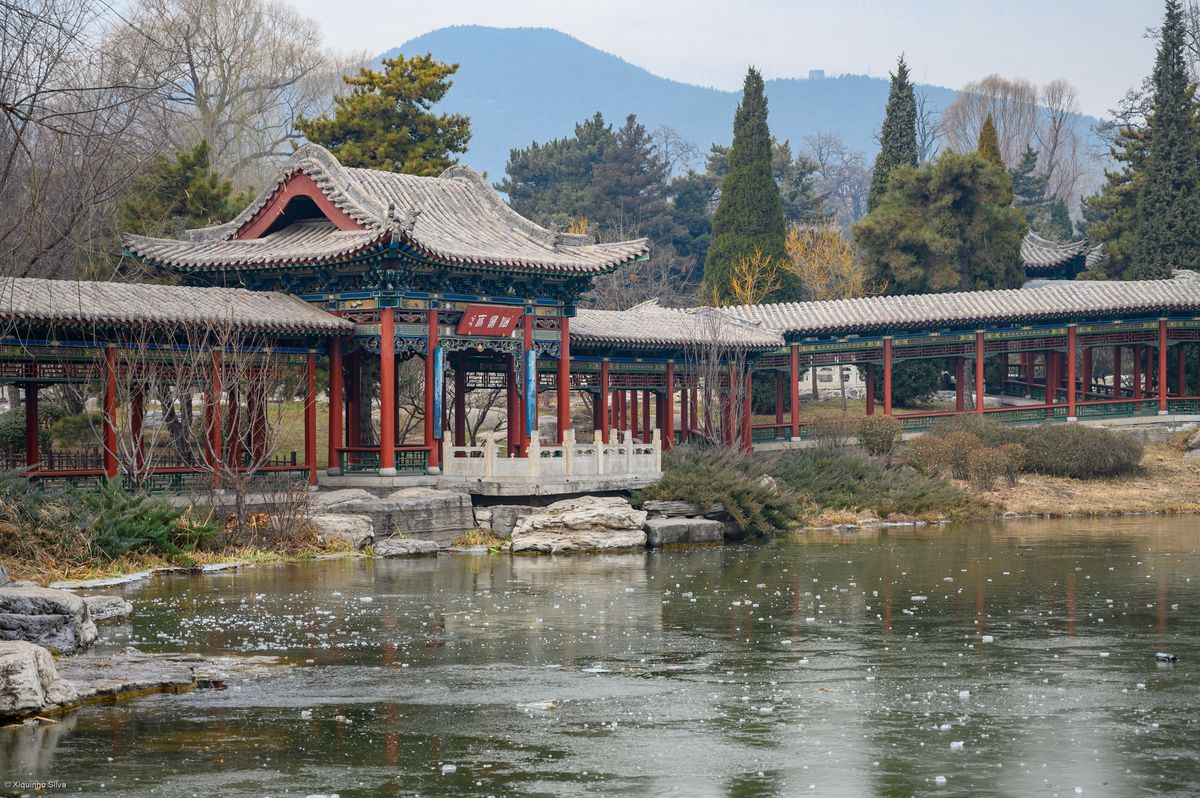
Jinci Temple — its Song-dynasty timber halls are among the finest surviving wooden architecture in China.
Around the hall, the complex rewards a slow wander:
- The Flying Bridge over the Fish Pond (Yuzhao Feiliang) — a rare cross-shaped stone bridge, built with the Song hall, with a square pond beneath.
- The Nanlao Spring — the “everlasting spring” that feeds the pond; its name comes from a legend of a daughter who refused to grow old.
- The 3,000-year-old cypress — a gnarled, tilting Zhou-dynasty tree, older than most of the buildings around it.
- The later halls — a Tang stele and the Hall of the Holy Mother’s neighbor halls add Jin and Ming layers.
Allow two to three hours. Go in the morning on a clear day, when the light is best on the timber and the paintwork, and the tour groups are still thin. Admission is around ¥80 (prices change) — book online ahead on holidays.
The Shanxi Museum
If Jinci is the temple highlight, the Shanxi Museum (山西博物院) is the indoor one — and it’s among the best provincial museums in China. The collection tracks the province’s extraordinary run of history: Bronze Age ritual bronzes, Buddhist sculpture from the great cave sites and temple hoards, tomb ceramics, and an outstanding section on ancient Chinese architecture using models and components, which makes sense for a province with more pre-Ming timber buildings than the rest of the country combined.
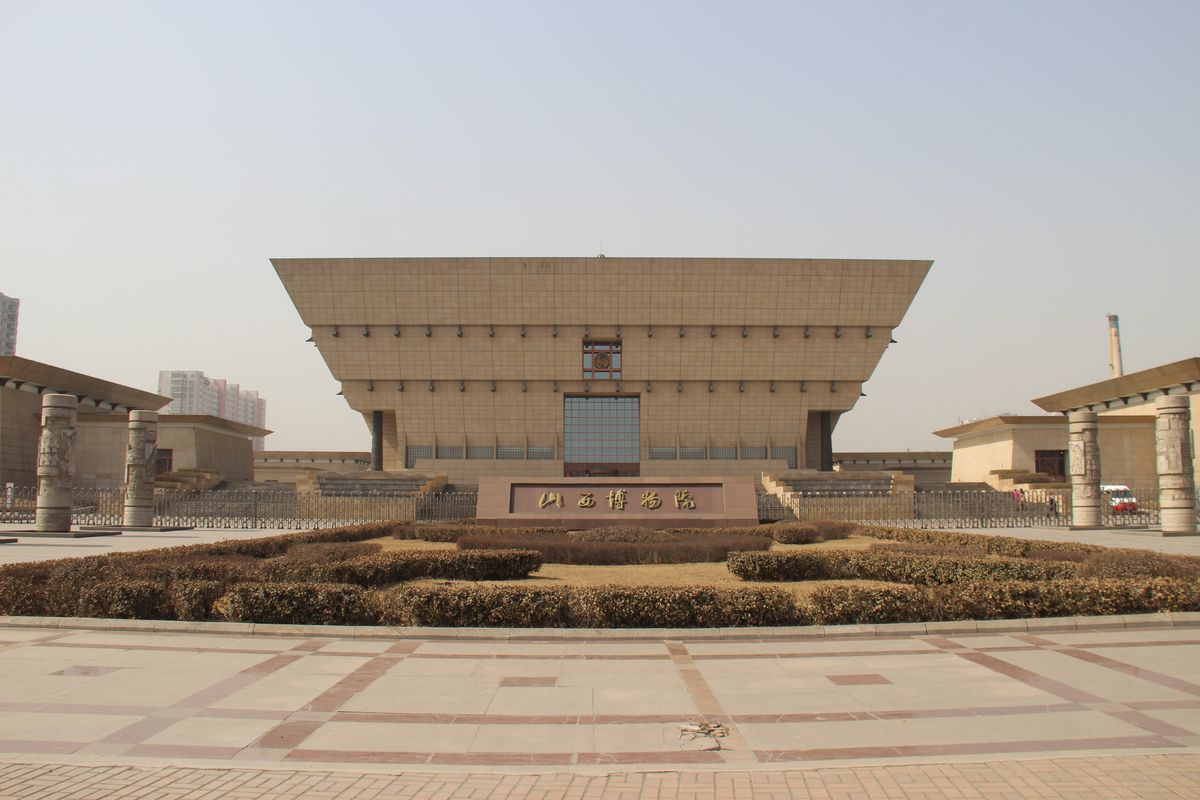
The Shanxi Museum holds one of China’s best provincial collections — strong in Bronze Age bronzes and Buddhist sculpture.
The museum is free but requires a reservation (usually via the official WeChat account, or your hotel can help); bring your passport. Allow two hours, more if you’re a museum person. It’s a short ride from the center and easy to combine with a morning at Jinci if you plan the day around the west side of the city.
Twin Pagoda Temple & the old city
Yongzuo Temple (永祚寺), known as the Twin Pagoda Temple, holds the symbol of Taiyuan: two Ming-dynasty brick pagodas standing side by side. Built in the late 16th to early 17th centuries, they’re about 54m tall, and the east tower leans slightly — a quirk that has become part of the city’s identity. You can climb one of them for a view over the rooftops. The temple grounds, with their peonies in spring, are a pleasant half-hour to an hour.
In the old city, a few sights round out the picture:
- Chongshan Temple — a Ming temple whose surviving gate and Hall of the Great Compassion hold some fine painted sculpture.
- Chunyang Palace — a Taoist temple complex in the center, now a small museum of local arts.
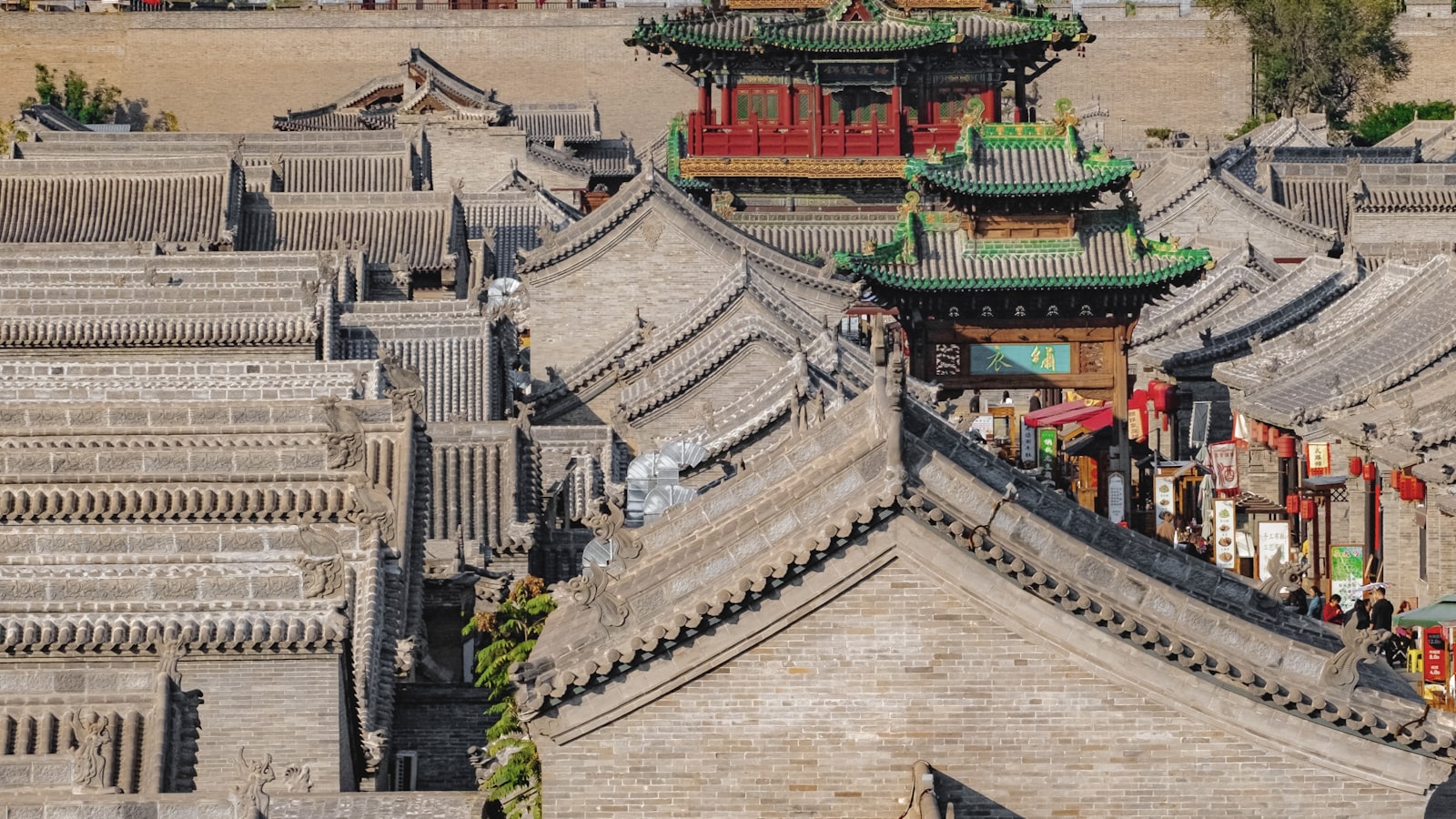
- Taiyuan Ancient County Town — a rebuilt Ming/Qing county town on the southern edge; a popular evening spot with lanterns and food stalls, though it’s a modern recreation rather than an original historic quarter.
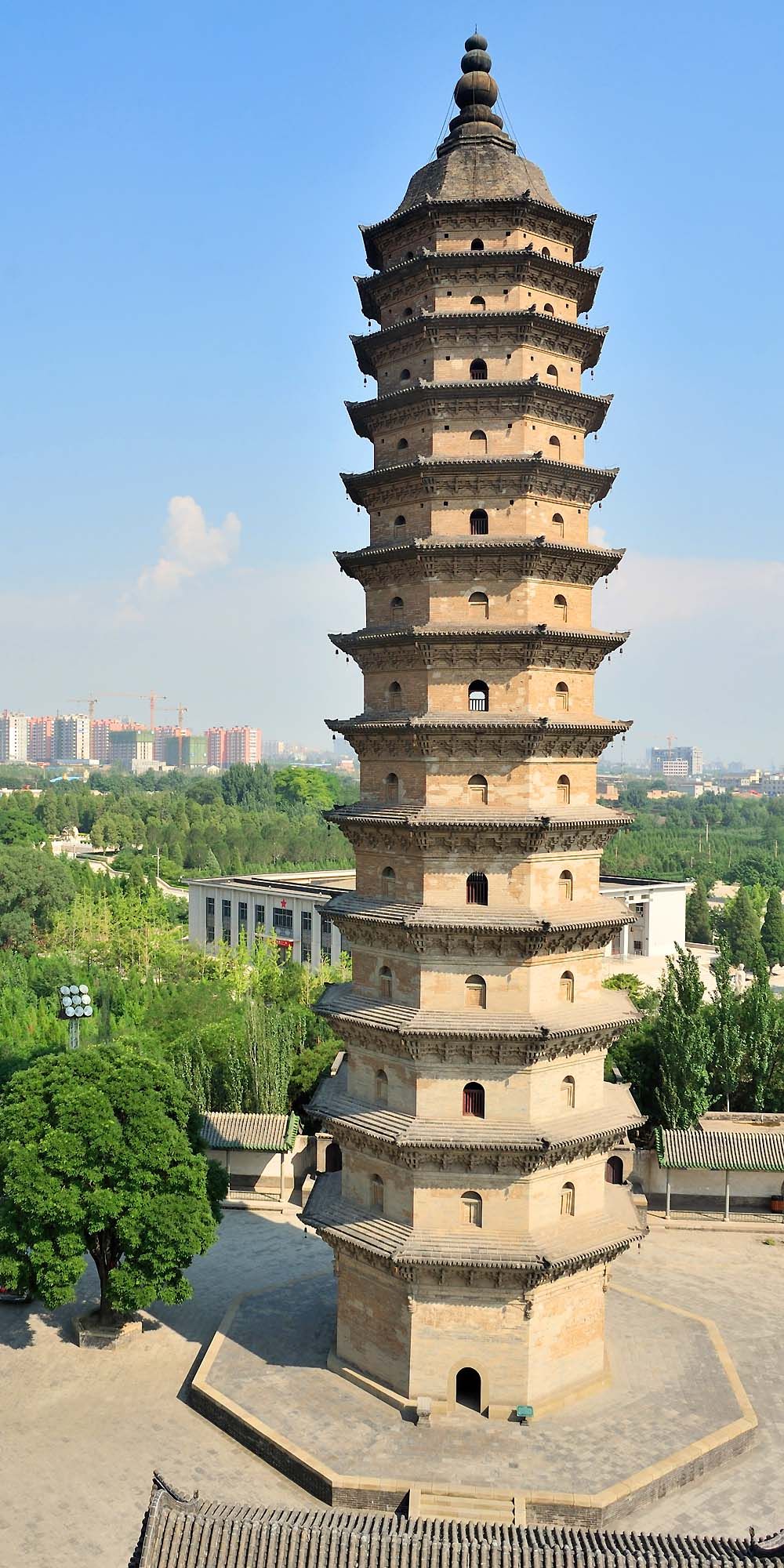
The Twin Pagoda Temple’s leaning Ming towers are Taiyuan’s most recognizable landmark.
The Tianlongshan Grottoes & Mengshan Giant Buddha
With a third day — or an ambitious second — the hills southwest of the city hold two remarkable early Buddhist sites. The Tianlongshan Grottoes (天龙山石窟) are cliff-cut caves from the Eastern Wei and Northern Qi dynasties (6th century), carved with a graceful, refined style considered among the best of the period. Tragically, most of the finest heads and statues were looted and sold abroad in the 1920s; in recent years some have begun to return, and the site is being carefully restored. It’s a beautiful, quiet mountain setting about 40km southwest — take a driver or a taxi.
Nearby, the Mengshan Giant Buddha (蒙山大佛) is a colossal stone Buddha carved into a hillside in the mid-6th century, its head lost long ago and restored in the modern era. It’s one of China’s oldest giant Buddha statues, and the climb to it passes fields and village lanes that feel a world away from the city. Both sites need transport; a private driver for the day is the practical option.
What to eat: the noodle capital
Shanxi is China’s noodle province, and Taiyuan is its heart. The signature is knife-cut noodles (dao xiao mian) — slabs of dough shaved by a knife blade straight into boiling water, served in a rich broth with braised pork, tomato-egg, or a slick of chili oil. Around it, the repertoire is huge: oat noodles (youmian) rolled into “baskets” and dipped in lamb sauce, cat’s-ear noodles, tijian (sharp-shaved noodles), hand-pulled lamian, and the local breakfast soups.
Two things define the flavor of a Taiyuan meal. First, the Shanxi vinegar — the dark, aged, almost smoky local vinegar (老陈醋) that is one of China’s great condiments; it goes on everything, and the province is famous for it across the country. Second, the lamb and wheat: Shanxi sits on the northern edge of wheat country, so the food is heavy on noodles, breads and lamb rather than rice. For the biggest variety, hit the restaurant lanes in the center — the food streets around Liu Xiang and the old quarter — and order several small dishes to share. A full meal is usually 30–60 RMB per person.
When to go, season by season
Taiyuan has a dry, continental climate with four distinct seasons.
- April–May and September–October: the sweet spots — mild, clear, good for the outdoor sites and photography. This is the recommended window.
- June–August: hot and occasionally smoggy, but workable if you start early; the museums and temples are fine, and hotel prices are lower than in coastal cities.
- November–February: cold and dry, with occasional snow; the city is quiet and the hotels cheap, but the outdoor hills (Tianlongshan, Mengshan) can be brisk and some mountain services close.
Avoid the early-October Golden Week if you can — Jinci and the railway stations get very busy.
Where to stay and eat
Taiyuan is a mid-size Chinese capital with straightforward hotel options. Staying near the Fen River or the city center keeps you close to the museum, Chunyang Palace and the food streets; the Taiyuan South station area is practical if you’re arriving and leaving by high-speed rail, since the main lines use that station. Budget hotels run from about ¥150–250 a night, mid-range ¥250–450, and there are plenty of international chains if you want familiar comfort.
For food, the center’s restaurant streets are the place to be. Try knife-cut noodles at a busy local shop (the queues are a good sign), an oat-noodle meal at a Shanxi specialty restaurant, and a bottle of aged vinegar to take home — the local vinegar shops sell it by the jar and it makes a genuinely unusual gift.
A realistic budget
Taiyuan is one of China’s more affordable cities. Rough guidance per person (prices change, treat as planning estimates):
- Hotels: ¥150–250 budget, ¥250–450 mid-range, more for international chains.
- Sights: Jinci about ¥80; Shanxi Museum free (reservation required); Twin Pagoda Temple around ¥30; Tianlongshan and Mengshan roughly ¥50 each; Chunyang Palace a small fee. Allow ¥200–300 across two days of sightseeing.
- Food: noodles and street food ¥15–30; a restaurant meal ¥30–60 per person; a splurge dinner maybe ¥100.
- Transport: the subway and buses are cheap (a few yuan a ride); a taxi across town ¥15–30; a private driver for the day to Tianlongshan and Mengshan around ¥400–600.
Carry a little cash as backup, but Alipay works almost everywhere.
Getting there & around
- Flights: Taiyuan Wusu International Airport (TYN) has good domestic connections and a few regional international routes.
- High-speed rail: the main station is Taiyuan South. From Beijing about 2.5–3 hours, from Datong about 2 hours, from Xi’an about 3 hours, from Pingyao about 40 minutes. Book with your passport through Trip.com or 12306.
- Around town: a metro line plus buses and cheap taxis. Jinci and the museum are reachable by public transport; the mountain sites (Tianlongshan, Mengshan) really need a driver.
Practical tips
- Book Jinci ahead on weekends and holidays — it’s the one sight that fills.
- Reserve the Shanxi Museum online and bring your passport for the free ticket.
- Take a translation app — English signage is limited outside the big sights.
- Set up Alipay and an eSIM before you arrive for payment, ride-hailing and maps.
- Dress for the air quality in winter — Taiyuan’s coal-and-industry history means the air is clearest in spring and autumn.
Combining Taiyuan with the region
Taiyuan is the transport and cultural hinge of the Shanxi ancient-architecture trail. To the north, Datong holds the Yungang Grottoes and the Hanging Temple — about two hours away by high-speed rail. To the south, Pingyao is China’s best-preserved walled city, about 40 minutes away and an easy day trip or overnight. All three cities, plus Wutai Mountain, are strung together on our Black Myth Shanxi route — one of the most rewarding five-day loops in China. Taiyuan works equally well as a stop on a Beijing–Xi’an journey through central China.
Last updated: August 2026. Admission prices, hours and rail schedules change — confirm before you go.
Frequently Asked Questions
Is Taiyuan worth visiting?
Yes — for travelers who want ancient China without the crowds. Taiyuan holds one of China's finest surviving Song-dynasty buildings (the Hall of the Holy Mother at Jinci Temple), one of the best provincial museums in the country, Ming-dynasty twin pagodas, and a food culture — especially noodles and vinegar — that food lovers come for on its own. It's also the natural base for a Shanxi ancient-architecture trip that takes in Datong and Pingyao.
How many days do I need in Taiyuan?
Two days covers the essentials: a day for Jinci Temple (the must-see) plus the Shanxi Museum, and a day for the Twin Pagoda Temple, the old city sights and the food. With a third day, add the Tianlongshan Grottoes or the Mengshan Giant Buddha, both just southwest of the city. Since the high-speed rail is fast, many travelers pass through in a day or two between Datong and Pingyao.
What is Jinci Temple?
Jinci is the single most important sight in Taiyuan — an ancestral temple complex about 25km southwest of the city, built up over more than a thousand years. Its centerpiece is the Hall of the Holy Mother, one of the best-preserved Song-dynasty timber halls in China, with 43 painted clay statues of palace maids. Around it are the rare cross-shaped Flying Bridge over the Fish Pond, the 'everlasting' Nanlao Spring, and a 3,000-year-old cypress. Admission is around ¥80 (prices change).
What food is Taiyuan known for?
Taiyuan is the heart of Shanxi's noodle culture — the province has hundreds of noodle varieties, and the city's signature is knife-cut noodles (dao xiao mian), shaved straight into boiling water. Also try oat noodles (youmian, often rolled into 'baskets' called kao lao lao), cat's-ear noodles, and everything served with a splash of the strong dark Shanxi vinegar, which the region is famous for across China. A full meal of noodles and small dishes is usually 30–60 RMB per person.
How do I get from Taiyuan to Pingyao?
Pingyao's ancient city is about a 40-minute high-speed rail ride from Taiyuan, which makes it the easiest day trip from the city. The train arrives at Pingyao Ancient City station, a short bus or taxi ride from the walls. See our [Pingyao guide](https://chinotrips.com/pingyao/) for the full plan.
What is Taiyuan's history?
Taiyuan is one of China's great ancient capitals, with more than 2,500 years of recorded history. Founded in the 5th century BC, it was the base from which Li Yuan launched the revolt that founded the Tang dynasty in 618, and it was repeatedly a capital or a crucial garrison city. Its nickname is the 'Dragon City,' and its Jin heritage gives Shanxi its single-character abbreviation, 晋. The ancient city was razed and rebuilt more than once, so the historic core you see today is mostly Ming and Qing, with the earlier masterpieces surviving in temples like Jinci.