
Yanbian Korean Prefecture Guide (2026): Korea in China
Yanbian — China's Korean autonomous prefecture: Yanji's Korean food and bilingual streets, Changbai Mountain, and the border towns of Tumen and Hunchun.
Yanji, Yanbian, Jilin, China
Open an external map for this location.
OpenStreetMap Google Maps (opens externally)
Yanbian is the Korean Autonomous Prefecture of Jilin province — the part of China where the street signs are in Korean, the noodles are cold, and the border looks across the Tumen River toward North Korea. It is often sold as “Korea without leaving China,” but the reality is richer: a distinct Korean-Chinese (Joseonjok) culture more than a century old, layered on top of northeast China, and crowned by Changbai Mountain, the sacred volcano whose crater holds Heaven Lake. Here’s how to visit it in 2026.
The essentials
- Days needed: 2–3 days — a day for Yanji’s food and streets, a full day for Changbai Mountain, and a half day for the border towns.
- Getting there: fly into Yanji Chaoyangchuan Airport (YNJ), or take the high-speed rail — about 2 hours from Changchun and 4 hours from Harbin, with direct flights from Seoul making it the closest part of China to Korea.
- Best season: June–September for Changbai Mountain and Heaven Lake; January–February for snow, frozen rivers and crisp border scenery.
- Vibe: bilingual streets, sizzling barbecue and neon karaoke in Yanji, then a quiet, dramatic change of mood at the North Korea border.
Yanji: the bilingual Korean-Chinese capital
Yanji is the prefecture’s capital and the city most visitors mean when they say “Yanbian.” It is a modern Chinese city that runs on two languages. Walk the central streets and nearly every sign appears twice — Chinese first, then Korean — while shopfronts, menus, karaoke bars and TV screens lean heavily toward Korean. Around a third of Yanbian’s population is ethnic Korean, and Korean is one of the two official languages of the prefecture, so you will genuinely hear it spoken on the street, in taxis and in restaurants. This is not a theme-park recreation; it is a living community.
The city hugs the Buerhatong River, and the riverside is the best place to get a feel for it — parks, promenades and joggers by day, and a bright, food-driven night scene after dark. The West Market (Ximarket) and the surrounding streets are the commercial heart, where you will find Korean cosmetics, groceries, hanbok shops and street snacks jostling for space. For a concentrated hit of atmosphere, head to the Yanbian University area and the Korean folk neighborhoods, where students, older Korean-Chinese residents and visitors mix. A couple of evenings of wandering, eating and people-watching is the whole point of Yanji — it is one of those places that rewards a slower, unplanned pace rather than a checklist of sights.
The food: cold noodles, kimchi, and Korean barbecue
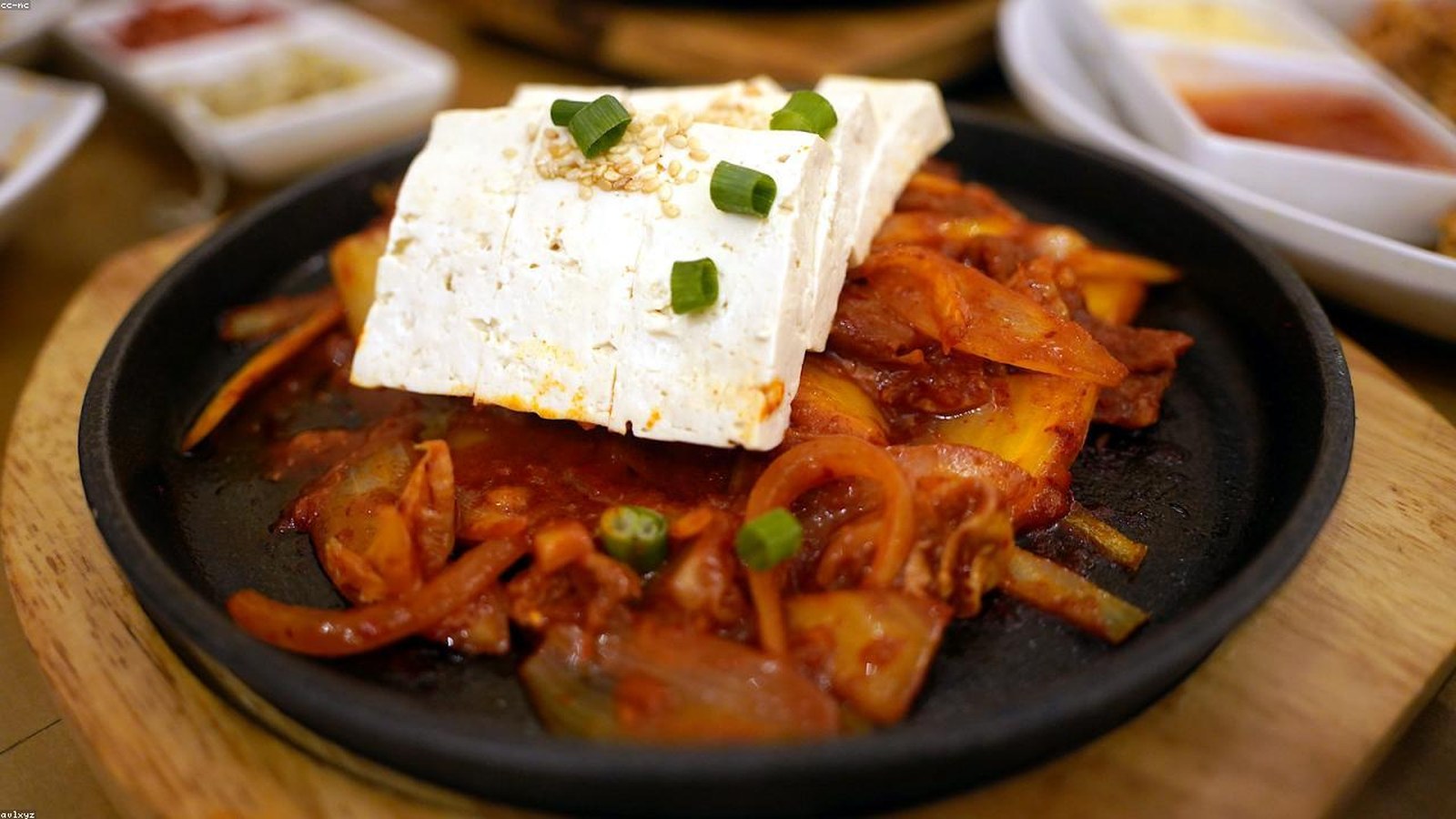
The food is the single best reason to come to Yanbian. This is arguably the strongest Korean-food scene in China, and it comes with a northeastern-Chinese heartiness thrown in.
- Cold noodles (naengmyeon) — Yanbian’s signature dish, and the one locals will insist you try. Buckwheat noodles in an icy, tangy broth, topped with beef, pear, cucumber and a boiled egg, often cut with scissors tableside. The Yanji-style cold noodles are famous across China, and the broth is the make-or-break detail — tart, savory and deeply refreshing. Expect around ¥15–25 a bowl (estimate).
- Korean barbecue — charcoal grills on the table, marinated beef and pork, ssamjang, lettuce wraps and side dishes. Yanji barbecue is a social event, and the late-night grill houses around the university area are some of the best value in the country.
- Kimchi and banchan — the table is never bare. Expect a parade of small dishes with every meal, from napa-cabbage kimchi to pickled radish and seasoned sprouts.
- Bibimbap and rice cakes — mixed rice bowls with gochujang and the chewy, spicy tteokbokki rice cakes, both widely available and consistently good.
- Northeast (Dongbei) dishes — because this is still Jilin, the menu runs both ways: dumplings, sweet-and-sour crispy pork (guo bao rou) and hearty stews sit alongside the Korean classics.
Prices are low by Chinese standards. A filling meal for one runs ¥30–60, a Korean barbecue spread for two ¥100–200, and street snacks ¥5–20. All figures are planning estimates — prices change, so check menus on the day.
Changbai Mountain and Heaven Lake
Changbai Mountain (Changbaishan) — known in Korean as Mount Paektu — is the region’s natural showstopper, a massive stratovolcano straddling the China–North Korea border and sacred in Korean culture. Its summit crater holds Heaven Lake (Tianchi), a deep, otherworldly-blue caldera lake that straddles the international line: you stand on the Chinese side, and part of the lake is North Korean territory. On a clear day the view from the rim is one of the great sights of northeast China; the catch is that the summit is frequently wrapped in cloud, so timing and luck matter.
The mountain is usually reached as a day trip from Yanji (about 2–3 hours by road) or from the resort town of Erdaobaihe closer to the base. Visitors take shuttle buses up to the main scenic areas, then either hike or ride to the crater rim. Below the lake, the mountain offers waterfalls, hot springs, forests and alpine tundra, and in winter it becomes a serious ski destination — the Changbaishan ski resort at the base is one of the best in China, with reliable snow and long runs. Book the mountain and any ski packages in advance in peak season, and check the forecast before committing to the summit — the lake view is weather-dependent.
Note that the mountain is shared with the North Korean side, but access from China is straightforward and entirely on the Chinese side of the border. Your passport is needed for tickets and entry, so carry it with you.
The border towns: Tumen, Hunchun, and views toward North Korea
The border is the other half of Yanbian’s appeal — a chance to stand on the Chinese side and look across at one of the world’s most isolated places.
- Tumen — a small city on the Tumen River, which forms the border with North Korea. It is one of the most accessible places to view North Korean territory from China: a bridge spans the river (with viewing areas on the Chinese side), and the riverbank offers long, quiet views across to the far shore. You are looking at North Korean land and, at times, small villages or watchpoints across the water — not a city skyline — but the sense of standing at the edge of two very different worlds is powerful.
- Hunchun — further east, near the point where China, North Korea and Russia meet. The Fangchuan area marks this tri-point, with a viewing tower and a monument; on a clear day you can take in three countries from a single vantage point. Hunchun is also a growing trade town with its own Korean-Chinese character and a gateway to the Russian border at Kraskino.
- Border-viewing rules — a China-side border visit is perfectly legal and a normal part of the local tourism circuit. But photography of border installations, guards and military facilities is restricted, and you should follow local signs and any instructions from staff without argument. Stick to the designated viewpoints and you will have no trouble. Take it as a scenic and geopolitical experience rather than an attempt to document the other side up close.
The towns are straightforward day trips from Yanji by road or rail, and many visitors combine Tumen and Hunchun into a single border-focused day.
Korean-Chinese culture and history
What makes Yanbian feel different from the rest of China is the Joseonjok — the ethnic-Korean community whose roots here go back more than a century. Large-scale Korean migration into what is now northeast China began in the late 19th and early 20th centuries, driven by hardship in Korea and opportunity on the Chinese side; the community grew through the Japanese colonial era and was formally recognized after the founding of the People’s Republic, when Yanbian Korean Autonomous Prefecture was established in 1952. Today it remains the largest Korean community in China, with its own schools, media, and cultural institutions.
The result is a hybrid identity that is neither simply “Korean” nor simply “Chinese.” The language is Korean (with a distinct local accent), the food is Korean-Chinese, and the culture has absorbed both Korean traditions and northeastern Chinese life. You will notice it in small ways — the bilingual school signs, the Korean-language newspapers, the hanbok shops next to Chinese pharmacies. It is worth remembering that this is a Chinese-Korean culture, related to but not identical with South Korea; a South Korean visitor would find it familiar but also distinctly its own. That specificity is exactly what makes Yanbian worth the trip.
Best season and weather
Yanbian has a classic northeast Chinese climate: a short, warm summer and a long, cold, snowy winter.
- Summer (June–September): warm and green, with the best odds of a clear summit at Changbai Mountain and a genuine alpine escape at the lake. This is the peak season for the mountain and for outdoor travel.
- Autumn (October): brief and beautiful — crisp air, golden forests, and sharp light over the border rivers. A short, underrated window.
- Winter (November–March): cold, with January–February the signature season. The rivers freeze, snow covers the border scenery, and Changbaishan becomes a ski destination. Temperatures in January routinely sit well below freezing — pack a proper down jacket, thermals, hat and gloves — but the frozen landscape and the mountain’s snow are worth the cold.
- Spring (April–May): a slow thaw; the mountain trails may still be snowbound early in the season.
For most visitors, the choice is simple: come in summer for the lake and comfortable travel, or in deep winter for snow, skiing and the frozen border.
Getting there
Yanbian is remote — it is literally China’s northeastern corner — but it is well connected by air and rail.
- By air: Yanji Chaoyangchuan Airport (YNJ) has flights from Beijing, Shanghai, Shenyang and other Chinese cities, plus the crucial direct flights from Seoul (about 2 hours). Because Seoul is the closest major international hub, many foreign visitors route through Korea — flying Seoul–Yanji is often the fastest and cheapest way in from outside China.
- By high-speed rail: Yanji sits on the HSR network. It is about 2 hours from Changchun, the Jilin provincial capital covered in our Changchun guide, and about 4 hours from Harbin, the great northeast hub in our Harbin guide. Connections run onward to Shenyang and beyond. For booking and navigating China’s rail system as a foreigner, read our step-by-step train ticket guide.
- Getting around once there: DiDi (China’s ride-hailing app) and local taxis are cheap and plentiful in Yanji. Changbai Mountain is 2–3 hours by road, and Tumen and Hunchun are easy day trips. Note that border and mountain areas are more remote than the city — check road conditions in winter.
Because this is a border region, mobile connectivity can be patchier than in the big cities and you will want reliable data for maps and translation near the border. Our guide to getting mobile data in China covers eSIMs and local SIMs so you are not stranded offline.
A suggested 2–3 day itinerary
- Day 1 — Yanji: arrive and settle in. Spend the afternoon wandering the bilingual streets and the West Market, walk the riverside at dusk, and make dinner the centerpiece — cold noodles followed by Korean barbecue, then the late-night street food around the university area.
- Day 2 — Changbai Mountain: take the full-day trip to the mountain. Aim for the crater rim and Heaven Lake early, then the waterfalls and forests. In winter, swap the lake for a ski day at the Changbaishan resort. Return to Yanji for a relaxed evening.
- Day 3 — the border: head to Tumen for the river views and the bridge, then on to Hunchun and the Fangchuan tri-point if time allows, where China, North Korea and Russia meet. Return to Yanji for a final Korean-Chinese meal before departure.
With only two days, drop the border day or compress it into a half-day at Tumen; the mountain and Yanji’s food are the two essentials.
Practical tips
- Border photography rules: photography of border installations, guards and military facilities is restricted. Stay in the designated viewing areas, follow signs and staff instructions, and do not use drones anywhere near the border.
- Language: Korean and Mandarin are both official in Yanbian, but as a visitor you will mostly use Mandarin (with translation apps) plus basic Korean. English is limited even by Chinese standards — download an offline translation app and keep it ready.
- Money and payment: it is a cash-and-app economy like the rest of China; Alipay and WeChat Pay are standard, and you should set them up before you arrive. Carry your passport — you need it for hotels, train tickets, the mountain and any border-area checks.
- Pack for the season: in winter, a real down jacket, thermals, hat and gloves are non-negotiable; even in summer, the Changbai summit is cold and windy — bring a layer.
- Book ahead in peak season: Changbai Mountain entry, ski packages and weekend hotels sell out in July–August and over the winter holidays. Confirm current prices, tickets and border access rules on the day.
Last updated: August 2026. Border access rules, mountain conditions and transport change — confirm before you go.
Frequently Asked Questions
What is Yanbian and why visit it?
Yanbian is the Korean Autonomous Prefecture of Jilin province — China's Korean heartland, where around a third of residents are ethnic Korean. The capital, Yanji, feels like a Korean city inside China: street signs are bilingual (Chinese and Korean), the food is Korean-Chinese (kimchi, cold noodles, barbecue, bibimbap), and you'll hear Korean spoken everywhere. It's a fascinating cultural pocket, and it's the main Chinese gateway to Changbai Mountain (Mount Paektu) — the sacred volcano and Heaven Lake on the North Korea border.
Does Yanji feel like being in Korea?
Partly — and that's the draw. Yanji's Korean identity is visible in the bilingual signage, Korean-language TV and shops, and the food culture. But it's distinctly Chinese-Korean (Joseonjok), not South Korean: the accent, some dishes, and the atmosphere reflect a century of Korean settlement in northeast China. You'll get Korean-style cold noodles, kimchi, and barbecue alongside Chinese northeastern specialties. It's best understood as its own hybrid culture — 'Korea in China' is the headline, but the reality is richer and more specific.
What are the top things to do in Yanbian?
The food is reason enough — Yanji's Korean restaurants serve some of China's best cold noodles (naengmyeon), Korean barbecue, kimchi, and rice cakes. Changbai Mountain (Changbaishan) is the region's natural wonder — a massive volcano with the stunning Heaven Lake (Tianchi) crater lake on the China–North Korea border. The border towns are unique: Tumen offers a bridge and viewpoints toward North Korea, and Hunchun sits at the point where China, North Korea and Russia meet. Yanji itself is a lively, modern city with a great riverside and night food scene.
How do I get to Yanbian?
Fly: Yanji Chaoyangchuan Airport has flights from Beijing, Shanghai, Seoul (the closest major international hub), and other Chinese cities. High-speed rail: Yanji is on the HSR network — about 2 hours from Changchun, 4 hours from Harbin, and connected to Shenyang and beyond. From South Korea, there are direct flights from Seoul (about 2 hours), making Yanbian a natural first stop if you're coming from Korea. Once there, DiDi and local taxis work well; Changbai Mountain is 2–3 hours by road from Yanji.
Can I see North Korea from Yanbian?
Yes, from the border towns — with caveats. In Tumen, you can look across the Tumen River to North Korean territory (a bridge and viewpoints make this accessible). Hunchun's Fangchuan area marks the tri-point where China, Russia and North Korea meet, with a viewing tower. You're seeing North Korean land across a river, not a city skyline — it's a scenic and geopolitically fascinating view rather than close-up urban observation. Photography of border installations is restricted; follow local rules and signs. A China-side border visit is perfectly legal and common for tourists.