
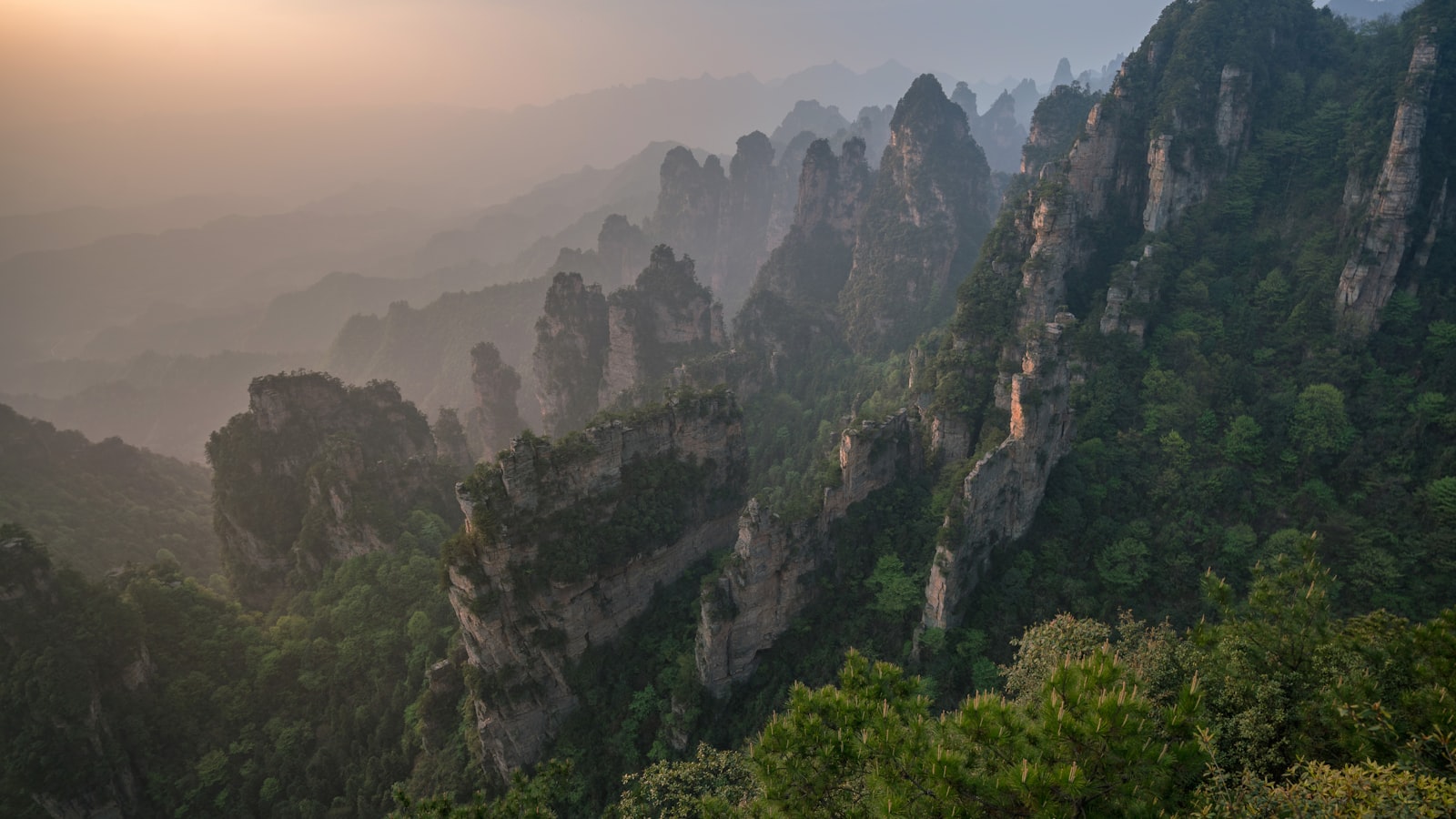
Chengdu, Leshan, Emei & Jiuzhaigou: A 6-Day Sichuan Route
Sichuan's greatest hits — pandas in Chengdu, the Giant Buddha at Leshan, Mount Emei's sunrise, then Jiuzhaigou's turquoise lakes. A day-by-day 6-day plan.
OpenStreetMap Google Maps (opens externally)
Sichuan is China’s most scenically diverse province — pandas in Chengdu, the world’s largest Buddha at Leshan, a holy mountain sunrise on Emei, and the impossibly blue lakes of Jiuzhaigou. This six-day loop packs them all in without making any one day a marathon.
The route at a glance
| Day | Destination | Focus |
|---|---|---|
| 1 | Chengdu | Pandas, hotpot |
| 2 | Chengdu | Old streets, teahouse |
| 3 | Leshan → Mount Emei | Giant Buddha, up the mountain |
| 4 | Mount Emei | Golden Summit sunrise, descend |
| 5 | Jiuzhaigou | The valley (overnight nearby) |
| 6 | Jiuzhaigou | Second pass, fly back |
Day 1 — Arrive in Chengdu
- Morning: if you land early, go straight to the Giant Panda Research Base — pandas nap by mid-morning, so arrive at opening.
- Afternoon: a teahouse in People’s Park to ease into Sichuan pace.
- Evening: your first hotpot — start mild if you’re new to the numbing spice. Full guide: Chengdu.
Day 2 — Old Chengdu
- Morning: Jinli Street and the Wuhou Shrine.
- Afternoon: the food lanes around Kuanzhai Alley, or a panda base repeat if you skipped it.
- Evening: stock up and pack for tomorrow’s early start.
Day 3 — Leshan & up Mount Emei
- Morning: high-speed rail from Chengdu to Leshan (about 1 hour), then the Giant Buddha — the riverside walkway and the boat view. See our Leshan guide.
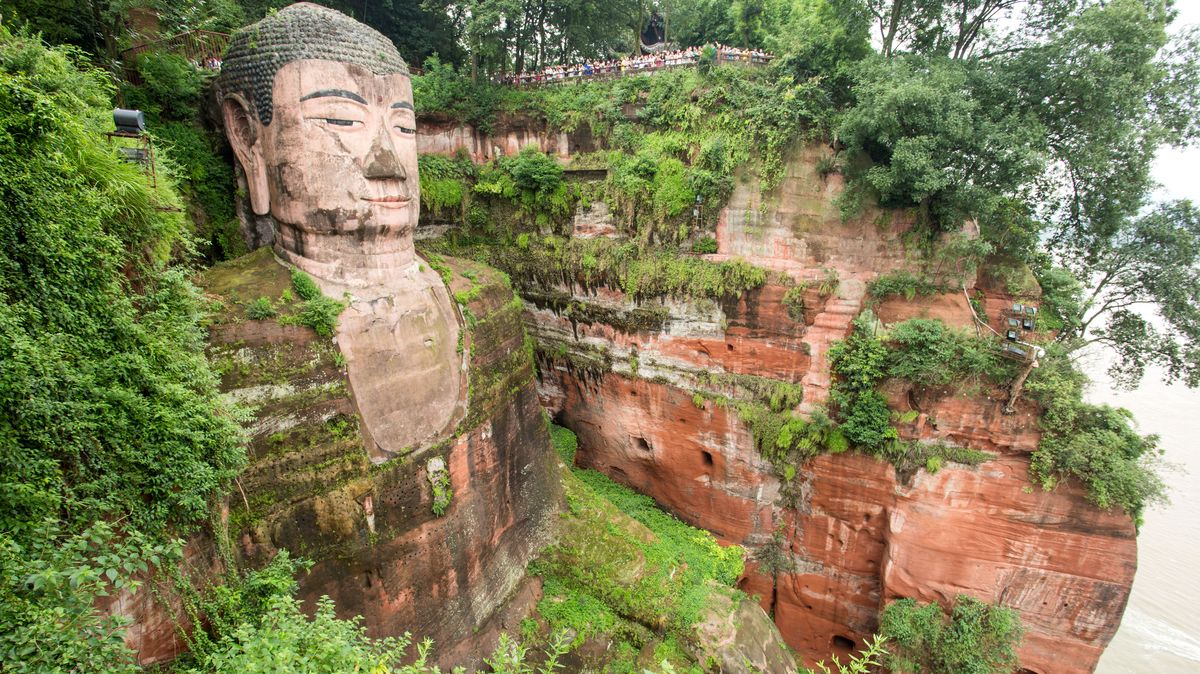
The Leshan Giant Buddha is the world’s largest stone Buddha, carved into a cliff at the confluence of three rivers — see it from the walkway and from a boat.
- Afternoon: onward to Mount Emei’s base (about 30 minutes), then take the cable car up to the summit area.
- Night: stay near the summit so you’re in place for sunrise. Full guide: Mount Emei.
Day 4 — Emei sunrise & back to Chengdu
- Dawn: the Golden Summit — the cloud sea and, on clear days, snow peaks far beyond.
- Morning: descend past Wannian Temple and the monkeys, and catch a train or afternoon flight back to Chengdu.
- Evening: fly to Jiuzhaigou Huanglong or take the evening flight the next morning.
Day 5 — Jiuzhaigou valley
- Morning: into the park early — shuttle to Long Lake first, then work down through Five Flower Lake and the classic stretches. See our Jiuzhaigou guide.
- Evening: stay in Zhangzha town just outside the park entrance.
Day 6 — A second pass, then home
- Morning: cover the Nuorilang Waterfall and the lower valley if you didn’t see them yesterday.
- Afternoon: shuttle to the airport and fly back to Chengdu for your onward connection — or, with more time, continue to Chongqing.
Short on time? Cut the second Jiuzhaigou day and do the valley in one efficient day. With less time still, drop Emei and see the Buddha as a day trip from Chengdu.
Chengdu in depth
Chengdu is the most laid-back of China’s big cities, and it rewards slowing down. The Giant Panda Research Base (about 40 minutes from the center) is the morning draw for a reason: the pandas are most active at feeding time, roughly 8–10am, after which they nap in the heat. Arrive at opening, walk the loop to the nursery and the adult enclosures, and you’ll catch them eating bamboo and, in the breeding season, cubs in the nursery. Later in the day the same enclosures are mostly sleeping pandas — still charming, but the morning is the real show.
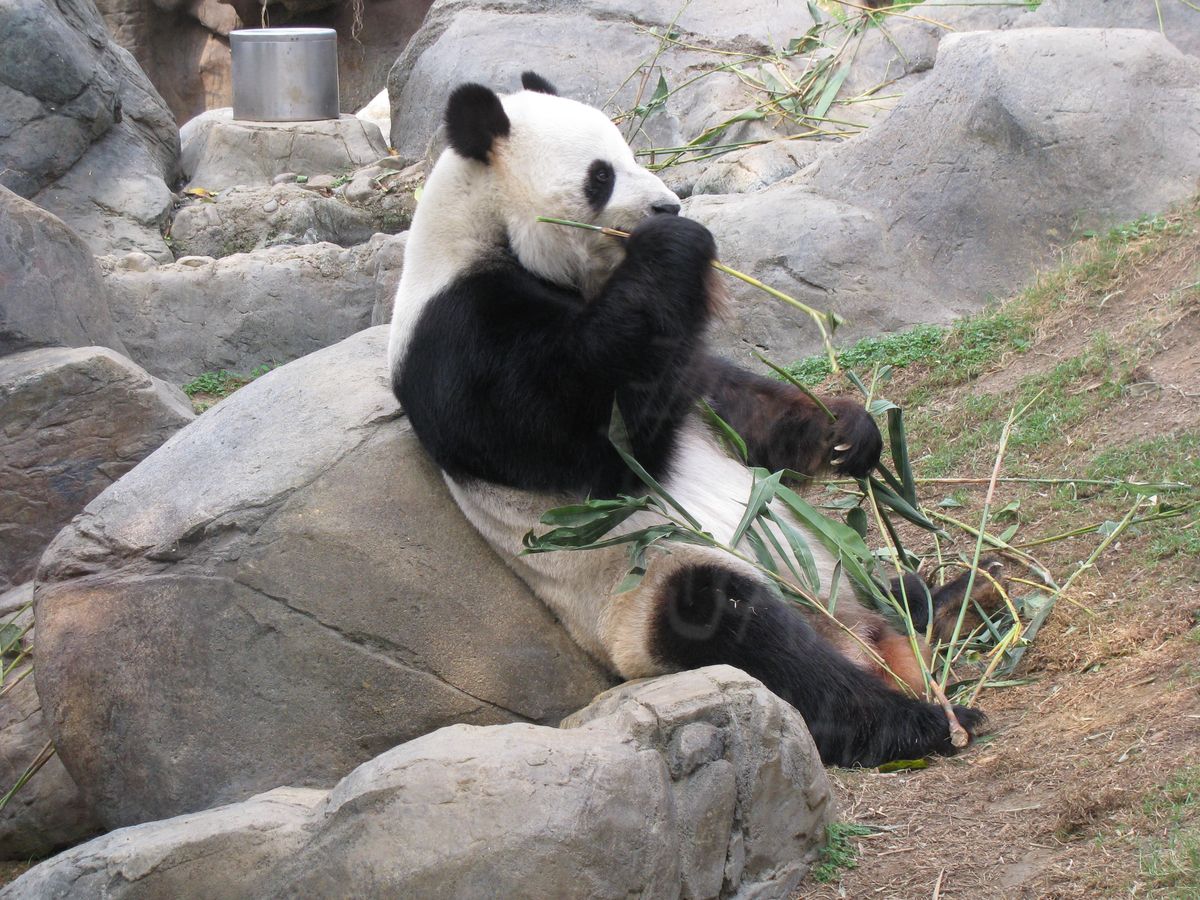
The pandas at Chengdu’s research base are most active at the morning feeding window, roughly 8–10am — after that, they nap.
The other essential Chengdu experience is the teahouse. People’s Park, in the center, is the classic spot: a bamboo chair under the trees, a cup of jasmine tea, and an afternoon of watching the city do nothing in particular — a pace that makes sense once you’ve eaten Sichuan food. The city’s UNESCO “City of Gastronomy” title is not hype: hotpot (choose a mild broth if you’re new to the numbing spice), mapo tofu, dandan noodles and gongbao chicken are the canon, and the food lanes around Jinli Street and Kuanzhai Alley concentrate the hits. Jinli also holds the Wuhou Shrine, dedicated to the strategist Zhuge Liang of the Three Kingdoms, whose stories are woven through Chinese culture.
Jiuzhaigou in depth
Jiuzhaigou — the “Valley of Nine Villages” — is a UNESCO World Heritage Site and the most stunning single natural sight on this route. The park is laid out in a Y-shape of three valleys — Rize, Zechawa and Shuzheng — threaded by travertine-dammed lakes so clear that the water seems to hold their color suspended in it. The famous names are real: Five Flower Lake, where fallen trees lie visible in the impossibly blue water; Long Lake at the top of Zechawa Valley, the highest and largest; Panda Lake and Five Colored Pond; and Nuorilang Waterfall, about 270 meters wide and one of the widest in China.
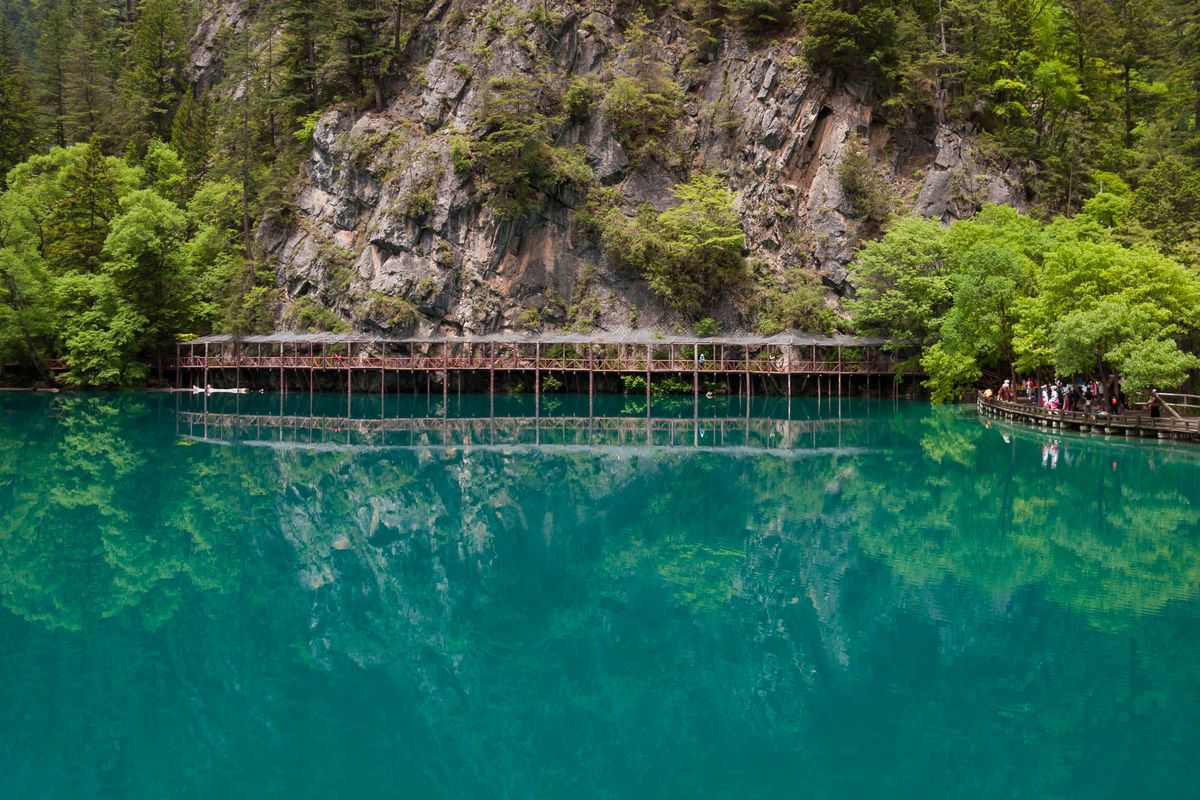
Jiuzhaigou’s travertine-dammed lakes hold their impossibly blue color suspended in clear water — most vivid on a morning visit before the sun gets high.
The park runs a shuttle-bus system that makes it manageable in one or two days: buses carry you from the entrance up each valley, and you walk the trail sections between stops and re-board. The classic efficient pattern is to take the shuttle to the top of one valley, then walk down through the best lakes. Boardwalks keep the trails flat and easy — this is the gentle half of the route, a relief after Emei’s stairs.
The one constraint is altitude: the valley floor is around 2,000m and the highest points near 3,100m. Most visitors are fine, but go slowly, hydrate, and don’t sprint the trails. And the light matters — lakes are most colorful in the morning before the sun gets high, and October’s golden forests are the single best reason to time a trip for autumn.
When to go, season by season
- April–May (spring): the valleys are freshly green and the pandas are out; weather is mild with some rain. Good, but not the peak.
- June–August (summer): warm and lush, with Jiuzhaigou’s water at its fullest; this is also school-holiday season, so expect crowds. Chengdu is hot and humid.
- September–October (autumn): the definitive window. Jiuzhaigou’s forests turn gold through October, Emei has its best clear-sky chances, and temperatures are perfect. Book everything well ahead.
- November–March (winter): Jiuzhaigou stays open but is cold and can be icy; some passes and Emei’s summit can close in snow. Fewer visitors and lower prices, but check current access before planning.
A realistic budget
Sichuan is affordable, and the two big-ticket items are the transport to Jiuzhaigou and the Emei cable cars.
- Sights: panda base about ¥55; Leshan Giant Buddha ¥80; Mount Emei entry about ¥160 plus cable cars (about ¥50–120 each leg); Jiuzhaigou ticket about ¥190 in peak season plus the mandatory shuttle ~¥90. Allow ¥700–1,000 total across the six days.
- Transport: Chengdu–Leshan rail ¥50–60; the Chengdu–Jiuzhaigou flight ¥500–900 if booked ahead; Jiuzhaigou airport shuttle to the park about ¥100. Total ¥800–1,400.
- Hotels: Chengdu ¥300–600 per night; the Emei summit hotel ¥400–900 (the premium is location); Zhangzha town at Jiuzhaigou ¥250–500. Six nights roughly ¥2,500–4,500.
- Food: Chengdu is one of China’s best-value food cities — ¥40–80 per person for a proper meal, hotpot more with a group.
A realistic 6-day mid-range total, excluding international flights, is roughly ¥4,500–7,500 per person. All figures are estimates — confirm current prices, especially at Jiuzhaigou, which has seasonal tiers.
Common mistakes to avoid
- Missing the panda feeding window. Arrive at opening or the pandas will be asleep; a midday visit to the base is a visit to napping animals.
- Squeezing Emei and Leshan into a rushed single day. The route does it as a full day, but the Emei sunrise requires staying at the summit — arriving late afternoon is the minimum.
- Not booking the Emei summit hotel and cable car. Both sell out in peak season; book as soon as your dates are firm.
- Doing Jiuzhaigou without the shuttle plan. The valley is huge; without the bus route you’ll walk the wrong bits and miss the best lakes.
- Booking the Jiuzhaigou flight late. The Chengdu–Jiuzhaigou route is the time-saver on this trip, and last-minute prices are painful.
- Forgetting the altitude at Jiuzhaigou. At 2,000–3,100m it’s mild, but a rushed first hour at the top of the valley can bring on a headache; hydrate and take the boardwalks at a stroll.
Practical tips
- Book the Emei cable car and summit hotel ahead — both sell out in peak season.
- Altitude: Jiuzhaigou sits around 2,000–3,100m. Most people are fine, but go slowly and hydrate. See our altitude notes in the Jiuzhaigou guide.
- Trains and flights: book rail with your passport via Trip.com; the Chengdu–Jiuzhaigou flight is the time-saver on this route. How to book trains.
- Payment and data: set up Alipay and an eSIM before you leave — Alipay and eSIM.
Where this route fits
Sichuan is a fantastic add-on to the classic Beijing–Xi’an–Shanghai line — see the 10-day golden triangle with Chengdu or the full 14-day route. For the whole picture of the province, see the Sichuan guide.
FAQ highlights
- Is 6 days too packed? It’s full but not rushed — the only long travel day is the flight to Jiuzhaigou.
- Do I need hiking gear? Emei involves stairs; Jiuzhaigou is flat boardwalks. Good shoes are enough.
- Can I skip Jiuzhaigou? If you’d rather trade it for a slower Chengdu/Leshan/Emei pace, that works too — Jiuzhaigou is the most travel-heavy stop.
Last updated: August 2026. Flight and cable car schedules change — confirm before you travel.
Frequently Asked Questions
How many days do I need for this Sichuan route?
Six days covers it: one in Chengdu, one for Leshan and Mount Emei, one for the Emei sunrise, and two for Jiuzhaigou including the travel days. Add a seventh if you want a slower pace or a spare Jiuzhaigou day.
Can I do Leshan and Mount Emei in one day?
As a full day, yes — but you'll arrive at Emei's base in the evening. For the sunrise you need to reach the summit area by the afternoon. If you'd rather not rush, give Emei its own day and see our [Mount Emei guide](https://chinotrips.com/mount-emei/).
How do I get to Jiuzhaigou from Chengdu?
The easiest way is a 45-minute flight to Jiuzhaigou Huanglong airport, then a shuttle to the park. The land route is an 8+ hour drive that's scenic but long. See our [Jiuzhaigou guide](https://chinotrips.com/jiuzhaigou/).
Is Jiuzhaigou worth the trip?
Yes — the turquoise lakes and waterfalls are unlike anywhere else in China, and the park's shuttle system makes it easy to cover a lot in one or two days. It's the single most stunning natural sight on this route.
When should I go for the best Emei and Jiuzhaigou weather?
Autumn (September–October) is ideal for both — Jiuzhaigou's forests turn gold and Emei's summit has its best chances of clear skies. Spring is the runner-up. See our [weather guide](https://chinotrips.com/how-to/weather-packing-by-season/).