

Kunming Guide (2026): Stone Forest, Dianchi & Spring City
Kunming, Yunnan's mild 'Spring City' — the Stone Forest day trip, Dianchi Lake, Green Lake and the climate that makes it pleasant year-round.
OpenStreetMap Google Maps (opens externally)
Kunming, the capital of Yunnan province, is China’s “Spring City” — a mild, flower-filled city that stays pleasant almost all year.
It rarely appears on first-timer itineraries, but Kunming is the natural gateway to southwest China: the jumping-off point for Dali, Lijiang and the rice terraces of Yuanyang, and a genuinely comfortable city in its own right. This guide covers the essentials.
Overview
Kunming sits on a plateau around 1,900 meters above sea level, which is exactly why the climate stays so moderate: warm days, cool nights and sunshine most of the year. The city blends modern Chinese development with Yunnan’s diversity — the province borders Vietnam, Laos and Myanmar, and its food and markets reflect that mix.
For a traveler, Kunming works as a one-to-two-night city stop with a famous day trip attached. The Stone Forest (Shilin) is the headline, but the lakes, parks and markets around town reward an easy-going day too. It’s also a genuinely good food city: Yunnan’s cuisine draws on the province’s ethnic diversity and mild climate, from wild mushrooms to rose-flavored pastries, and the local coffee scene is the most developed in China.
How many days
Two to three days covers the essentials. A workable plan:
- Day 1: arrive, walk Green Lake (Cuihu) Park, and wander the Flower and Bird Market and old town lanes.
- Day 2: full-day trip to the Stone Forest.
- Day 3 (optional): Dianchi Lake and the Western Hills in the morning, then continue to your next stop — most travelers head to Dali. If you’re traveling onward by train, Kunming’s rail station has frequent departures to Dali, Lijiang and Chengdu, so the timing is easy to make work.
Suggested itinerary
A 2-day plan:
- Day 1 — Around the lake: Green Lake Park and the Flower and Bird Market in the morning, then an afternoon around Dianchi Lake — the Dragon Gate grottoes or a lakeside walk.
- Day 2 — Stone Forest: a full-day trip to the Stone Forest (Shilin), about 90 minutes away, back in time for dinner.
Have more time? Add a day for a Yunnan detour toward Dali and Lijiang — see our Yunnan route.
Best time to visit
- Spring (February–April): flowers everywhere — the city’s plum, camellia and cherry blooms are at their best, and the weather is ideal.
- Autumn (September–November): clear, dry and comfortable — a reliable window for the Stone Forest.
- Summer (June–August): warm with regular afternoon showers, but still mild compared with eastern China’s humidity.
- Winter (December–January): dry, sunny and cool; nights can drop close to freezing, but days are pleasant.
Top sights
- Stone Forest (Shilin) — a UNESCO World Heritage Site of towering limestone pillars, some shaped like towers, animals and figures. The “Greater Stone Forest” is the main loop; go early.
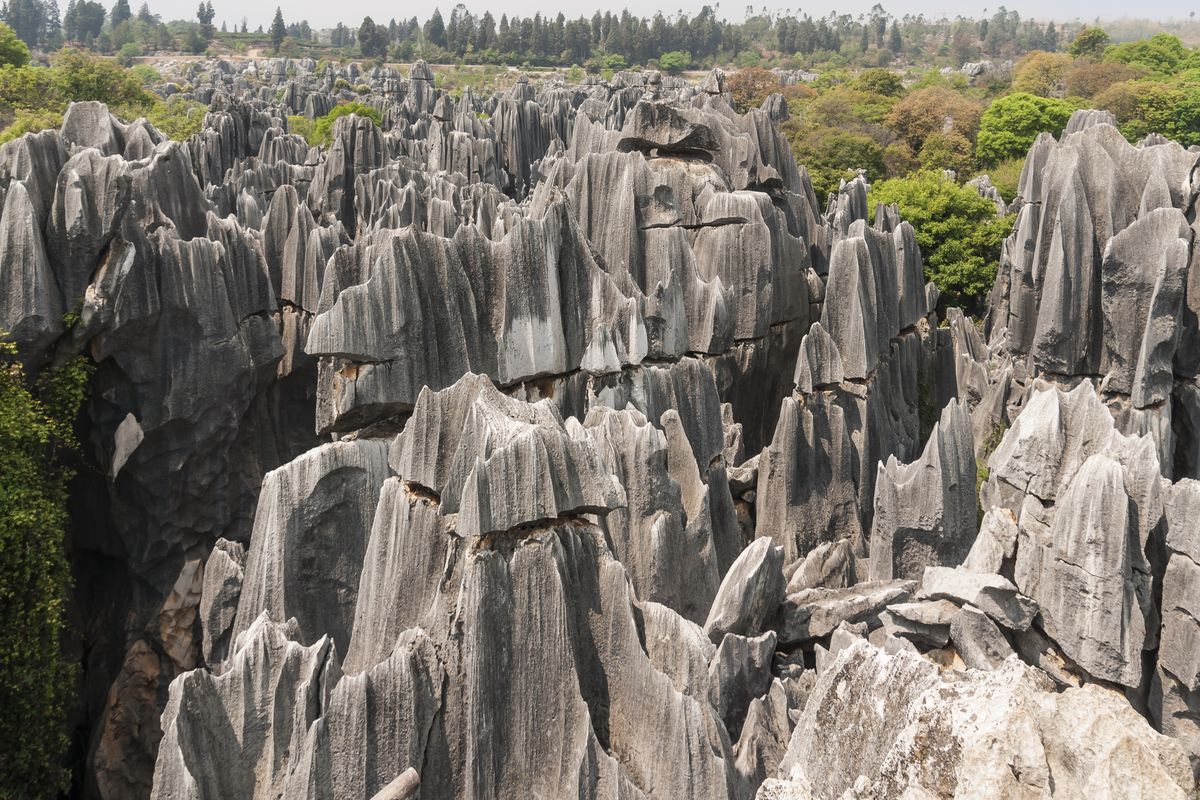
The towering limestone pillars of the Stone Forest (Shilin), a UNESCO site about 90 minutes from Kunming. 2. Dianchi Lake — the largest lake in Yunnan, stretching along the city’s south side. The Western Hills climb above it gives the classic panorama.

Dianchi Lake, Yunnan’s largest lake, with the Western Hills on the far shore. 3. Green Lake Park (Cuihu) — the relaxed heart of the city, ringed by willow trees, teahouses and, in winter, thousands of gulls.

Green Lake Park in Kunming, the willow-ringed heart of the city. 4. Flower and Bird Market — a lively old-town market street for flowers, tea, handicrafts and street snacks. 5. Yuantong Temple — one of the city’s oldest Buddhist temples, tucked into a leafy hollow near the old town.
Getting there
- By rail: high-speed trains connect Kunming with Chengdu in about 3 hours, with Guilin roughly 4–5 hours away and routes from most eastern hubs. Book with your passport — see our train guide.
- By air: Kunming Changshui International Airport (KMG) is a major hub with flights from across China and some international routes.
Getting around
- Metro: Kunming’s metro covers the airport, the rail station and most central sights — the easiest way to get around.
- Buses & Didi: cover the gaps, including the lakeside areas.
- To the Stone Forest: day-trip buses and trains run from the city; many travelers take a seat on an organized shuttle or a private car for the simpler door-to-door option. A high-speed train now serves the Stone Forest area, making the round trip faster than the old road transfer, though the shuttle remains the most straightforward option.
Kunming in depth: why the climate is so good
Kunming’s nickname, the “Spring City” (春城), is earned rather than claimed. The city sits on the Yunnan-Guizhou Plateau at about 1,900 meters, which tempers the heat of lower-lying southern China. Its latitude keeps days warm, while the altitude keeps nights cool — a combination that produces an unusually narrow temperature range across the whole year. Average daytime highs hover around 15–24°C in most months, which is why Kunming rarely feels either scorching or freezing.
The trade-off is that the plateau weather is changeable. Bright mornings can give way to sudden afternoon showers, especially in summer, and the ultraviolet is strong because the air is thin and clear. Locals joke that you can experience four seasons in one day — the practical takeaway is to pack layers, carry a light rain jacket, and use sunscreen even when it does not feel hot. The dry winter months (roughly November to March) bring crisp, sunny days and cold nights, occasionally dipping near freezing, while summer afternoons deliver most of the city’s rainfall.
What to eat in Kunming
Kunming is a genuinely underrated food city, shaped by Yunnan’s ethnic diversity and its mild climate.
- Cross-bridge rice noodles (过桥米线): the signature dish — a bowl of chicken broth brought to the table boiling, into which you add raw slices of meat, vegetables and rice noodles that cook in the broth. Find it everywhere from street stalls to sit-down restaurants.
- Wild mushrooms: in the rainy summer months, Yunnan’s famous mushroom harvest reaches the markets — porcini, matsutake and the local “chicken leg” mushroom. Wild-mushroom hotpot is a seasonal treat.
- Rose-flavored pastries (鲜花饼): a Yunnan specialty of crisp pastries filled with edible rose petals, sold everywhere as a snack and a souvenir.
- Erkuai: chewy rice cakes, stir-fried or grilled, a local staple.
- Yunnan coffee: the province produces a large share of China’s coffee, and Kunming’s café scene is the most developed in the country — a strong flat white is easy to find near Green Lake.
A realistic budget
Kunming is one of the cheaper big cities in China. A budget traveler can manage on ¥150–250 per day including a hostel bed and street food; a mid-range traveler with a hotel, sit-down meals and the Stone Forest day trip should plan for ¥400–600 per day.
- Stone Forest: entry is roughly ¥130–180 (prices change), plus transport and a shuttle inside the park — the single biggest sight-related cost.
- Local transport: the metro is cheap (¥3–8 per ride), and Didi covers most other trips for ¥10–30.
- Food: street meals run ¥15–40; a sit-down Yunnan restaurant meal is ¥40–80 per person.
Common mistakes to avoid
- Skipping the Stone Forest on a weekend. It fills up with domestic tour groups on Saturdays, Sundays and holidays — go on a weekday if your schedule allows.
- Assuming “Spring City” means warm at night. Evenings cool off sharply at altitude; a light jacket or fleece is essential in every season.
- Underestimating the plateau sun. The UV is strong even when the air feels mild — hat, sunglasses and sunscreen matter.
- Cramming Kunming into a single day. The Stone Forest alone is a full day; rushing the city and the lake into the same 24 hours means seeing little of either.
- Forgetting to book rail tickets with a passport. High-speed rail bookings are passport-linked — see our train guide.
- Skipping the food. Kunming’s Yunnan cuisine and coffee scene are a highlight of southwest China; a transit-style stop misses the point.
The Stone Forest in detail
The Stone Forest (Shilin) is a full-day outing, so a little planning smooths the logistics. The park is a 90-minute-plus drive southeast of Kunming; the most common options are an organized day tour, a private car, or a combination of bus and the shuttle service that now serves the area. Inside, the main “Greater Stone Forest” loop is the classic walk, with boardwalks threading between the tall pillars and viewpoints looking out over the ‘stone sea’. Most visitors spend three to four hours inside, so aim to arrive by mid-morning. On weekends and holidays the park is busy with domestic tour groups — a weekday visit makes an enormous difference. Entry plus the internal shuttle is the main cost; some travelers also add the smaller Naigu Stone Forest section, which is quieter and worth the extra ticket if time allows.
Practical tips
- Pack layers and sun protection — the plateau sun is strong even in mild weather, and evenings cool off quickly.
- Book the Stone Forest on a weekday if you can; weekends and holidays are busy.
- Try Yunnan coffee and food — Kunming is the center of China’s Yunnan coffee scene, and the cross-bridge rice noodles (guoqiao mixian) are the local classic.
- Set up Alipay before you arrive — most tickets, taxis and street food stalls take mobile payments.
- Where to stay: the area around Green Lake (Cuihu) is the pleasant, walkable heart of the city; the rail-station district is more convenient for a short transfer.
- What to eat: try cross-bridge rice noodles (guoqiao mixian), wild-mushroom hotpot in the rainy summer months, and Kunming’s café culture — Yunnan produces much of China’s coffee.
Where to go next
Kunming is the gateway to Yunnan’s most famous stops, and the natural route continues through Guilin and the karst scenery of Guangxi, or heads to Xi’an and Beijing for history. If you’re planning a longer southwest loop, Chengdu connects easily by high-speed rail.
Last updated: August 2026. Stone Forest ticketing and train timetables change — confirm before you go.
Frequently Asked Questions
How many days do I need in Kunming?
Two to three days is right — a day for the Stone Forest, a day for Dianchi Lake and the Western Hills, and a half day for the city sights around Green Lake. Kunming is also a practical base for moving on to Dali, Lijiang and the rest of Yunnan.
Is the Stone Forest worth a day trip?
Yes — the Stone Forest (Shilin) is a UNESCO World Heritage Site of limestone pillars that looks like a forest made of rock. It's about an hour and a half from Kunming and makes a full day out. Go early on weekends and holidays, when the park fills with visitors.
Can I see Dianchi Lake without renting a car?
Yes — buses and ride-hailing connect the lake's viewpoints, and the Western Hills (Xishan) climb offers the classic panorama over the water. You can also walk part of the lakeside promenade in the city center. A full lake circuit is easier with a car or a tour.
What's the weather really like in Kunming?
Mild year-round is the honest summary — that's why it's nicknamed the Spring City. Summers are warm with cool nights and regular afternoon showers; winters are dry and sunny with crisp mornings. Pack layers, and always bring a light jacket for the evenings.
How do I get from Chengdu or Guilin to Kunming?
High-speed rail links Kunming to Chengdu in about 3 hours and to Guilin in roughly 4–5 hours, with more routes via other hubs. Flights from most major Chinese cities land at Kunming Changshui (KMG). Book rail tickets with your passport — see our train guide.
Do I need a visa for Kunming?
The same mainland China rules apply — many passports are visa-free for up to 30 days, and others can use the 240-hour transit scheme. Check your situation before booking flights and trains.
More in Yunnan
Yunnan Travel Guide (2026) — Yunnan travel guide